A Rainbow in the Dust
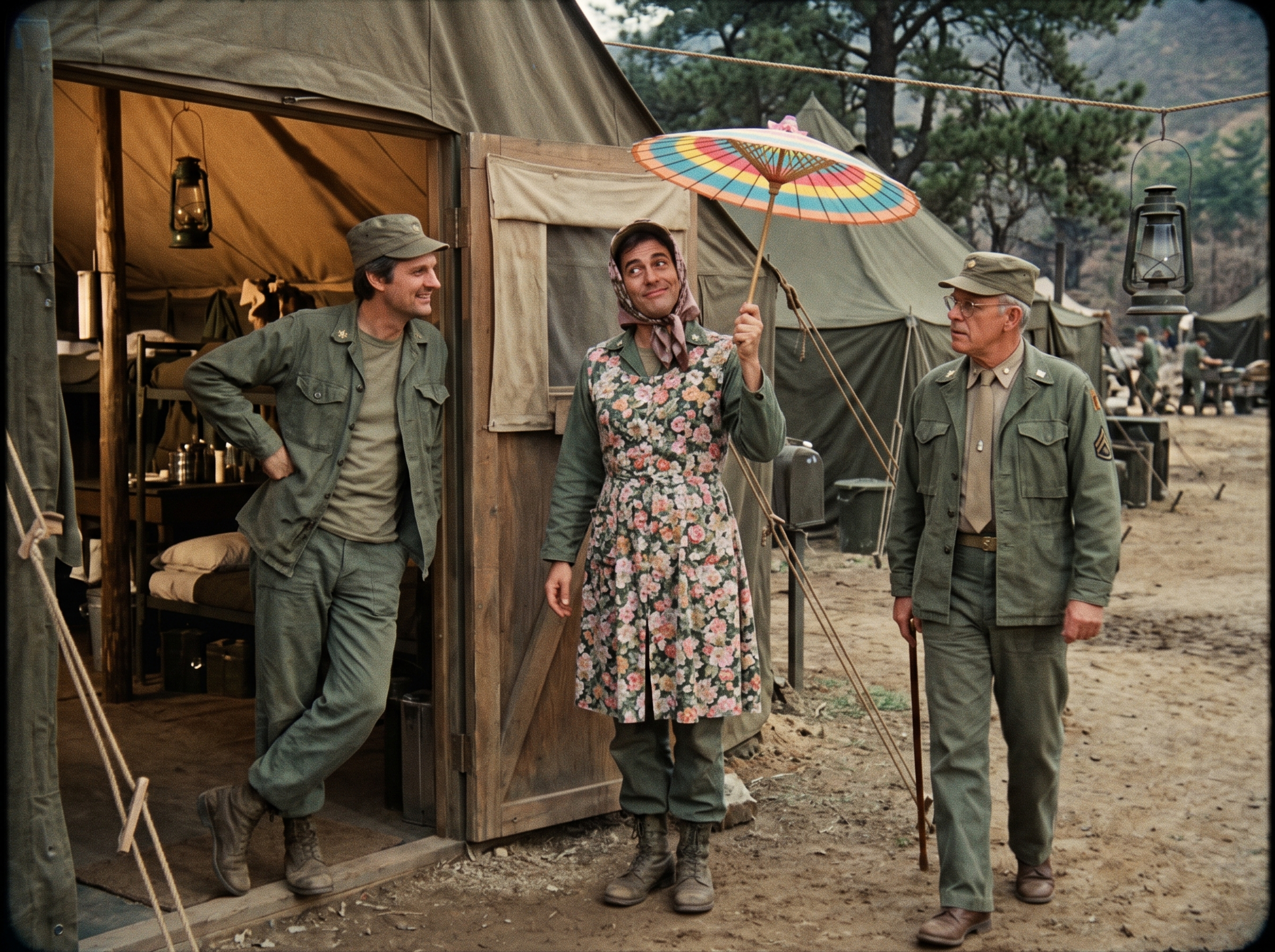
There were rare, fleeting days at the 4077th when the war simply forgot about them, leaving the camp suspended in a quiet, dusty haze.
It didn’t happen often. Usually, the sky was tearing itself apart with the mechanical roar of incoming choppers, and the ground vibrated with the distant, heavy thud of artillery. But on this particular Tuesday afternoon, the air was entirely still.
The camp was collectively catching its breath after a brutal, nerve-shredding marathon in the O.R. The smell of ether and iodine still clung to everything, a phantom scent that washed over the compound.
Captain Benjamin Franklin Pierce stood just inside the wooden doorway of the Swamp, seeking a momentary escape from the heavy atmosphere.
He leaned heavily against the crude doorframe, his body draped in standard-issue, lived-in green fatigues. The olive drab canvas was worn soft, acting as a second skin for a man who had forgotten what civilian clothes felt like.
Hawkeye was bone-tired, running on fumes, cheap gin, and nervous energy. Yet, as he looked out onto the dirt path, he let the soft, muted daylight wash over his face.
Behind him, the warm indoor light of the tent mixed with the afternoon sun, casting a soft, vintage glow over the wooden beams and the hanging kerosene lantern. It was a perfectly ordinary, quiet camp scene.
Then, exactly when the camp needed a dose of sheer, unadulterated madness, Corporal Maxwell Q. Klinger arrived.
He didn’t merely walk onto the dirt path; Klinger made an entrance. He stood dramatically outside the doorway, striking a theatrical posture that belonged on a Broadway stage rather than a mobile army surgical hospital in South Korea.
Klinger was dressed in a full-length floral dress—a modest, oddly grandmotherly print of pink and white flowers that clashed magnificently with the olive drab fatigue shirt worn underneath.
A sensible headscarf was tied firmly under his chin, framing a face that currently sported a sly, incredibly hopeful expression. Down below, his heavy, scuffed combat boots peeked out from under the hem, grounding the entire bizarre ensemble in military reality.
But the undisputed crown jewel of his outfit was in his right hand.
Klinger was holding a brightly colored, rainbow-striped parasol. He held it aloft with immense pride, the vibrant reds, yellows, and blues cutting through the dusty, washed-out landscape of the camp like a siren.
Hawkeye let out a soft snort of laughter. A clever, spontaneous smile broke through the deep exhaustion etched into his features. He leaned forward, crossing his arms, instantly appreciating the absurdity that kept their minds from snapping.
“Going to a garden party, Klinger?” Hawkeye asked, his voice dripping with affectionate teasing. “Or are you just hoping the wind picks up and carries you all the way back to Toledo?”
“A lady never reveals her social calendar, Captain,” Klinger replied, lifting his chin with theatrical dignity. “But I will have you know this parasol is an absolute medical necessity. The afternoon sun here is absolute murder on my delicate complexion.”
Before Hawkeye could deliver a fitting punchline, a steady, rhythmic crunch of boots on the dirt path signaled an approaching storm.
Colonel Sherman T. Potter was making his rounds.
He looked every inch the regular army commander, his uniform neat despite the exhaustion of the camp, his tie tucked perfectly into his shirt. He carried his walking stick in one hand, striding forward with the heavy, weary weight of leadership on his shoulders.
Potter turned the corner and stopped dead in his tracks.
The silence that fell over the dusty camp path was sudden, heavy, and thick. Hawkeye stiffened slightly against the doorframe, his teasing smile freezing in place. Klinger froze completely, the rainbow parasol caught mid-twirl.
Potter just stared. His eyes narrowed behind his wire-rimmed glasses, taking in the combat boots, the floral dress, the babushka, and the ridiculous, cheerful umbrella.
The tension in the air was suddenly electric. They had all just survived an endless wave of casualties, and Potter was running on the same empty tank as the rest of them.
Hawkeye held his breath, watching the Colonel’s stern face, waiting to see if the commander would finally blow his top, or if the delicate sanity of the 4077th was about to break.
The standoff stretched for what felt like an eternity.
Colonel Potter stood firmly planted on the dusty path, both hands resting heavily on the grip of his walking stick. His face was a masterful mask of weary wisdom, projecting the kind of expression only a man who had survived a lifetime of military absurdity could naturally muster.
He looked from the brightly colored parasol down to Klinger’s dusty army boots, and then slowly back up to the corporal’s hopeful, terrified eyes.
Hawkeye remained by the doorway, his mind racing. He was ready to step in, ready to deploy his sharpest wit to defuse the situation if the old man’s temper snapped. Hawkeye knew exactly how fragile they all were today. One loud noise, one broken rule too many, and the whole found-family ecosystem they had built to survive this war could easily shatter.
“Corporal,” Potter finally said. His voice wasn’t a roar. It was low, gravelly, and bone-dry.
“Sir,” Klinger squeaked, his theatrical bravado suddenly shrinking under the Colonel’s intense gaze. He lowered the parasol just a fraction of an inch. “I know how this looks, Colonel, but it’s a documented preventative measure. My Aunt Sophie sent it. She said the Toledo sun is nothing compared to the rays in the Orient, and a man—a person—must protect their—”
“Klinger,” Potter interrupted softly, raising a single, commanding finger.
The corporal immediately snapped his mouth shut.
Potter took a slow, deliberate breath. He looked at the ridiculous rainbow stripes of the umbrella. He looked at the floral dress that clashed horribly with the harsh canvas tents in the background.
Then, Potter shifted his gaze to Hawkeye.
In that brief, quiet exchange of glances, Hawkeye saw it all. He saw the profound, bone-deep fatigue in the Colonel’s eyes. He saw the shared grief of the last thirty-six hours they had spent elbow-deep in tragedy.
But most importantly, Hawkeye saw the quiet, desperate realization in Potter’s eyes that this—this glorious, stupid, beautiful nonsense—was the only thing holding their humanity together.
Potter wasn’t angry. He was just a father staring at his most exasperating, fiercely beloved children.
“I have served in two world wars,” Potter began, his tone shifting into that comforting, dry, Midwestern cadence that made them all feel safe. “I have seen cavalry horses eat generals’ hats. I have seen grown men try to dig foxholes with mess kit spoons.”
He took a half-step closer, his face remaining completely deadpan.
“But I have never, in all my born days, seen a man try to accessorize a spring floral print with standard-issue combat boots. It’s a crime against fashion, son.”
Hawkeye let out a long breath he didn’t realize he was holding. His shoulders sagged against the wooden doorframe as a genuine, relieved smile spread across his face.
Klinger’s eyes widened, and the sly, theatrical spark instantly returned to his expression. “You really think so, sir? Because I have a lovely pair of sensible pumps in my footlocker that might—”
“Don’t push your luck, Corporal,” Potter warned softly, though the corner of his mouth twitched upward just a fraction of an inch. “Just keep that colorful contraption out of the O.R. The glare would blind the surgical team.”
“Yes, sir. Absolutely, sir,” Klinger beamed, hoisting the parasol proudly back up over his shoulder.
Potter shook his head, a mixture of mild disbelief and deep, profound affection washing over his stern, fatherly features. He tapped his walking stick against the dry earth, adjusted his cap, and continued his slow walk down the dusty path, leaving them to their madness.
Hawkeye watched the Colonel walk away, feeling a sudden, tight lump in his throat. He looked back at Klinger, who was now happily admiring the way the afternoon light filtered through the rainbow fabric of his umbrella.
It was so profoundly stupid. It was completely absurd.
And yet, as Hawkeye leaned back against the canvas of the Swamp, he realized he wouldn’t trade this crazy, beautiful family for anything in the world.
The war was still waiting for them just beyond the hills. The choppers would inevitably return, bringing the blood, the noise, and the heartbreak right back to their doorstep. The fatigue would settle back into their bones, and the fear would return.
But for right now, in this singular, golden moment, the sun was shining, the camp was quiet, and Maxwell Klinger was standing in the dirt in a dress, holding a rainbow over their heads.
Hawkeye smiled, pushing himself off the doorframe. “Come on, Klinger,” he said softly, his voice full of quiet tenderness. “Let’s go find some shade. Your complexion is far too important to the war effort.”
Klinger grinned, falling into step beside the surgeon.
They walked together down the dusty path, two weary friends under a brightly colored parasol, finding just enough humor and light to keep the darkness at bay for one more day.
In a place surrounded by madness, the greatest act of survival was finding a reason to smile together.