The Clipboard Chronicles: A Quiet Midnight Inventory of the Heart
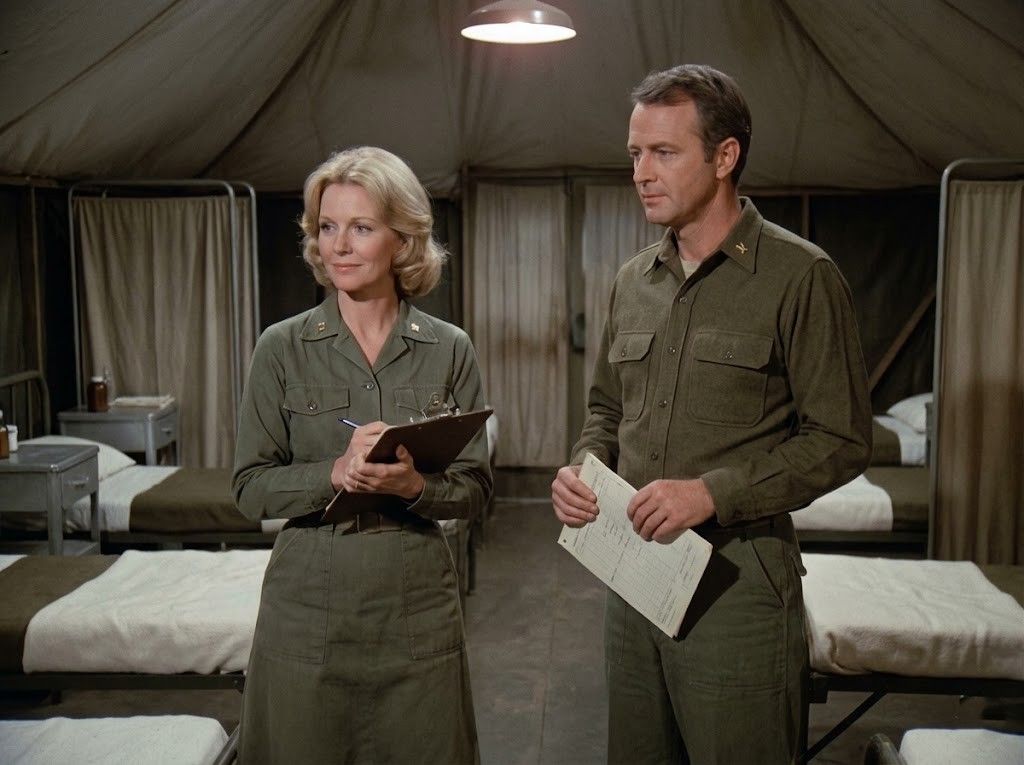
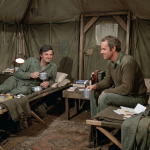
The O.R. doors had finally stopped swinging, leaving behind that heavy, ringing silence that only a M*A*S*H unit truly understands. The air in the post-op tent smelled faintly of rubbing alcohol, stale coffee, and the unique brand of exhaustion that settles deep into your bones after a twelve-hour shift.
Margaret stood by the row of empty cots, her posture characteristically straight, though her shoulders carried the weight of the entire nursing staff. A clipboard was tucked into the crook of her arm, a pen poised over a fresh sheet of paper that represented the only order she could control in a chaotic world.
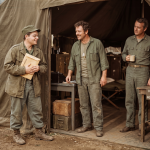
Beside her, a visiting surgeon—a man who looked less like a battle-hardened doctor and more like a weary father wondering how he ended up ten thousand miles from home—held a single sheet of supply tallies. His uniform was immaculate but worn, the small gold insignia on his collar catching the dim light of the overhead bulb.
“According to the central supply manifest, Major, we are short exactly three crates of penicillin,” he said, his voice flat with the kind of fatigue that makes numbers lose their meaning. “And four boxes of surgical gauze.”
Margaret didn’t look up from her clipboard, her eyes scanning the neat columns of her own records. “Central supply is three days late on the convoy, Doctor. If we relied on their manifest, we’d be wrapping wounds in old newspapers and praying for miracles.”
“And what do your records say?” he asked quietly.
“My records say we have exactly enough to get through tomorrow morning’s intake,” she replied, her tone firm, professional, and entirely unyielding. “Provided Hawkeye doesn’t use half a roll of tape to fix the swamp’s still, and Hunnicutt doesn’t borrow the extra pillows for his makeshift lounger.”
The doctor allowed a small, tired smile to tug at the corner of his mouth, looking out over the empty beds. “They’re a handful, aren’t they? I’ve never seen a unit run with so much noise and so little regard for the manual.”
“They are insufferable,” Margaret said, though the sharp edge was missing from her voice, replaced by something closer to a protective, maternal exasperation. “But they are the finest surgeons in the visual path of this war. They work until their hands shake, and then they work some more.”
She finally looked up, her gaze fixed on the far corner of the tent where the shadows stretched long against the canvas wall. “But it’s not the gauze I’m worried about tonight.”
The doctor turned his head, his brow furrowing slightly as he followed her gaze toward the darkest part of the ward. “Is there a patient we missed?”
Margaret’s pen stopped moving, hovering just a millimeter above the paper. “No. It’s what we found tucked behind the last supply crate when we cleared out the intake ward an hour ago.”
The doctor stepped closer, his own papers crinkling slightly in his grip. “What was it?”
“A pair of small, hand-knitted woolen mittens,” Margaret said, her voice dropping to a soft whisper that barely carried across the quiet tent. “Much too small for a soldier. They were wrapped in a scrap of parchment with a name written in Korean. One of the local orphans must have dropped them during the shelling yesterday.”
The visiting doctor looked down at the sheet of paper in his hands, the columns of numbers suddenly feeling very small and insignificant. “A child’s mittens. In a place like this.”
“Radar tried to find the boy,” Margaret continued, her eyes reflecting the soft, warm light of the single bulb above them. “He spent the last two hours running between the tents, checking with the local guides, even asking Klinger if he’d seen anyone matching the description. But the convoy moved out, and the kids were relocated to the valley.”
The doctor looked at Margaret, seeing past the rigid military exterior to the deep, aching humanity that she so fiercely guarded. “And where are the mittens now?”
“They’re sitting on Radar’s desk,” she said, a faint, bittersweet smile appearing on her face. “He insists on keeping them warm. He thinks if he leaves them near the stove, whoever lost them will somehow feel it.”
The doctor let out a long, slow breath, the tension leaving his shoulders as he looked back at the empty cots. “You know, back home, I used to worry about inventory losses. I’d lose sleep over a missing shipment of syringes or a discrepancies in the ledger. Out here, the numbers don’t seem to matter as much as the things you can’t count.”
“Out here, Doctor, we count the minutes until the next chopper arrives,” Margaret said softly, lowering her clipboard. “And we count ourselves lucky for every life we get to send back down that road.”
The silence returned to the tent, but it no longer felt heavy; it felt shared, a quiet understanding between two people holding the line in a world that had temporarily lost its mind.
“Let’s sign off on the manifest,” the doctor said, handing his sheet to Margaret. “Write down whatever numbers keep the brass happy. We know what we really have.”
Margaret took the paper, her fingers brushing against his in a brief, grounding moment of human contact. “Thank you, Doctor. Go get some sleep. The war will be waiting for us at dawn.”
As he turned to walk out into the cool Korean night, Margaret remained under the single light bulb for a moment longer, looking down at her clipboard, rewriting the inventory of a small M*A*S*H unit that possessed nothing but shortage, sacrifice, and an endless supply of heart.
Behind the starch and the regulations of the 4077th lay a family bound not by the army, but by the quiet grace of holding each other together.