A Culinary Distress Signal in the 4077th
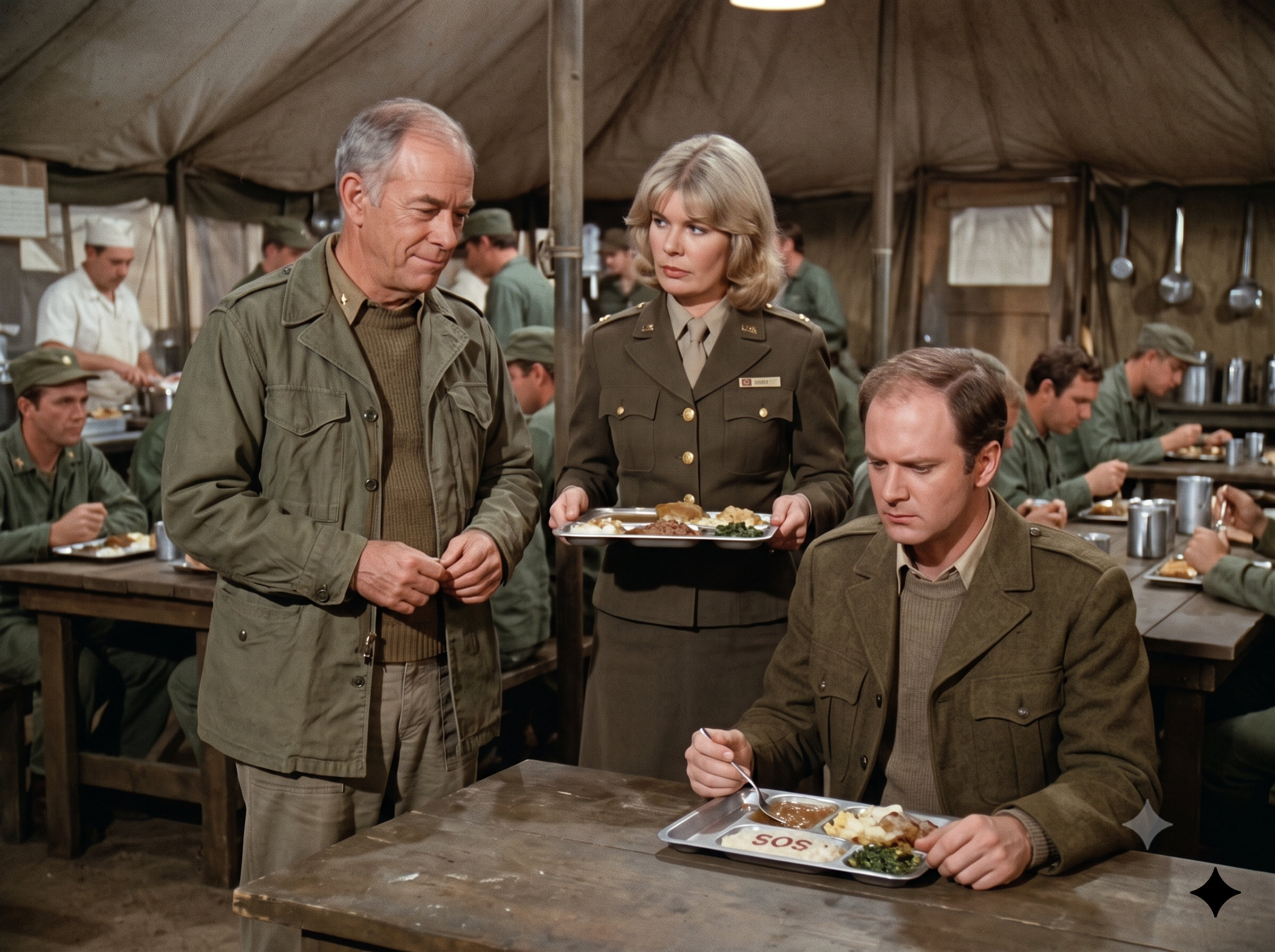
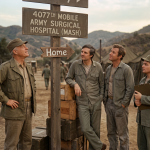
The mess tent at the 4077th Mobile Army Surgical Hospital was a place where culinary dreams went to die, but occasionally, it served up a masterpiece of pure, unadulterated tragedy.
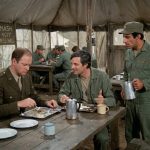
Today, the tragedy was sitting right in front of Major Charles Emerson Winchester III, and he was taking it quite personally.
He sat perfectly upright on the unforgiving wooden bench, his posture a defiant, unyielding barricade against the squalor around him. His olive drab sweater was remarkably neat, the collar of his shirt perfectly pressed, but the deep, bruised exhaustion around his eyes told the real story.
It had been a brutal eighteen hours in the operating room. The endless stream of casualties had pushed every surgeon to the brink, leaving them hollowed out and aching for a shred of comfort.
For Charles, comfort meant a quiet room, a glass of fine cognac, and a meal that didn’t taste like it had been scraped off the bottom of a jeep.
Instead, he wasn’t eating at all. He was simply staring down at his divided metal tray with a look of restrained, refined horror.
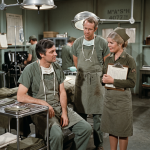
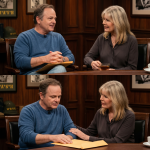
Beside him, Major Margaret Houlihan paused. She had walked in looking for a quiet corner to quickly consume her calories, clutching her own tray of beige slop.
Instead, she found herself captivated by the sheer magnitude of Winchester’s silent, vibrating despair.
She stood composed, her uniform as crisp as army laundry would allow, but a flicker of exhausted skepticism crossed her face as she looked down at what had caused this aristocratic paralysis.
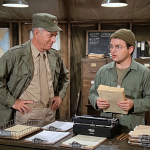
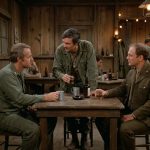
Colonel Sherman Potter strolled up beside her, his hands buried deep in the pockets of his worn canvas field jacket. He brought with him a quiet, steadying presence, the kind of grounded authority that kept the camp from spinning entirely off its axis.
Potter had seen a lot of things in three wars, but the sight of a Boston Brahmin being emotionally defeated by a dollop of mess tent potatoes was a unique brand of entertainment.
A dry, fatherly smile tugged at the corner of the Colonel’s mouth. He didn’t say a word at first. He just stood there, letting the heavy, comedic tension of the moment breathe.
There, written perfectly in some unidentifiable, congealed brown sauce across a mound of grayish-white mush, were three unmistakable letters: S-O-S.
It was a distress signal, a culinary cry for help, and an all-too-accurate description of army food, all rolled into one terrible visual pun.
Charles finally broke the silence, his voice a low, dangerous rumble of wounded pride that echoed off the canvas walls.
“I have dined at the finest establishments in Europe,” he began, his eyes never leaving the tray, refusing to acknowledge the officers standing beside him. “I have consumed truffles in Paris, prime rib in London, and the freshest lobster on the Massachusetts coast.”
He slowly raised his head, his gaze fixing on the empty space ahead of him as if addressing the ghosts of his ancestors.
“And yet, here I sit, in the armpit of the world, staring at a plate of food that is actively calling for the Coast Guard.”
Potter chuckled, a warm, gravelly sound that briefly cut through the clatter of the busy mess tent.
“I think it’s fitting, Major,” Potter said. “Considering what’s usually in it, a distress signal seems like the most honest thing the kitchen has served all week.”
Charles gripped the edges of his metal tray, his knuckles turning white under the harsh overhead lights. He took a slow, deep breath, and for a terrifying second, it looked like he was going to launch the entire meal into the nearest canvas wall.
“Don’t do it, Charles,” Margaret said quietly, stepping just a fraction closer.
Her voice wasn’t a sharp command; it was a tired, gentle warning from someone who understood exactly how close he was to snapping. She shifted her weight, the dull metal of her own tray clinking softly.
“If you throw it, they’ll just scoop it back up and serve it to you again for dinner,” she reasoned. “And it will be considerably colder.”
Charles closed his eyes, the absolute indignity of the situation washing over him in waves. The rigid anger slowly drained out of his posture, replaced by a profound, heavy homesickness.
“Margaret, I ask you,” he whispered, gesturing to the offending plate with a limp, defeated hand. “What manner of sadist takes the time to write ‘SOS’ on a pile of something that already resembles the aftermath of a natural disaster?”
Potter pulled up a rickety folding chair and sat down across from him, resting his elbows on the rough, splintered wood of the table.
The amused twinkle in the Colonel’s eye softened into something much more paternal and understanding. He had seen this kind of fatigue before, the kind where a bad cup of coffee or a ruined pair of socks could bring a strong man to tears.
“My guess? Pierce and Hunnicutt bribed a cook,” Potter said gently, his voice low enough to keep the conversation private.
“They figured you needed a laugh. Or they just wanted to poke the bear. Knowing those two, it’s probably a little of column A, a little of column B.”
“I assure you, Colonel, my sense of humor does not extend to the desecration of my palate,” Charles replied stiffly, trying to pull his dignity back around him like a cloak.
“Nobody’s palate is laughing in this place, son,” Potter said, leaning in slightly, his tone dropping the commanding officer routine for a moment.
“I remember eating canned meat in France in ’18 that smelled like boot polish, and it didn’t look much better than what’s on your plate. But you’ve got to eat.”
Potter paused, looking Charles dead in the eye. “You left three pints of sweat in that OR today. Your hands were shaking when you tied off that last bleeder. You’re running on fumes.”
Charles looked up, genuinely surprised that the Colonel had noticed the slight tremor in his fingers during the final hour of surgery. He tried to mask his surprise with a dismissive scoff, but the sound fell flat in the noisy tent.
Margaret slid onto the bench next to him, placing her tray on the table. She didn’t look at him with pity; she just started cutting the unrecognizable meat on her own plate with methodical precision.
“He’s right, Charles,” she said, her tone professional but laced with an undeniable undercurrent of care that only the people in this camp ever got to see.
“You’re absolutely no good to the wounded if you pass out in the compound. Just close your eyes, hold your nose, and pretend it’s… whatever it is you eat in Boston.”
“Pheasant under glass,” Charles murmured softly, staring blankly at the tent wall. “Scallops wrapped in bacon. A simple, perfectly seared filet mignon, medium rare.”
“Right. Pretend it’s a filet mignon,” Margaret said, taking a brave, deliberate bite of her own food and wincing slightly as she chewed. “A very, very overcooked, previously frozen, completely unseasoned filet.”
A long beat of silence passed between the three of them.
The clatter of the mess tent continued unabated, a symphony of exhausted doctors, nurses, and enlisted men trying to fuel up before the inevitable sound of choppers returned.
Charles looked back down at the “SOS” written in the sauce. He thought about Pierce and Hunnicutt, probably hiding in the Swamp, waiting for the explosion that wasn’t going to come.
Slowly, a tiny, almost imperceptible smirk broke through his aristocratic facade. He would never admit it to anyone, least of all the pranksters themselves, but the sheer, ridiculous stupidity of the joke had managed to pierce through his wall of misery.
“Very well,” Charles sighed dramatically, picking up his spoon with the delicate, practiced grace of a man wielding a fine silver utensil.
He looked at Potter, then turned his head to look at Margaret, finding a strange, begrudging comfort in their quiet solidarity.
They were all thousands of miles from home, all eating the same terrible food, all surviving on the same thin thread of stubborn resilience and unlikely friendship.
“I shall consume this… culinary tragedy,” Charles announced, his voice regaining a fraction of its usual pompous thunder. “But I do so under extreme protest. And I expect it to be noted in my permanent record.”
“I’ll have Radar type it up in triplicate this afternoon,” Potter smiled, his eyes crinkling at the corners as he gave the wooden table a firm pat before standing up. “Enjoy your meal, Major.”
“Try the potatoes, Charles,” Margaret added dryly, a fond, genuine little smile playing on her lips as she took another bite. “I hear they’re sending a rescue boat.”
Charles Emerson Winchester III rolled his eyes toward the canvas ceiling, took a deep, bracing breath, and finally took a bite, chewing with an expression of absolute, stoic martyrdom.
It was truly awful. It was salty, mostly lukewarm, and tasted faintly of wet canvas and despair.
But as he sat there, shoulder-to-shoulder with Margaret, with Potter’s steady presence lingering warmly in his mind, the food went down just a little bit easier.
Even a distress signal tastes a little like home when you’re surrounded by family.