The Weight of the Paperwork
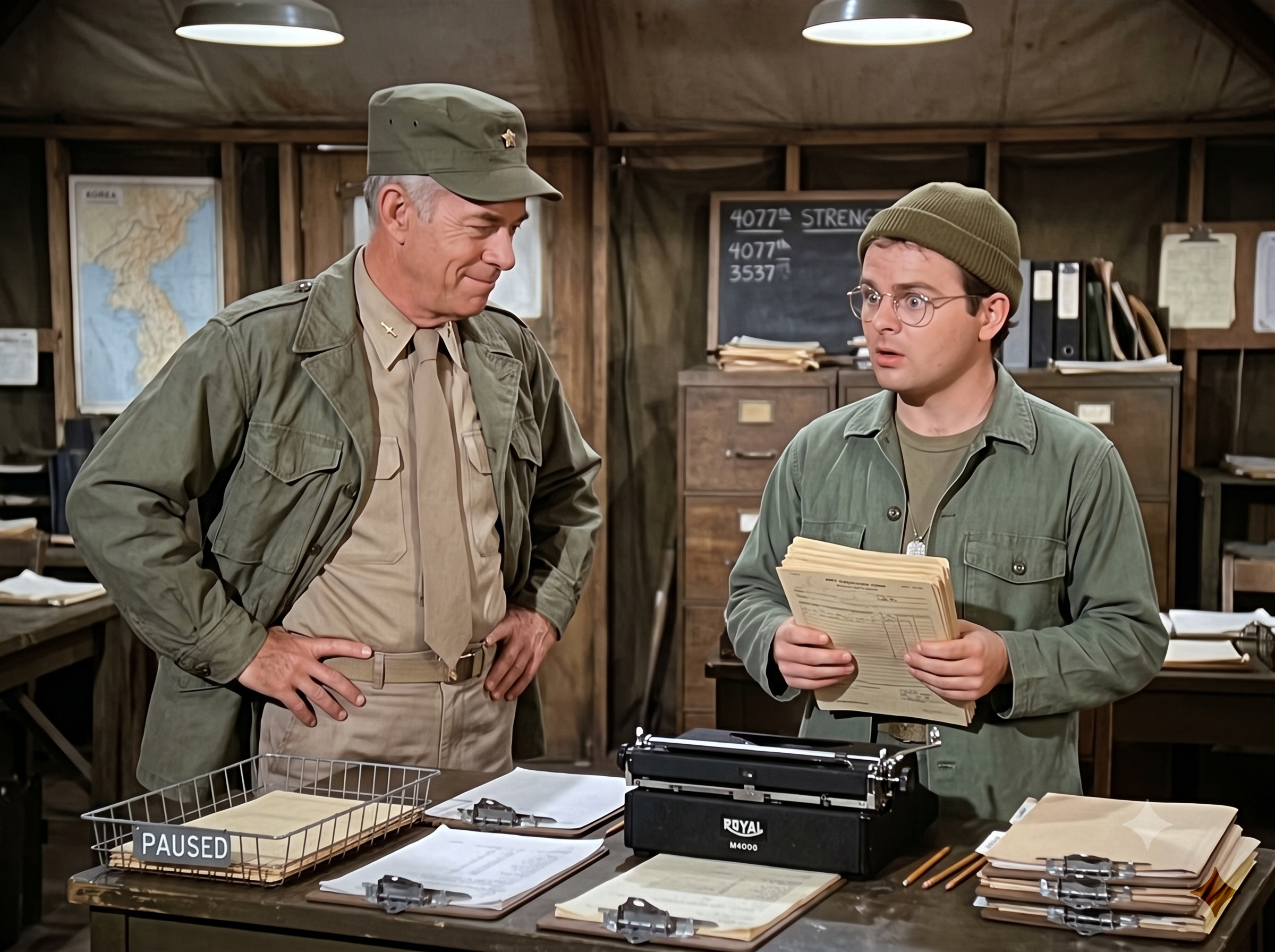
The air in the Company Clerk’s office was thick with the scent of damp canvas, old coffee, and the unique, dusty smell of mimeograph ink. It was one of those afternoons where the war seemed to have paused for a collective breath, leaving the 4077th in a state of uneasy, quiet suspension.
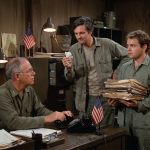
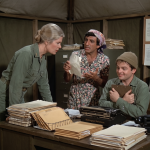
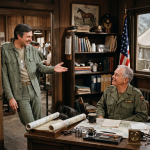
Colonel Potter stood by the desk, his hands planted firmly on his hips. He wasn’t angry, exactly—that would have been too simple. It was that specific, weary disappointment that only the commander of a surgical hospital could muster after staring at a stack of forms that defied the laws of logic.
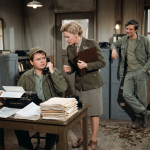
Across from him, Radar stood frozen, clutching a bundle of requisition papers like a lifeline. His glasses were slightly askew, perched on the bridge of his nose as he stared at the Colonel with wide, blinking eyes. He looked like a deer caught in the headlights of a supply truck, his mouth slightly parted, trying to summon the words to explain the unexplainable.
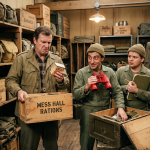
“Radar,” the Colonel sighed, the sound echoing against the wooden walls. “I’ve seen a lot of things in my time. I’ve seen bridge-building, I’ve seen horse-trading, and I’ve certainly seen my fair share of bureaucracy. But this… this is a masterwork of confusion. Are you telling me we’ve officially requisitioned twelve crates of snowshoes for a camp currently sitting in the middle of a Korean heatwave?”
Radar swallowed hard, the Adam’s apple in his throat bobbing nervously. “Sir, I know how it looks. But the supply sergeant in Seoul said it was a clerical error that had to be filed as a request before it could be filed as a cancellation. He said if I didn’t sign it now, the computer—well, the people who work the computers—would think we were trying to hide a surplus.”
The Colonel leaned in closer, his expression shifting from frustration to a kind of pained disbelief. “Radar, son. Look at me. We’re in the middle of a war, not a polar expedition. If these snowshoes arrive, where exactly do you propose we store them? In the operating room? Perhaps we can use them as stirrups for the wounded.”
Radar shifted his weight, his knuckles white as he tightened his grip on the files. “I really am sorry, Colonel. I just didn’t want to get flagged. I thought if I processed it fast, it would disappear into the system before anyone noticed.”
Potter let out a long, ragged exhale that sounded like a tire losing air. He looked at the typewriter on the desk, then back at his young clerk, his eyes softening despite himself. “You know, Radar, sometimes I think the paperwork is going to be the death of us long before the artillery does. Just… hold that thought.”
He turned slightly, his gaze lingering on the piles of charts and the quiet, empty space behind Radar. He looked tired—bone-deep, soul-weary tired—and for a fleeting second, the facade of the iron-willed Colonel cracked entirely. His shoulders slumped, and a look of profound, quiet heartbreak crossed his face, as if he had just remembered every name he’d had to write on a casualty list that morning.
He reached out, his hand hovering for a moment near the edge of the desk, before he stopped, his fingers trembling ever so slightly.
Radar noticed the tremor. He had always noticed everything—the way the Colonel’s gait changed after a long shift in O.R., or how the silence in the mess tent meant someone hadn’t come home. His own nervousness evaporated instantly, replaced by that quiet, intuitive protectiveness that made him the heartbeat of the 4077th.
“Colonel?” Radar whispered, his voice losing its frantic, high-pitched edge. “Maybe we don’t have to fix the snowshoes today. Maybe we can just… leave them for tomorrow.”
Potter blinked, pulling himself back from whatever dark place his thoughts had wandered. He looked at Radar—really looked at him—and saw not just a clerk, but a boy who had grown up entirely too fast in the shadow of a tent. The Colonel straightened his posture, though the heaviness remained in his eyes.
“Tomorrow,” Potter murmured, a ghost of a wry smile touching his lips. “Yes, I suppose the snow will still be ‘falling’ in Seoul tomorrow, too.”
He reached out and gently took the top page from Radar’s hand, setting it aside on the desk. He didn’t toss it or crumple it; he placed it with a deliberate, almost reverent care, as if acknowledging that every piece of paper in this office represented a life, a moment, or a struggle.
“You’ve been at this desk since dawn, haven’t you, son?” Potter asked, his voice low and steady, lacking the usual command bark.
Radar nodded slowly. “There was a lot of filing, sir. And a message came in for Captain Pierce. I had to make sure it didn’t get buried.”
“Pierce,” Potter chuckled softly, shaking his head. “He’s probably looking for a way to turn those snowshoes into a mobile ice-cream maker.”
“Actually, sir, I think he was going to try to trade them for a spare fan,” Radar offered, a small, genuine smile finally breaking through his worried expression.
The tension that had filled the small room began to dissipate, replaced by that familiar, bittersweet camaraderie that kept them all sane. It wasn’t about the snowshoes, and it wasn’t about the paperwork. It was about two men, thousands of miles from home, finding a moment of normalcy in the middle of the madness.
Potter patted the desk, the wood grain worn smooth by thousands of hands before them. “Leave it for now, Radar. Go get some coffee. Maybe see if that chaplain of ours has anything to say that isn’t related to the logistics of a supply run. I’m going to go see if I can find a glass of something that doesn’t taste like swamp water.”
Radar looked at the desk, then at the Colonel. He realized then that Potter wasn’t just checking on the supply requisition; he was checking on him. He was making sure that underneath the uniform, the rank, and the endless, crushing weight of the war, the boy from Iowa was still holding on.
“Yes, sir,” Radar said, his voice soft. “I think I’ll do that.”
As the Colonel turned to leave, his footsteps heavy but measured on the wooden floorboards, the late afternoon light slanted through the tent flap, catching the dust motes in the air. For a moment, the war felt very far away, and the 4077th felt, against all odds, like a family.
Radar stood alone in the office, the quiet settling around him like a blanket. He looked at the typewriter one last time, decided the snowshoes could wait for another lifetime, and headed out toward the sound of laughter drifting from the direction of the mess tent.
In the heart of the 4077th, the paperwork never ends, but the kindness of friends makes it bearable.