The Bamboo Mandate
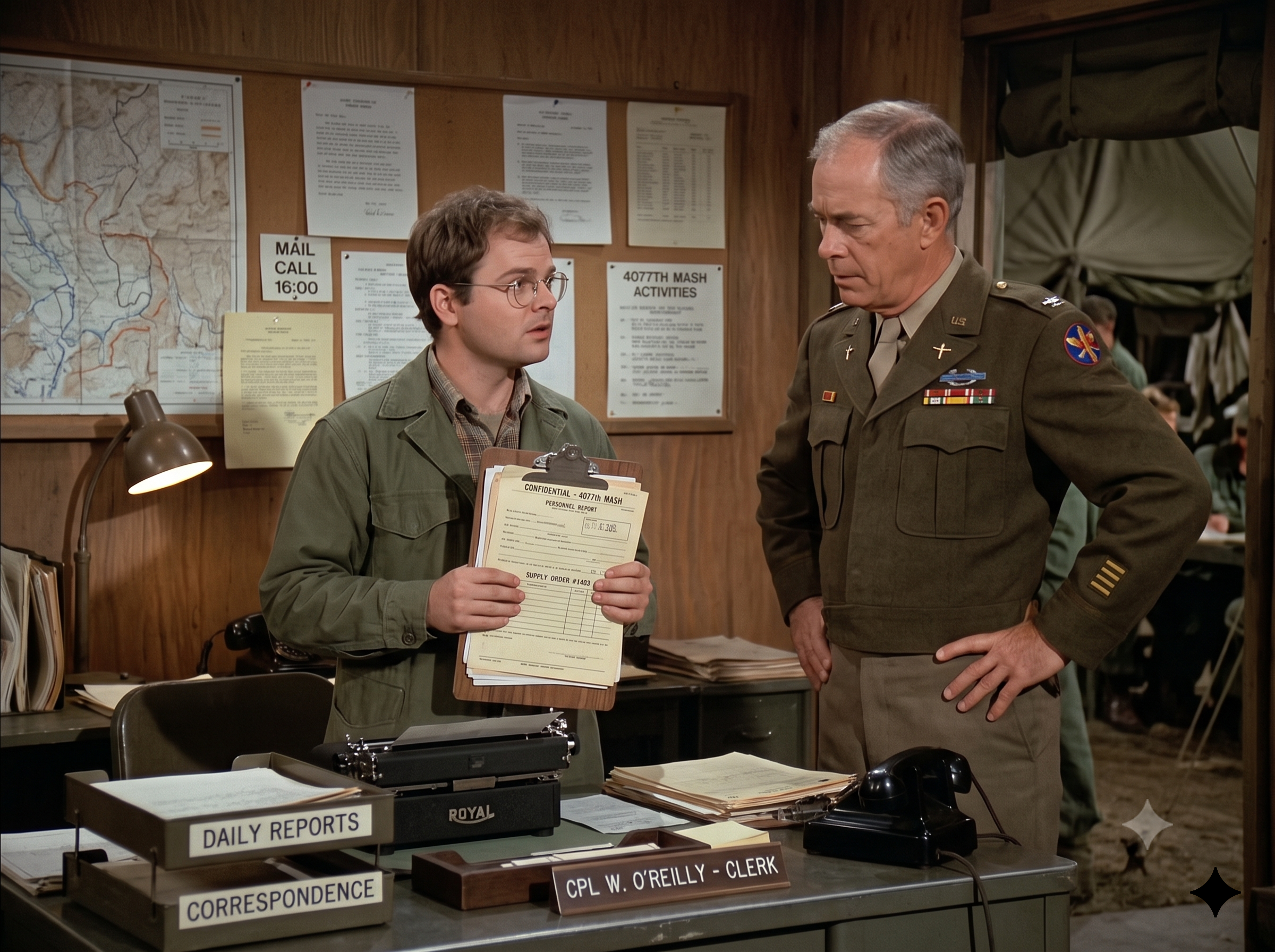
The wind coming across the 4077th felt tired, just like everyone else. It was one of those rare, quiet afternoons—the calm before the inevitable storm of the next casualty convoy. Inside the clerk’s office, the setting was the only piece of home that never quite felt real. There were wood-paneled walls that felt too thin, a metal desk that vibrated with every helicopter that landed, and a bulletin board pinned with maps and reminders that did their best to pretend the mud and the war didn’t exist right outside.
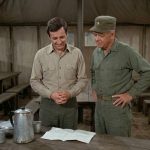
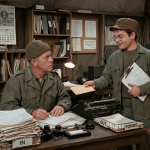
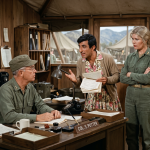
Colonel Sherman Potter stood before the desk, not moving, but his posture was a story in itself. His hands were planted firmly on his hips, his uniform jacket impeccable but worn, and his expression was a carefully practiced mixture of weary exasperation and fatherly authority. His gaze was fixed not on the boy in front of him, but on the object held tightly in the boy’s hands. It was the same look he gave his favorite mare back home when she decided to get stubborn about a simple fence post.
And there was Radar O’Reilly. He stood politely at attention behind his desk, but his focus was equally intense. The glasses perched on his nose made him look younger than any soldier should ever be, and right now, his face was a portrait of pure, earnest confusion masked by an innocent pride. He didn’t just hold the yellow Army clipboard; he presented it like a fragile, confusing treasure. The papers were stacked thick, typed with a bureaucracy that made no sense in the middle of a muddy war.
“Radar,” Potter began, his voice gravelly and low, dropping the word like a stone into a quiet pond. “I’m looking at this paper, and I’m seeing words, but they are not processing. You want me to sign *what*?”
Radar shifted on his feet, his fingers gripping the clipboard tighter. “Well, Colonel, sir, it’s not *just* paper. This is a very important communication from Fourth Army Headquarters, G-4 Logistics and Supply.” He looked down at the form as if to double-check its complexity. “They call it ‘Project: Aesthetic Morale.’ It seems our recent request for more penicillin and plasma was flagged. It didn’t have the right ‘priority clearance number for medical non-essentials.'”
Potter’s eyebrows shot up. “Medical *non-essentials*? Plasma is the closest thing this outfit has to water! Radar, you tell those pencil-pushers that if they don’t give us plasma, the only morale we’re going to have left is a collection of empty bed frames!”
Radar’s eyes went wide. “Oh, no, sir! I didn’t say that! I told them that. Specifically. I used the special supply-sergeant voice that gets things done, sir.” He patted the clipboard with innocent pride. “And it worked! But… there’s a catch.”
Potter’s hands seemed to press even harder into his hips. “There is always a catch. What is the catch, son? Spit it out before my hands fall off.”
Radar’s voice dropped to a nervous whisper, even though no one else was in the room. He pointed to the thickest paragraph on the top form. “They won’t release the medical supplies unless we ‘demonstrate a commitment to the spiritual and mental environment of the field unit.’ Sir, they are refusing the penicillin shipment unless you sign this purchase order… for fifty cases of imported, decorative bamboo desk organizers.”
The silence in the office was complete. Radar didn’t blink. He just held the clipboard out, his knuckles white.
“Bamboo?” Potter asked, his voice dead flat. “import. Decorative. Organizers. Radar, the only things that need organizing around here are the patients and the mud, and bamboo won’t do a lick of good for either. You’re telling me… that I have to sign for a shipment of wooden boxes I don’t want, or men will die because of boxes I *can’t get*?”
Potter felt the pressure of Command pressing down. His hands were still on his hips, but now they felt heavy. He looked down at the yellow paper as it laughed at him. He knew what he had to do. The high-tension, bureaucratic nightmare of the war was distilled down to this absurd moment. One signature to receive fifty cases of nonsense, or let the convoy go without medicine. He had to sign it. But first, he had to look at his clerk, truly look at him, and see the shared, helpless exasperation.
Potter let out a breath that sounded like a deflating tire. The sheer, colossal stupidity of the system always felt worse when he was looking into Radar’s earnest, worried face. “A bamboo mandate. Only the Army. God help us, Radar. If we don’t laugh, we’re all going to cry, and I can’t afford to waste the tears. They affect my aim.”
Radar nodded quickly, the nervousness subsiding just a little as his Colonel didn’t immediately detonate. “Yes, sir. That’s what the supply sergeant said. He said it’s a bureaucratic feedback loop. A catch-22, sir. He was very insistent about the catch part.”
“Well, you tell him I’m very insistent about the *plasma* part,” Potter grunted, finally reaching slowly for the black rotary phone on the desk. He didn’t pick it up, just tapped it, as if trying to summon the logic himself. He looked at Radar again. “This kid… Walter… how does an eighteen-year-old from Ottumwa, Iowa, know how to speak this nonsense better than any General I ever served with?”
“Oh, it’s just about watching patterns, sir. Supply forms are like farm animals. You gotta know what they want to eat or they’ll stubborn up on you.” Radar smiled a small, innocent smile. “And sir… I was thinking.”
Potter sighed, but it was a softer sound. “About the bamboo? Radar, please don’t tell me you want one for your collection.” He looked at the “DAILY REPORTS” tray on the desk, imagining it made of exotic wood.
“No, sir. Not for me. But… fifty cases. That’s a lot of bamboo. And it’s coming from an actual *bamboo* place. They say it’s strong. And flexible. And water-resistant.” Radar’s eyes sparkled behind his glasses.
Potter raised an eyebrow. The dry humor returning, his body language shifting just enough to show he was listening. “Radar. Elaborate. Before my hands fall off my hips.”
“Well, sir. I’ve seen some of the Korean refugees from the village. They have these really beautiful flutes and boxes they make, sir. From bamboo. But good bamboo is hard to find. And if we accept the cases… we could… maybe… give the boxes away. After we unpack them, of course. For supplies. You know. For music. Or for building material. It doesn’t say we *have* to *keep* them in the boxes. The forms just say we have to *receive* them.”
Potter stared at his clerk. He Truly looked at him. The frustration melted into a quiet, warm pride that only those who knew Sherman Potter well could see. This was the kid who always knew who was calling before the phone even finished ringing. But more than that, this was the kid who looked at a pile of bureaucratic nonsense and saw a way to turn it into kindness.
“So, you’re not just bringing me a problem, Corporal. You’re bringing me a solution dressed up like a headache,” Potter said softly. “You want me to play the silly game, sign for the bamboo, so we can turn the nonsense into something beautiful for people who have nothing.”
“Yes, sir. Something like that. I just thought… they shouldn’t just be boxes.”
Potter reached slowly for the pen resting next to the Royal typewriter on the desk. He didn’t just sign; he scrawled his name across the yellow form with authority, but also with a tenderness he only showed here, in this office. He slapped the clipboard back into Radar’s hand, the photo perfectly capturing this shared, understanding moment.
“Done,” Potter said, his voice a warm gravel. “Inform the supply sergeant we accept the Project: Aesthetic Morale shipment in full. And Radar?”
“Yes, sir?”
“You’re a good man, Walter. You see the heart in everything. Even paper.” Potter patted Radar’s shoulder—a brief, solid, fatherly gesture that said more than any speech. The war, the mud, the exhaustion—it all felt a tiny bit lighter. “Now, get that bamboo ordered before the supply sergeant realizes I’m signing with *their* pen.”
Radar beamed, clutching the clipboard like a shield of victory. “Yes, sir! On it, sir!”
He watched the Colonel turn away, back to the maps and the waiting reports, but the air in the office had changed. Radar looked down at the desk nameplate that read “CPL W. O’REILLY – CLERK” and then over at the typewriter. He knew exactly what he was going to type. It wasn’t just bureaucracy; it was found-family tenderness, a shared understanding that sometimes kindness was the only rule that mattered, and a promise that, yes, the bamboo organizers would arrive.
Just outside, the sound of a distant truck engine backfiring made Radar flinch, but then the familiar sound of Hawkeye and BJ laughing about something—probably a bad pun—floated in from the swamp. The wind across the 4077th didn’t feel quite as tired anymore.
Because sometimes, the only way to beat the logic of the machine was with the heart of a kid who cared about everything.