The Dress with the Daisy Petal Heart
Sometimes, at the 4077th, the loudest bombs are just pieces of paper. This whole afternoon started with a shipment, a supply truck that got redirected, then found, then delivered, bringing what we actually *needed* (surgical gloves) and something nobody had ordered: a box of civilian donations from a church guild in Ohio.
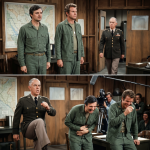
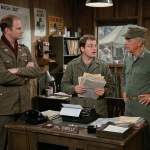
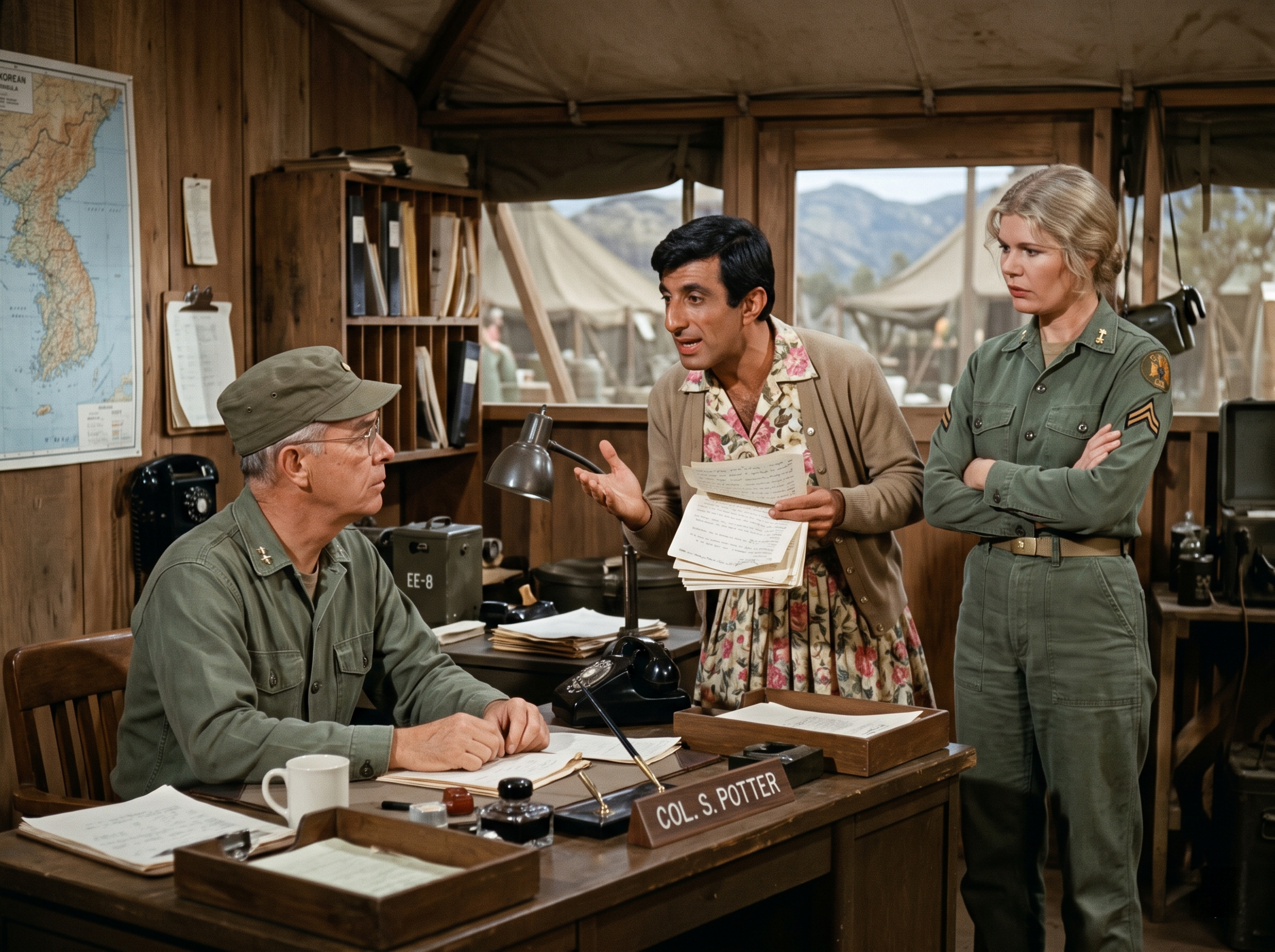
Colonel Potter was already in a mood that matched the rainy, gray sky over the Korean mountains. A batch of bad sutures had held up surgery for six hours, and he was currently rewriting his report for the tenth time. The office of the 4077th’s Commanding Officer, usually a quiet refuge of steady organization, was thick with frustration. A weathered map of the peninsula glared from the wooden wall; papers piled high on his desk like snowdrifts.
That was when the tent flap opened, letting in a draft and Corporal Maxwell Klinger.
He wasn’t wearing his usual fatigues or even his most outrageous gown. Today, he’d chosen a soft, floral summer dress – modest but distinctly un-military – underneath a beige cardigan. His expression was a storm front of agitation. In his hands, he held a stack of letters, clutching them like they were unexploded grenades.
Beside him, standing stiffly with her arms crossed, was Major Margaret Houlihan. She hadn’t ordered the donation box, she was *certain* of that. But the box had been opened by a bored GI, and its contents were now circulating through the camp, starting with the letters. Margaret, ever vigilant for breaches of regulation and discipline, had escorted Klinger and the evidence directly to the Colonel.
Colonel Potter looked up, removing his glasses, rubbishing his eyes. The sight of Klinger in a floral print and Houlihan looking ready to court-martial a potted plant didn’t improve his disposition. “What is it now, Klinger? I’m busy.”
Klinger didn’t even offer a salute. Instead, he gestured wildly with the bundle of papers. “Colonel! This box of civilian goods… it was meant for the orphanage in Seoul. I opened it. Look!”
Margaret huffed. “Corporal, lower your voice in the presence of the Commanding Officer. Colonel, it’s a distraction. These people are sending… sentimental clutter. It’s bad for morale.”
“Clutter!” Klinger protested, turning on her. “You call this clutter? It’s *love*, Major. It’s hope!”
Colonel Potter put his glasses back on, leaning forward. “What exactly did you find that’s caused this entire office to vibrate, Corporal?”
Klinger looked at Margaret, then back to the Colonel, his voice softening, a real, trembling emotion replacing his typical bluster. “These letters… they’re from the kids themselves. And Colonel… one of them… it’s written *to me*.” He held out one crinkled sheet, different from the rest, with crayon drawings and clumsy script. “Or at least, she calls me ‘the lady in the pretty dress.’”
The silence that fell was thick and heavy, punctuated only by the distant, rhythmic *thump-thump-thump* of a mortar somewhere on the front. A memory, both warm and painful, settled in the room.
Margaret shifted, her posture still rigid, but the hard line of her jaw softened. Her eyes flickered from Klinger to the paper he was holding. Colonel Potter just sat, watching Klinger, his face unreadable but his eyes focused.
“You read it?” Potter asked quietly.
Klinger nodded. “Her name is Soo-Min. She’s seven. Her favorite colors are pink and yellow. And she wrote this after the supply sergeant in Seoul gave out the last donation boxes months ago. She drew a little person with big hair and a dress with daisy petals. It’s not me, Colonel. It can’t be.”
He started pacing, agitation returning, but a different kind. “Major Houlihan says it’s all sentimental junk. But it’s not! Look at this dress!” He gestured to himself. “I bought this to get *out* of here. I wear it because I’m crazy, right? To prove I don’t belong.”
He looked directly at Margaret, then at the Colonel, the floral print of his dress suddenly seeming to reflect the complex mix of absurdity and humanity that defined his life here. “But then… I get this letter. From some kid who doesn’t know about 4077ths or chest wounds. She sees a *lady*. She sees someone holding a gift. And she remembers.”
The office, filled with maps and official documents and the practical business of war, felt unexpectedly small. “It makes you think, Colonel,” Klinger said, his voice dropping to a whisper. “About what we’re trying to build back up, not just keep alive. This dress… maybe it’s not *crazy* to wear it. Maybe it’s… brave. Maybe it’s remembering who we all were, before the green suits.”
Margaret let out a long, slow exhale. Her arms remained crossed, but her shoulders dropped. “I remember a dress my mother made for me. A yellow sundress. I haven’t thought about it in years.”
“Yellow was Soo-Min’s favorite,” Klinger said softly.
“What do you want, Klinger?” Colonel Potter asked, his voice unexpectedly gentle. He gestured to the papers still clutched in Klinger’s hand.
Klinger looked at the letter one more time, then offered a quiet, respectful salute—something rarely seen from him in uniform. “Just… can we send this stuff on, Colonel? The proper way. No rerouting. No mix-ups. To the orphanage. And maybe… maybe we can throw in some of that bad suture material that’s so strong? Those kids, they have clothes with holes.”
Potter’s face cracked into a small, dry smile. He nodded once, a quick, grandfatherly gesture. “We’ll make sure it goes. Major, see that a new supply list is prepared. Include the… miscellaneous donations. They are, as Corporal Klinger notes, highly regulated morale boosters.”
“Yes, Colonel,” Margaret said, her voice softer than it had been in a long time. She glanced at Klinger, a complex look that held both lingering skepticism and a flicker of deep respect. “And Klinger… that dress? It doesn’t look half-bad on you.”
Klinger didn’t smile, not completely. He held the letters tighter, a strange, profound gravity in his eyes. He turned to leave, and as he pushed through the canvas flap, for just a moment, the gray day outside seemed a little brighter, illuminated not by the war, but by the quiet, stubborn persistence of daisy petals and pink crayons.
You find your dignity where you find your heart.