The Quilt and the General’s Boots
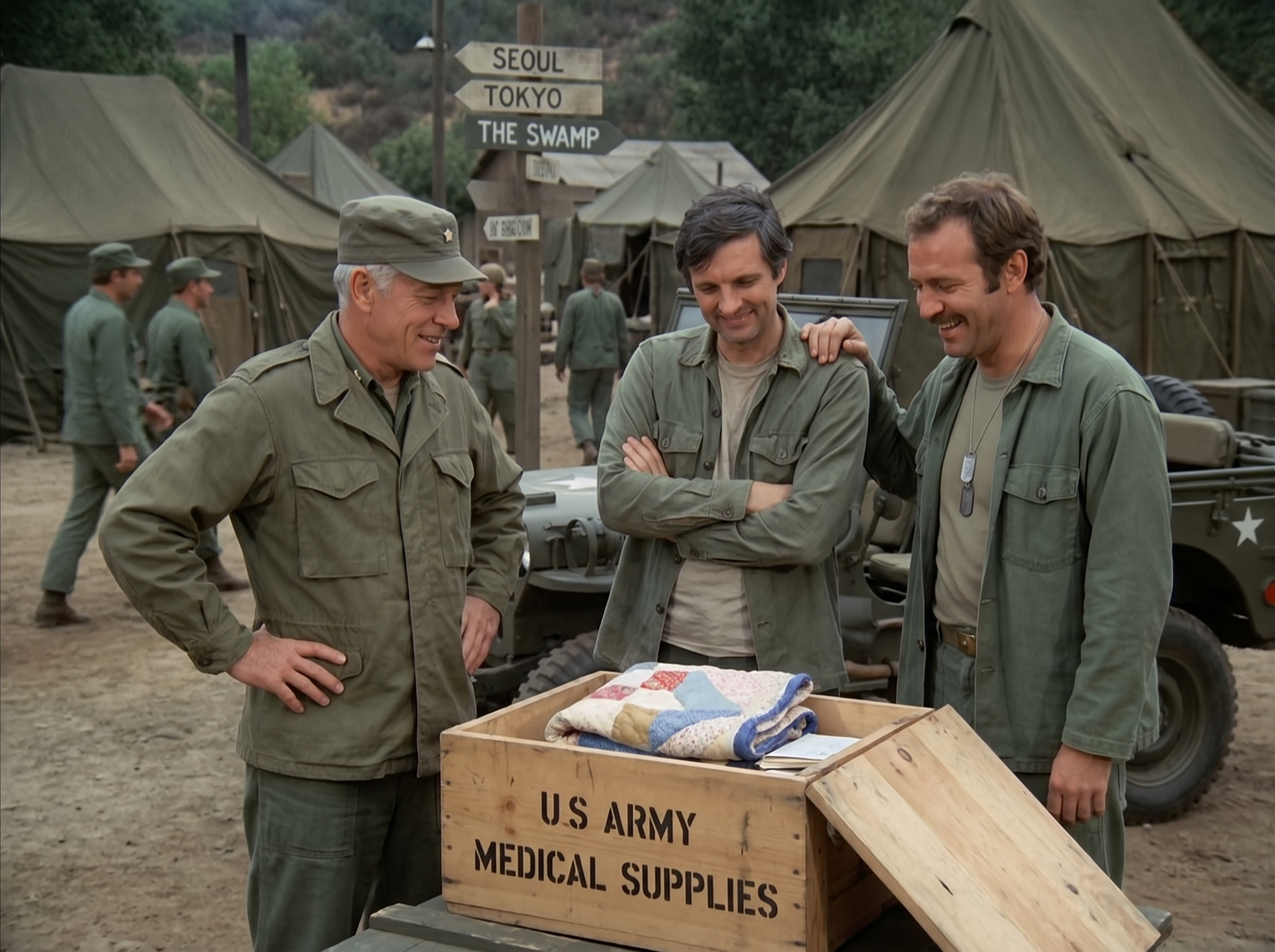
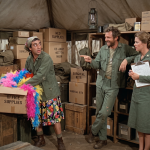
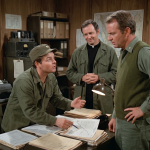
If there is one image that sums up the soul of the 4077th, it is three doctors standing over a mystery box.
It was another one of those deceptively quiet Tuesdays. The red dust was settled. The operating room was empty. The sound of the surrounding war had faded just enough to let you think about home.
Radar had materialized with his usual sense of cosmic timing, dropping a heavy wooden crate on Colonel Potter’s desk.
“Package for the whole unit, sir. Stateside,” Radar said, his eyes already wide. “The address is in cursive. Like, *really* neat cursive.”
And so, the ritual began. When a crate arrived for *the whole unit*, it wasn’t just supplies. It was a ritual.
B.J. was already there, smelling a glimmer of sanity. “Maybe it’s cookies. Peg’s famous oatmeal raisins. She said she sent a batch weeks ago.”
Hawkeye wandered in, his hands in his pockets, his wit running low after a 36-hour shift. “Or maybe it’s a manual on how to assemble a working soul from spare parts.”
Potter just huffed, finding his claw hammer. He prized the top plank off with a satisfying *CRAAAK*.
The smell hit them first. Not antiseptic. Not dried mud. It smelled like cedar and line-dried laundry.
Potter didn’t reach in. He just stared.
Resting on a layer of straw, folded in a neat stack, was a quilt. It was a patchwork of blues, faded reds, and creams, clearly stitched by hand. Underneath, other folded fabrics could be seen.
“My word,” Potter whispered. He looked at the crate. It was an old medical supplies box, but the black stencil still read: U.S. ARMY MEDICAL SUPPLIES.
“I didn’t order this,” Potter murmured, his voice sounding older.
“Sir,” Radar squeaked from the corner, “The return address is from a Mrs. Eleanor Vance in Ohio. She says she’s a Gold Star Mother.”
The silence that followed was heavy. It was the silence they all hated—the one that arrived when they had to remember *why* they were here, sewing people back together.
“What else is in there?” Hawkeye asked, his joke dying before it could reach his lips.
Potter gently pulled out the quilt. Below it lay sweaters. Four perfectly knitted wool sweaters. And below *those*…
Hawkeye saw it first. He reached in, his fingers numb. He pulled out a small, framed photo.
It was a young man in a dress uniform. He had the kind of eager, innocent face you only see in 1940s portraits. He was smiling. His eyes were bright. He looked like the kind of kid who still believed in happy endings.
And in his lap was a tiny, sleeping infant.
Hawkeye felt B.J.’s steady hand land on his shoulder. He looked at B.J., and the usual easy smile was gone. It was replaced by a look of sheer, quiet grief.
Hawkeye’s wit, his main defense, had vanished. He held the photo, looking at the man and the baby, and felt his throat tighten in a way he couldn’t stop.
“Let me see that,” Potter said gently, taking the photograph from Hawkeye’s hand. He held it carefully, like it was made of ancient paper.
Hawkeye didn’t move. He kept looking into the box, into the folds of the quilt and the soft wool.
“Eleanor Vance,” Potter repeated. “She included a note.”
Radar handed it over, already looking like he wanted to salute something and start crying at the same time.
Potter read it aloud. His voice was steady, the old regular army cavalry officer, but the warmth of a father was bleeding through every syllable.
*Dear 4077th M*A*S*H. This quilt was my son’s. He received it when he went off. He was with the Big Red One. My grandson is growing up without him now, and it breaks my heart. I’ve heard you are the best. That you bring them back. I wanted to send this, so someone can be warm when they have no one else.*
Potter put the note down. He looked at the quilt, then at the photograph. The young man who would never use it again. The child who would only know him through pictures.
It wasn’t a military supply chain request. It was a mother’s heart, packaged up and sent around the world.
Potter set the photograph back in the box, then closed the lid. He didn’t lock it. He just rested his hand on it, as if trying to steady a ship in a storm.
“Hunnicutt, Pierce,” Potter said, his voice softer than they had ever heard it. “There will be a quiet rotation on this quilt. Put it on a bed that needs it. Someone who’s a long way from Ohio. Let them feel it.”
B.J. just nodded. The hand on Hawkeye’s shoulder tightened, just for a second. It was a message of friendship, a grounding wire for a soul that was starting to float.
“Yes, sir,” Hawkeye said. He crossed his arms, looking down at the box. The familiar joke that usually buffered the pain just wasn’t there. He felt the weight of it.
“Radar,” Potter said, turning. “You write Mrs. Vance. You tell her we received it. You tell her her son would be proud that his mother still fights.”
“Yes, Colonel,” Radar said, already on it. He saluted, but this time, he did it without any of the clumsy panic. It was deliberate.
In the corner, Winchester sniffed, adjusted his collar, and looked profoundly annoyed by the sudden lack of discipline—but he stayed to watch.
Mulcahy just offered a simple, powerful benediction with his silent presence.
“All right, let’s get moving,” Potter said, breaking the spell. He gave a nod to B.J. and Hawkeye, and started to walk away. “I have a date with Mildred on the shortwave, and if I’m late, she will court-martial me.”
He was halfway out the door when he stopped. He looked back at B.J. and Hawkeye, still standing over the crate, the light from the afternoon sun highlighting the red and blue patches through the cracked lid.
The three of them locked eyes. And just for a moment, the war wasn’t about politics or strategy or casualty numbers. It was about a blanket and a picture of a man who would never hold his own child.
And that shared moment, that tiny shared grief, was all that held them together.
Sometimes the strongest medicine came in a simple cardboard box.