A Toast to the Beautiful Absurd
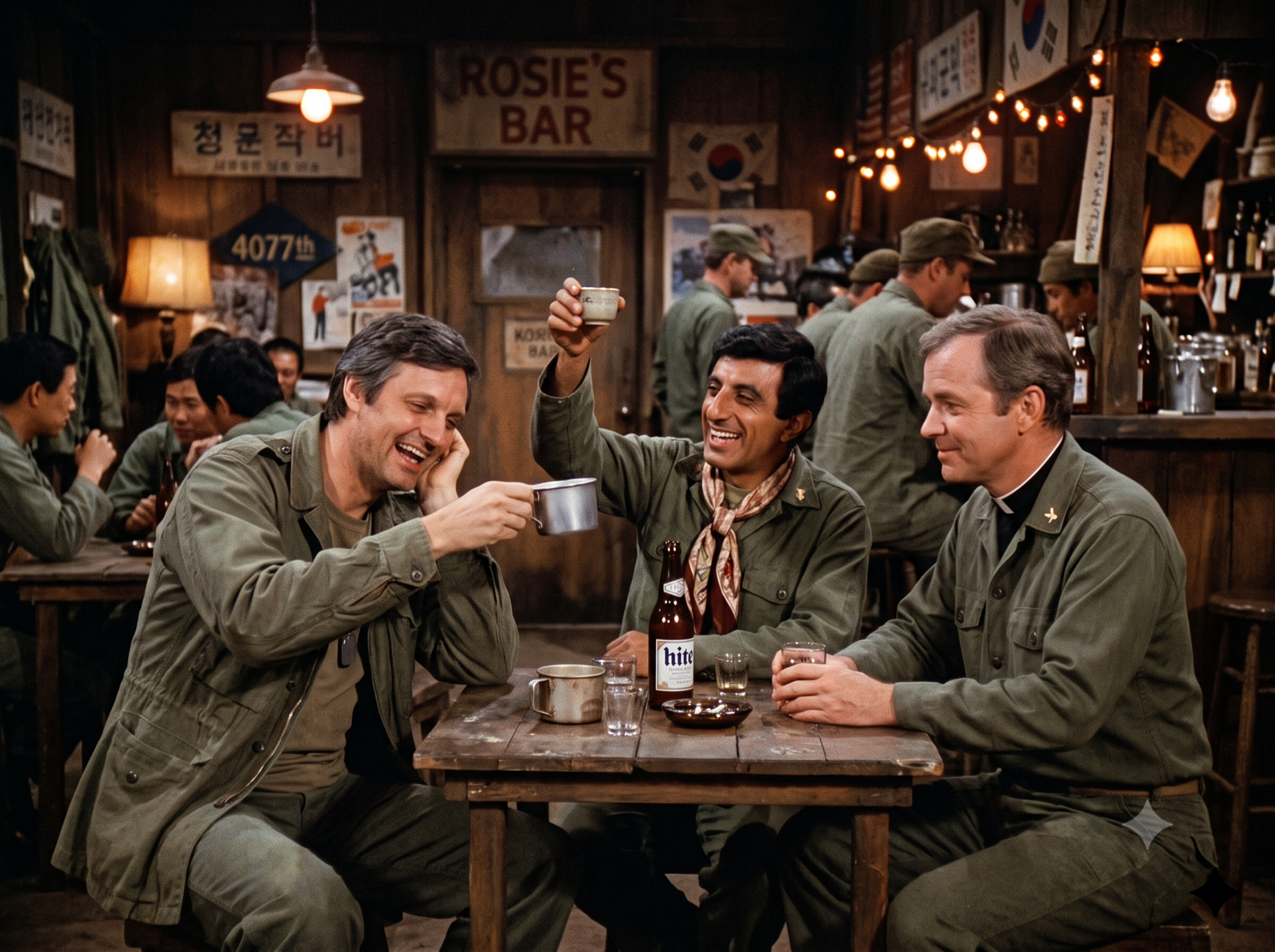
The war always stopped at the swinging doors of Rosie’s Bar. It was an unspoken rule of the 4077th, a silent treaty drawn up the moment you crossed the threshold and let the smell of spilled beer, stale smoke, and cheap soy sauce wash over you.
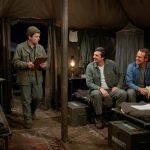
Outside, the Korean night was cold and unforgiving. The distant rumble of artillery thumped against the hills like a restless, angry heartbeat. But inside, under the warm, amber glow of bare bulbs strung up on wire, the world was reduced to four wooden walls and the people you trusted with your sanity.
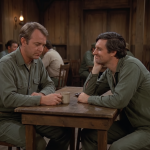
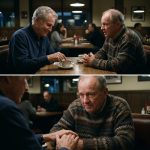
Hawkeye Pierce sat at a small, rickety table near the center of the room, his long frame slumped in a posture of total surrender. He was wearing his standard olive drab, an unbuttoned fatigue shirt thrown carelessly over a dusty t-shirt. His dog tags caught the dim light, resting against his chest like small, heavy anchors.
They had just survived a grueling forty-eight-hour session in the OR. The meat grinder had been running at full capacity, churning through youth and innocence with relentless efficiency. Hawkeye felt completely hollowed out, scraped clean of everything except a bone-deep, vibrating exhaustion.
He rested his elbows on the sticky wooden table, his right hand loosely holding a dented metal camp cup. He hadn’t even taken a sip yet. He was too tired to drink, too tired to speak, almost too tired to keep his eyes open.
But beside him, entirely defying the heavy atmosphere of the camp, sat Corporal Maxwell Klinger.
Klinger wasn’t wearing a dress tonight, but he had still managed to find a way to insult uniform regulations with spectacular flair. Tied elegantly around his neck was a brightly colored patterned silk scarf, its warm reds and golds popping loudly against the drab military green of his fatigues.
He was holding court, his voice full of theatrical bravado. In his hand, pinched delicately between his thumb and forefinger, was a tiny, chipped ceramic teacup. It was absurdly small, the kind of delicate cup you’d find in a highly formal, very brief tea ceremony.
Sitting across from them, holding his own small glass with both hands near the edge of the table, was Father Mulcahy. The chaplain wore his collar under his fatigue shirt, his posture modest and unassuming. He wasn’t speaking; he was simply watching his flock.
Klinger was in the middle of a grand tale. He was detailing exactly how he had managed to swindle a visiting general’s supply clerk out of a specific bottle of Korean beer, a handful of clean glasses, and the magnificent scarf he now wore. It involved a rusted jeep hubcap, two cans of creamed corn, and a magnificent lie about an exiled Lebanese prince.
Hawkeye just stared at him. The contrast between the horrors they had just left in the surgical ward and the ridiculous, trivial victory Klinger was celebrating was jarring.
The exhaustion weighed on Hawkeye like a physical blanket. He felt the familiar, cynical darkness creeping up the back of his throat. He wanted to tell Klinger to shut up. He wanted to point out that none of this mattered, that the war would still be here tomorrow, that the helicopters would always return.
Klinger finished his grand story and raised his tiny, delicate cup high in the air. He struck a grand, heroic pose, his eyes sparkling with absolute, undeniable resilience.
“And so, gentlemen,” Klinger announced, his voice ringing out over the low murmur of the bar. “I propose a toast. To the finer things in life. To silk in a war zone, to beer that doesn’t taste entirely like gasoline, and to the undisputed genius of the Toledo swindle.”
He looked expectantly at Hawkeye. Father Mulcahy looked at Hawkeye, too.
The bar seemed to hold its breath. Hawkeye gripped his metal cup, his knuckles turning white. The heavy silence stretched, thick with the ghosts of the OR, as the cynical surgeon stared down the absurd corporal, teetering dangerously on the edge of a breakdown.
For a long, agonizing moment, Hawkeye didn’t move. He just stared at the tiny ceramic cup hovering in the air, and then up at Klinger’s beaming, hopeful face.
The darkness in Hawkeye’s chest swelled, ready to spill over into a bitter, biting remark that would deflate the entire room. But as he looked at Klinger—really looked at him—the darkness hit a solid wall.
Klinger wasn’t just being foolish. He was fighting the war in the only way he knew how. That ridiculous scarf and that tiny cup were his weapons against the madness. It was a desperate, beautiful refusal to let the army strip away his humanity.
Slowly, the tension drained out of Hawkeye’s shoulders. The tight grip on his metal cup loosened. A small, ragged breath escaped his lips.
And then, a smile broke through the grime on his face. It wasn’t his usual sharp, cynical smirk. It was a weary, affectionately irreverent smile that reached all the way up to his tired eyes.
A low chuckle started deep in his chest, vibrating against his dog tags. He leaned heavily on his left arm, bringing his right hand up, raising the battered tin mug to meet Klinger’s impossible little teacup.
“You’re a maniac, Klinger,” Hawkeye said, his voice raspy with fatigue. “A beautiful, deeply disturbed maniac.”
Klinger’s smile widened, if such a thing were possible. “I prefer the term ‘visionary,’ Captain,” he replied smoothly. “It looks much better on a Section Eight application.”
Across the table, Father Mulcahy’s face softened into a smile of pure, mild amusement. He didn’t offer a grand sermon or a heavy piece of advice. He simply held his glass a little tighter, his eyes crinkling at the corners.
Mulcahy had spent years searching for God in quiet chapels and grand cathedrals back home. But out here, thousands of miles from anything familiar, he found the divine in the strangest places. He saw it in the exhausted, blood-stained hands of the surgeons. He saw it in the endless compassion of the nurses.
And right now, he saw it in the golden amber light of Rosie’s Bar, reflecting off a stolen silk scarf and a dented tin cup. This was communion, just as sacred as any he had ever administered.
“I must admit, Corporal,” Mulcahy said gently, his voice barely rising above the hum of the bar. “It is a rather striking scarf. It brings out the… resilience… in your eyes.”
Klinger puffed out his chest, preening just a little bit in his chair. “Thank you, Father. I like to think it says, ‘I may be drafted, but I will never be drab.'”
Hawkeye laughed again, a softer, easier sound this time. He finally took a sip from his metal mug. The beer was warm and slightly bitter, but at that exact moment, it tasted like absolute salvation.
He looked around the small table. At Klinger, who was now taking a delicate, theatrical sip from his tiny cup, pinky finger extended in a blatant mockery of high society. At Father Mulcahy, who was watching them both with the quiet, protective love of a guardian angel in olive drab.
The heavy weight of the last two days didn’t magically disappear. The physical ache was still in their bones, and the memories of the operating room were still fresh in their minds. The war was still waiting for them just outside those swinging doors.
But for right now, the war couldn’t touch them.
They had built a fortress out of cheap beer, ridiculous stories, and a profound, unspoken brotherhood. They were a family forged in blood and mud, bound together by the desperate, daily need to keep each other sane.
Hawkeye set his mug down on the wooden table. He leaned in slightly, closing the physical distance between them, basking in the intimate, warm light.
“To the Toledo swindle,” Hawkeye said quietly, raising his cup one more time.
“To minor miracles,” Father Mulcahy added, lifting his glass in a gentle, sweeping salute.
“And to us,” Klinger concluded, clinking his tiny cup against the tin mug with a satisfying, fragile little tink.
They sat there together as the night wore on, three men from wildly different worlds, sharing a rickety wooden table in the middle of a conflict they didn’t want to be in. The ambient noise of Rosie’s Bar washed over them—the clinking of glasses, the murmur of tired soldiers, the occasional burst of laughter from a dark corner.
The amber light cast long, soft shadows across their faces, softening the harsh lines of war and fatigue. It was a fleeting, fragile moment of peace. A deeply familiar warmth that they would carry with them long after the war was over, a quiet reminder that even in the darkest of places, you could still find a reason to laugh.
Some families are born, but the best ones are found in the quiet, amber glow of a makeshift sanctuary at the end of the world.