The Best Vintage at Rosie’s
The smell of ether and iodine had a way of settling deep into the pores, lingering long after the surgical gloves were finally peeled away.
It had been a brutal, unrelenting eighteen-hour shift in the OR, the kind that blurred the edges of reality and left the surgeons of the 4077th moving like ghosts. When the last suture was tied and the final bandage taped, the silence that fell over the camp was heavier than the artillery fire that usually rattled the windows. There was an unspoken agreement among the doctors: sleep would not come easily, not with the echoes of the operating room still ringing in their ears. They needed a buffer between the blood and the bunks. They needed Rosie’s.
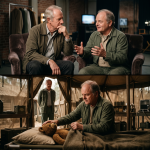
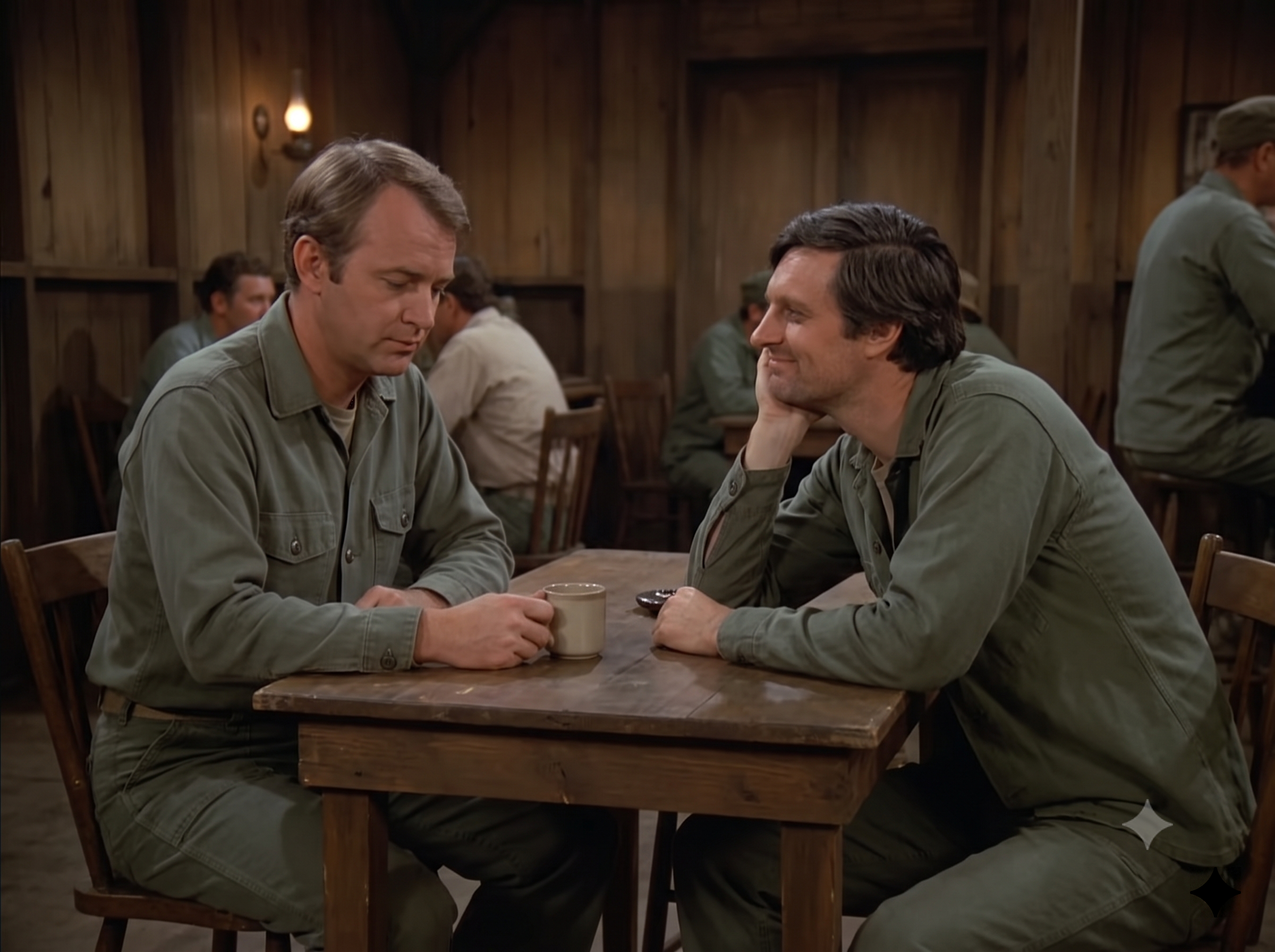
The interior of Rosie’s Bar was a hazy sanctuary of dim, warm amber light and the comforting smell of stale beer and cheap cigars. The rustic wooden walls, worn smooth by the shoulders of a thousand weary G.I.s, seemed to absorb the frantic energy of the war, offering a muted, faded beige haven in return. In the corner, hunched over a simple wooden table, two men in identical, rumpled olive drab fatigues sat in a pocket of quiet isolation.
Major Charles Emerson Winchester III sat rigidly upright, a physical defiance against the exhaustion threatening to pull him under. His face was drawn, the lines around his eyes etched deep by the strain of the day. He stared downward with an expression of reluctant participation, his aristocratic features caught somewhere between disdain and profound weariness. In his hands, he cradled a simple, thick ceramic cup, staring into its murky depths as if trying to divine how a Boston blueblood had ended up in a muddy Korean bar drinking something that only technically qualified as coffee.
Across from him, Captain Benjamin Franklin Pierce was an entirely different study in exhaustion. Hawkeye leaned heavily on the table, his posture a relaxed slouch that defied every military regulation ever written. His left hand was propped up, supporting his chin as he watched his colleague. On Hawkeye’s face was a soft, amused, clever smile. It was a playful, knowing look, stripped of his usual biting sarcasm.
Hawkeye was watching Charles process his own humanity, a spectator to the rare moments when Winchester’s ironclad pomposity gave way to the simple, crushing reality of their shared existence. Hawkeye knew the look on Charles’s face. It was the look of a man who had just played God for eighteen hours and was now terrifyingly aware of his own mortal hands.
“I have to admit, Charles,” Hawkeye finally said, his voice a low, raspy drawl that barely carried over the low hum of the bar. “I never thought I’d see the day you’d look at a chipped mug of Rosie’s finest mud with such deep, spiritual reverence. You look like you’re about to baptize someone in it.”
Charles did not immediately rise to the bait. He didn’t puff out his chest or issue a booming declaration about the superiority of Massachusetts dining. Instead, his shoulders dropped just a fraction of an inch. His grip on the ceramic cup tightened, his knuckles turning white against the thick glaze.
He took a slow, measured breath, keeping his eyes firmly fixed on the table. The silence stretched, heavy and unnatural. When Charles finally spoke, his voice lacked its usual theatrical resonance. It was quiet, ragged, and entirely stripped of armor.
“Pierce,” Charles murmured, the single word hanging in the dim amber air, heavy with a weight that made Hawkeye’s smile falter just enough to let the raw truth of the moment slip through.
“Pierce, tell me,” Charles continued, his eyes finally lifting to meet Hawkeye’s. “When you are in there, up to your elbows in a boy who has no business being anywhere near a battlefield… how do you stop the trembling when the shift is over?”
The question was so stark, so utterly devoid of Winchester’s usual defensive bluster, that it commanded the space between them. Hawkeye’s posture didn’t change, but the playful spark in his eyes softened into a deep, empathetic understanding. The clever smile remained, but it shifted from amusement to a quiet, steadfast reassurance.
“You don’t,” Hawkeye said gently. “You just learn to hide it in your pockets until you can get somewhere like this.”
Charles looked back down at the cup. He turned it slowly in his hands, tracing a small chip on the rim with his thumb. “That boy in pre-op,” Charles said, his voice barely above a whisper. “The one with the chest wound. I had his heart in my hand, Pierce. Literally in my hand. I felt it stutter. For three seconds, it simply stopped.”
Hawkeye remembered. He had been working at the adjacent table, stealing glances as Winchester performed a surgical miracle with the quiet precision of a maestro.
“But you started it again, Charles,” Hawkeye reminded him, his voice steady and grounding. “You massaged it. You brought him back. He’s breathing right now because your hands didn’t tremble when it actually mattered.”
Charles closed his eyes, exhaling a long, shuddering breath. “It is a terrifying responsibility. To hold the thread of a life and know that the slightest tremor, the briefest lapse in focus, could snap it.” He opened his eyes, looking around the worn, rustic room, taking in the faded olive tones and the weary faces of the other soldiers. “And then to walk out of that blood-soaked tent and sit in a place like this, drinking this… this ungodly swill, as if nothing happened.”
Hawkeye let the silence settle over them, allowing the truth of Charles’s words to breathe. This was the paradox of the 4077th. They were trapped in a revolving door of tragedy and absurdity, expected to transition from saving lives to drinking terrible coffee in the span of a heartbeat.
“That’s the trick, Charles,” Hawkeye said, leaning in just a fraction closer, his smile returning, warm and deeply fond. “The swill helps. It reminds us we’re still alive. If you were drinking a 1928 Bordeaux from a crystal goblet, you might think you’d died and gone to heaven. Or at least to Boston. The fact that your coffee tastes like boiled bootlaces is absolute proof that you survived the shift.”
A faint, reluctant huff of breath escaped Charles’s nose—the closest thing to a laugh he could muster. The crushing weight of the OR seemed to lift slightly from his shoulders, dispersed by the dry, absurd logic of his tentmate. He looked at Hawkeye, really looked at him, recognizing the shared fatigue and the unspoken bond forged in the crucible of meatball surgery.
“Only you, Pierce,” Charles said, his tone regaining a microscopic hint of its usual superiority, “could find philosophical salvation in a beverage that violates the Geneva Convention.”
“I’m a visionary, what can I say?” Hawkeye replied, his smile widening into that familiar, charming smirk. He tapped his own glass against the table. “Drink up, Major. It builds character. Or at the very least, it dissolves stomach lining, which takes your mind off the war.”
Charles looked down at the ceramic cup one last time. The reluctance was still there, but the profound, shaking dread had passed. He raised the mug to his lips with practiced elegance, extending his pinky finger in a silent, stubborn rebellion against the mud and the madness surrounding them. He took a sip, grimaced beautifully, and set the cup back down on the wooden table.
Hawkeye chuckled quietly, shifting his weight but keeping his head propped on his hand, content to simply sit in the dim amber light with his friend. They didn’t need to say anything else. The noise of Rosie’s Bar buzzed around them—the clinking of glasses, the low murmur of conversations, the scratchy tune from the jukebox. It was a temporary escape, a fleeting moment of peace in a world gone mad.
They were thousands of miles from home, wearing faded olive green, exhausted to their very bones. But in that quiet corner, separated by a scarred wooden table and a cup of terrible coffee, they had found exactly what they needed to face tomorrow.
In a place where tomorrow was never promised, surviving today with a friend across the table was the only victory that mattered.