The Light in the Swamp
Silence was a rare and suspicious visitor at the 4077th.
When the choppers stopped coming, the camp didn’t immediately relax. Instead, it held its collective breath, waiting for the other shoe to drop in the muddy terrain of Korea.
But after twelve hours without the screaming engines of a Bell H-13, the deep, bone-weary fatigue finally gave way to a strange, quiet comfort.
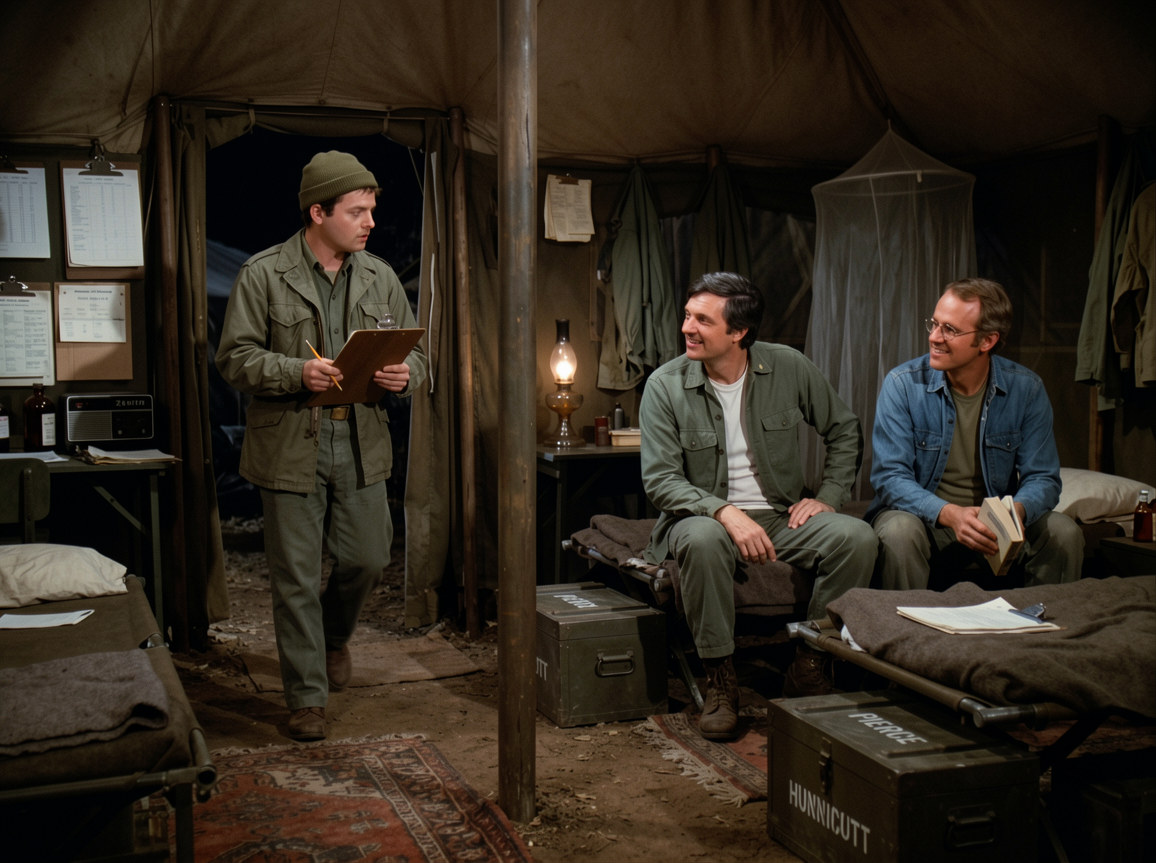
Inside the Swamp, the kerosene lamp cast a warm, golden circle of light against the olive-drab canvas walls. The hissing of the lantern and the faint, static-laced jazz drifting from the small Zenith radio were the only sounds in the tent.
It was a rare moment of peace, and the doctors were soaking it in like sunshine.
Hawkeye sat on the edge of his cot, wearing a crisp white t-shirt and an unbuttoned green fatigue shirt. He wasn’t drinking, he wasn’t scheming, and for once, he wasn’t pacing.
Across from him, B.J. Hunnicutt was propped up on his own bunk, a worn paperback book in his hands. He wore his comfortable blue denim shirt, looking more like a friendly neighbor back in Mill Valley than a drafted army surgeon.
They were just two men sitting in the dirt, enjoying the profound luxury of doing absolutely nothing.
Then, the tent flaps parted.
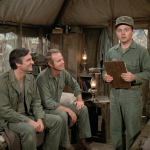
Radar O’Reilly stepped into the dim light, looking exactly as he always did—like a boy wearing a soldier’s clothes.
His green knit cap was pulled down low over his forehead, and his oversized field jacket hung loosely on his frame. In his hands, he clutched his eternal clipboard and a yellow number-two pencil, holding them tight against his chest like a wooden shield against the war.
Hawkeye looked up, his face immediately breaking into a gentle, welcoming smile.
B.J. lowered his book, a matching grin spreading across his face, his eyes crinkling with genuine affection for the young corporal.
“Enter, oh bearer of midnight tidings,” Hawkeye said softly, his voice lacking its usual sharp, sarcastic bite. “To what do we owe the pleasure of the company clerk at this ungodly hour of peace?”
Radar hesitated, shifting his weight from one booted foot to the other. “Uh, sorry to disturb you, sirs. I’m just doing a… a late-night inventory check.”
B.J. chuckled warmly. “Inventory? Radar, the only thing we have an excess of in here is dirty laundry and existential dread.”
“It’s Colonel Potter’s orders, Captain,” Radar said, though his voice lacked its usual crisp, bureaucratic conviction.
He didn’t look down at his clipboard to read a list. He didn’t start counting the extra blankets or checking the footlockers that sat plainly on the floor, boldly stenciled with the names PIERCE and HUNNICUTT.
Instead, Radar just stood there, staring at the two surgeons.
He looked at Hawkeye’s relaxed posture, and then at the quiet, amused warmth radiating from B.J.
Radar’s grip on the pencil tightened until his knuckles turned white, and the yellow wood gave a faint, threatening creak. He swallowed hard, his Adam’s apple bobbing in his throat.
“I don’t understand,” Radar whispered, his voice suddenly sounding terribly young and terribly tired.
The smiles on Hawkeye and B.J.’s faces didn’t vanish, but they softened, shifting from playful amusement to careful attention.
“Understand what, kid?” Hawkeye asked gently.
Radar looked down at the clipboard. It was covered in requisition forms, casualty reports, and the endless, depressing mathematics of a war that never seemed to stop.
He looked back up, his eyes shining with unshed, exhausted tears in the lamplight.
“We lost three boys in post-op today,” Radar said, his voice trembling in the quiet tent. “I spent the last two hours typing up the telegrams for their mothers. I just finished.”
He took a shaky breath, looking at the two men he admired more than anyone else in the world.
“I just finished typing them,” Radar repeated, his voice cracking with a sudden, overwhelming desperation. “So how… how can you guys just sit here and smile?”
The question hung in the air, heavier than the damp Korean cold outside the canvas walls.
The faint jazz from the Zenith radio suddenly seemed incredibly loud in the space between the three men.
B.J. slowly closed his paperback book, marking his page with a thumb, and rested it on his knee. He didn’t look away from Radar.
Hawkeye let out a long, slow breath. The gentle smile remained on his face, but the humor was entirely gone from his eyes, replaced by a deep, ancient ache.
Neither doctor stood up to offer a frantic medical response. They knew this wasn’t a physical wound. This was the soul-deep injury that every person in the 4077th caught eventually, like a virus in the mud.
“Come here, Radar,” Hawkeye said quietly, patting the empty space on his cot.
Radar didn’t move at first. He remained frozen by the door, the clipboard still pressed against his chest as if the forms could somehow protect him from the truth of his own question.
“I’m on duty, sir,” Radar mumbled, a weak attempt to retreat back behind military protocol.
“The war is asleep right now, Walter,” B.J. said, his voice a low, comforting rumble. “And so is the Colonel. You can put the clipboard down.”
The use of his real name did what an order could never do. Radar’s shoulders slumped.
He stepped forward, the heavy combat boots dragging slightly in the dirt, and carefully placed the clipboard onto the top of Hawkeye’s footlocker. He didn’t sit, but he stood close to the lantern, the light illuminating the deep, dark circles under his young eyes.
“I’m sorry,” Radar whispered, looking down at his boots. “I shouldn’t have asked that. It’s insubordinate. I just… I get so tired, Captains. I look at the names on the paper, and I see their faces when they came off the chopper.”
Hawkeye leaned forward, resting his elbows on his knees, bringing himself closer to Radar’s eye level.
“You want to know why we’re smiling, kid?” Hawkeye asked, his tone stripped of all jokes and defenses.
Radar gave a small, hesitant nod.
“Because we have to,” Hawkeye said simply. “Because if we don’t smile at the small things—a quiet night, a good book, the fact that our favorite company clerk just walked into the room—then the big things will eat us alive.”
B.J. nodded slowly, leaning back against the wooden frame of his cot.
“Radar, those three boys we lost today… Hawkeye and I spent six hours up to our elbows trying to save them,” B.J. said gently. “We know their names. We know what color their eyes were. And when we close our eyes tonight, we’ll see them all over again.”
Radar looked at B.J., his brow furrowing. “But you look so… okay.”
“We’re not okay, Radar,” Hawkeye said, his voice dropping to a raw, honest whisper. “None of us are okay. We’re thousands of miles from home, stitching up kids who should be taking girls to the prom. It’s insane. The whole thing is a madhouse.”
Hawkeye offered a small, bittersweet smile, gesturing around the cramped, dirty tent.
“But this right here? This tent? You, me, Beej, the Colonel, Father Mulcahy? We are the life rafts,” Hawkeye explained. “We hold onto each other. And sometimes, smiling at your friend is the only way to prove to the universe that it hasn’t completely beaten you yet.”
Radar absorbed the words, his youthful face caught between the crushing reality of his job and the profound comfort of his friends.
“It just feels disrespectful,” Radar admitted softly. “To laugh when they… when they can’t.”
B.J. set his book down on the footlocker and leaned forward, his eyes full of fatherly warmth.
“It’s the exact opposite, Radar,” B.J. said softly. “The best way we can honor those kids is to keep living. To keep feeling human. If we let the war turn us to stone, then we’re really lost.”
The Swamp fell quiet again. The wind rattled the canvas flap, but inside, the cold couldn’t quite reach them.
Radar looked at the clipboard sitting on the footlocker. For the first time in hours, it just looked like a piece of wood and some paper, not a tombstone.
He looked back at Hawkeye and B.J. The two surgeons were still looking at him, their expressions completely open, radiating nothing but patience and deep, brotherly love.
Slowly, the tight, defensive knot in Radar’s chest began to loosen. The shaking in his hands stopped.
“I guess… I guess that makes sense,” Radar said, his voice finding its normal rhythm again.
“Good,” Hawkeye said, his smile widening just a fraction, returning to that familiar, roguish warmth. “Because if you stop being our beacon of innocence, I’m going to have to rely on Frank’s memories of his childhood, and that’s just too depressing to survive.”
Radar actually managed a small, tired grin at that. “Yes, sir.”
“Are you done for the night, kid?” B.J. asked.
“Almost,” Radar said, reaching down to pick up his clipboard. He held it a little looser this time. “I just have to file these in the office, and then I can turn in.”
“Go file them,” Hawkeye ordered softly. “And then go to sleep, Radar. No listening for the radio. No organizing the motor pool in your head. Just sleep.”
Radar nodded, pulling his knit cap a little tighter against the cold he was about to face.
He turned toward the door, but stopped halfway through the tent flaps. He looked back over his shoulder at the two men sitting by the glow of the kerosene lamp.
“Hey, Captains?” Radar asked softly.
“Yeah, Radar?” Hawkeye replied.
“I’m really glad you guys are my life rafts.”
Hawkeye and B.J. smiled again—not a mask against the dark, but a genuine reflection of the light.
“Same to you, kid,” B.J. said softly. “Same to you.”
Radar gave a small, crisp nod, stepped out into the Korean night, and let the tent flaps fall shut behind him.
In a place surrounded by darkness, they survived by simply refusing to let the light go out.