A Rare Vintage in a Tin Cup
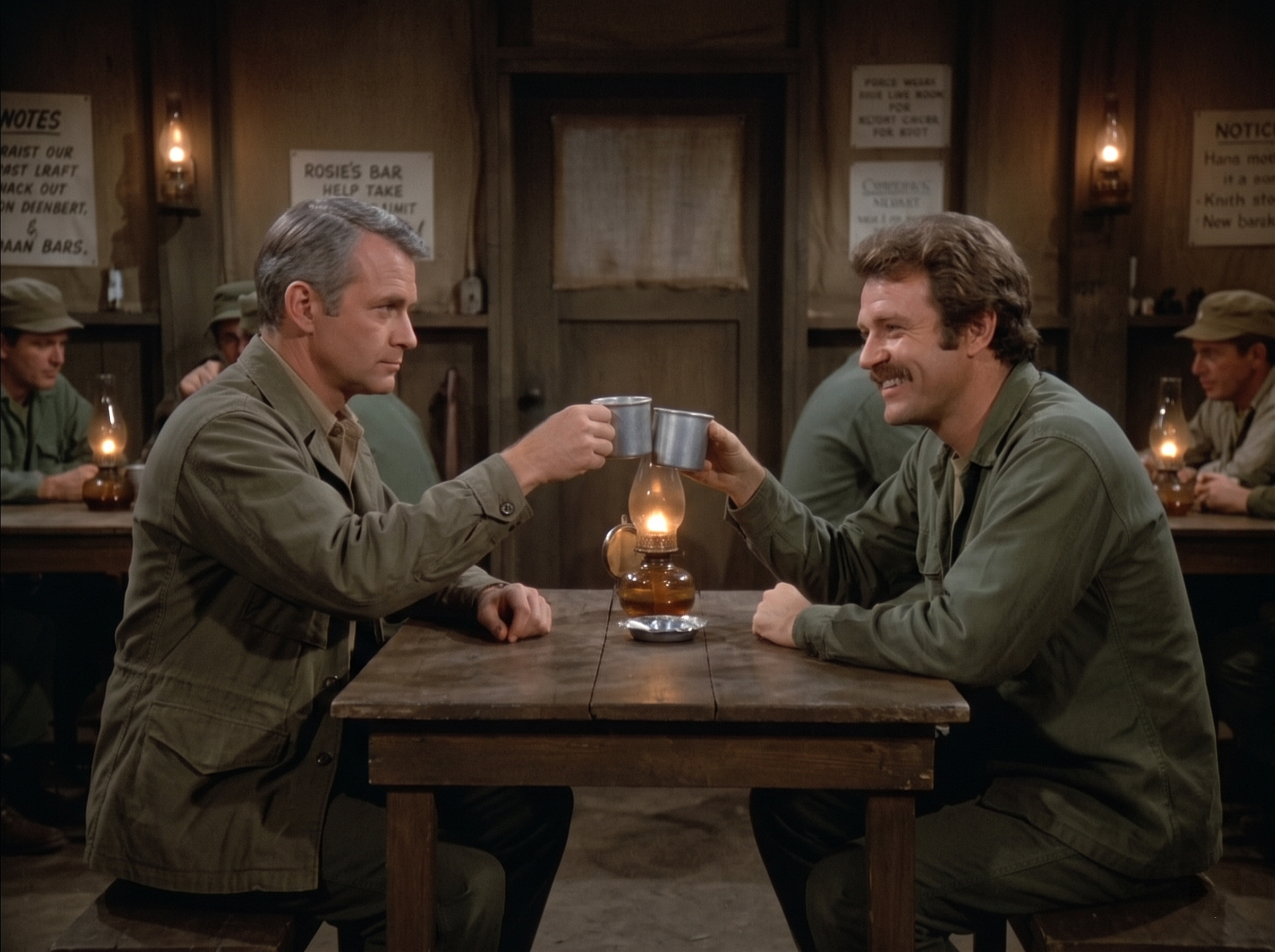
Rosie’s Bar always smelled of stale beer, damp wool, and the desperate need to be anywhere else.
It was a small, rustic sanctuary, built out of plywood, corrugated tin, and sheer stubbornness. Worn, hand-painted signs decorated the muddy walls, illuminated by the dim, flickering amber glow of kerosene lamps scattered across the wooden tables.
It wasn’t much of a refuge, but for the doctors of the 4077th, it was the only one they had.
The OR had finally gone quiet after a brutal, unending three-day push. The wounded had stopped arriving just as the sun began to set behind the Korean hills.
Major Charles Emerson Winchester III sat alone at a corner table, his posture as immaculate as ever. Despite the bone-deep fatigue that surely plagued him, his back was perfectly straight. His OD green fatigues were rumpled, but he wore them as if they were a tailored suit in a Boston parlor.
Before him sat a dented tin cup. It was filled with something Rosie claimed was whiskey, though Charles suspected it was distilled from old jeep tires and regret.
Normally, he would have complained. Normally, he would have demanded a proper glass, a better vintage, and an entirely different continent. But tonight, Charles was silent.
His face, usually set in lines of aristocratic disdain, betrayed a subtle, quiet vulnerability. He stared at the flickering flame of the oil lamp between his hands, lost in a place far away from the muddy reality of the camp.
From across the room, Captain B.J. Hunnicutt watched him.
B.J. was just as exhausted, his shoulders heavy and his eyes rimmed with red. But B.J. possessed a quiet radar for the emotional casualties of this war. He knew what a man looked like when the homesickness finally broke through the armor.
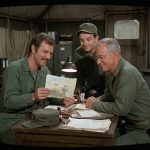
Carrying his own tin cup, B.J. walked slowly over to Charles’s table. He didn’t ask for permission to sit. He simply pulled out the wooden chair opposite the Major and settled in.
B.J. leaned forward comfortably, resting his elbows on the rough surface of the table. He didn’t offer a witty remark or a sarcastic jab. He just looked at Charles with a warm, dryly funny, and deeply humane smile.
For a long moment, neither man spoke. The ambient noise of the bar—the low murmur of other weary soldiers, the clinking of bottles—seemed to fade into the background.
The amber light from the small glass lamp cast dancing shadows across their faces. The silence between them grew heavy, thick with the shared weight of a thousand unspoken fears and the ghosts of the operating room.
Charles tightened his grip on his cup. His knuckles went white under the dim light. He closed his eyes for a fraction of a second, fighting a sudden, overwhelming wave of emotion.
He took a slow, deep breath, his chest rising as he commanded his composure to return. He opened his eyes and finally met B.J.’s steady, empathetic gaze.
The walls Charles had built so carefully around himself were trembling. The proud Bostonian, who guarded his heart with a fortress of vocabulary and arrogance, looked as fragile as glass.
His hand shook slightly as he began to lift the tin cup from the table, a confession hovering on the very edge of his lips.
“It is October,” Charles said, his voice barely more than a gravelly whisper.
He didn’t look at the walls of Rosie’s, or the other men in their wrinkled green fatigues. He kept his eyes locked on the space just above the flickering lamp.
“In Boston,” Charles continued, his tone carefully controlled, “the air has just turned crisp. The leaves along the Charles River are beginning to burn with color.”
B.J. nodded slowly, his smile softening into something profoundly tender. He didn’t interrupt. He simply listened, anchoring Charles to the present moment while letting him wander through his memories.
“My family,” Charles swallowed hard, his throat tight, “will be attending the symphony tonight. They will sit in our usual box. And afterward, there will be a late supper. Roast pheasant, perhaps. And a Burgundy that does not taste like kerosene.”
Charles finally lifted his chin, his pride warring with his sorrow. The mask of subtle vulnerability was fully visible now in the warm lamplight. He looked at B.J., entirely unshielded.
“I have never missed a crisp October in Massachusetts, Hunnicutt. Until this miserable, godforsaken war.”
B.J. kept his elbows on the table, his demeanor relaxed and unthreatening. He understood that Charles didn’t want pity. Pity would have offended him. What Charles needed was a witness.
“Mill Valley gets a nice autumn, too,” B.J. said quietly. His voice was a gentle, steady rumble. “The air gets sharp. Smells like pine needles and woodsmoke.”
B.J. traced the rim of his tin cup with his thumb. The humor in his eyes shifted into a deep, familiar longing.
“Right about now, Peg is probably putting Erin in a sweater. One of those little knitted ones with the wooden buttons. They’re probably raking leaves in the front yard. Making a pile just big enough for a little girl to jump into.”
Charles looked at B.J., recognizing the same hollow ache in the other man’s chest. It was a different flavor of homesickness, perhaps—a symphony versus a pile of autumn leaves—but the pain was exactly the same.
The tension in Charles’s shoulders eased, just a fraction. He sat perfectly upright, maintaining his dignified precision, but the rigid defiance was gone.
“It is a cruel joke,” Charles murmured softly, “that we are expected to save lives in a place that feels entirely devoid of it.”
“Yeah,” B.J. agreed gently. “It is.”
B.J. shifted his weight, his warm, empathetic smile returning. It was a smile born of shared survival. He picked up his battered tin cup and held it out across the center of the wooden table, just above the chimney of the small oil lamp.
“To crisp air,” B.J. said warmly.
Charles looked at B.J.’s outstretched cup. For a moment, his innate snobbery almost won out. The idea of toasting with this vile liquid, in this muddy shack, seemed absurd.
But then Charles looked at B.J.’s face. He saw the genuine care, the unassuming friendship, and the quiet strength that kept them all from completely falling apart.
With restrained, dignified reluctance, Charles raised his own cheap tin cup.
He met B.J.’s cup in the middle of the table. The two pieces of metal met with a dull, hollow clink that sounded louder than artillery fire in the quiet space between them.
“To Boston,” Charles said, his voice finding its familiar resonance, though much softer than usual.
“And to Mill Valley,” B.J. added.
They both drank. Charles grimaced slightly as the fiery liquid burned its way down his throat, a sharp reminder of exactly where they were. B.J. just winced, giving a dry chuckle as he lowered his cup.
“You know, Charles,” B.J. said, wiping his mustache with the back of his hand, “if you close your eyes and really use your imagination, this stuff almost tastes like a 1948 drain cleaner.”
Charles lowered his cup, placing it back on the table with deliberate care. The ghost of a genuine smile touched the corners of his mouth.
“Your palate is entirely unrefined, Hunnicutt,” Charles replied, his tone laced with its usual sarcastic elegance, though entirely devoid of malice. “Any fool can tell this is clearly a ’49.”
B.J. laughed softly, a quiet sound that seemed to chase a bit of the gloom out of the dim corners of Rosie’s Bar.
They sat together in the amber light for a long time after that. They didn’t talk much more. They didn’t need to. The grueling fatigue of the OR was still in their bones, and the war was still waiting for them just outside the wooden doors.
But in that small, rustic room, over dented cups and terrible liquor, the distance to home didn’t feel quite so impossible to bear. They were an unlikely pair, a snob and a country doctor, bound together by blood, mud, and an unbreakable thread of human decency.
Charles adjusted his collar, regaining his polished armor piece by piece, but he did not leave the table. He stayed right where he was, sharing the quiet space with his friend.
Sometimes, the only cure for being ten thousand miles from home is finding someone who understands exactly how far that is.