The Angel of the 4077th
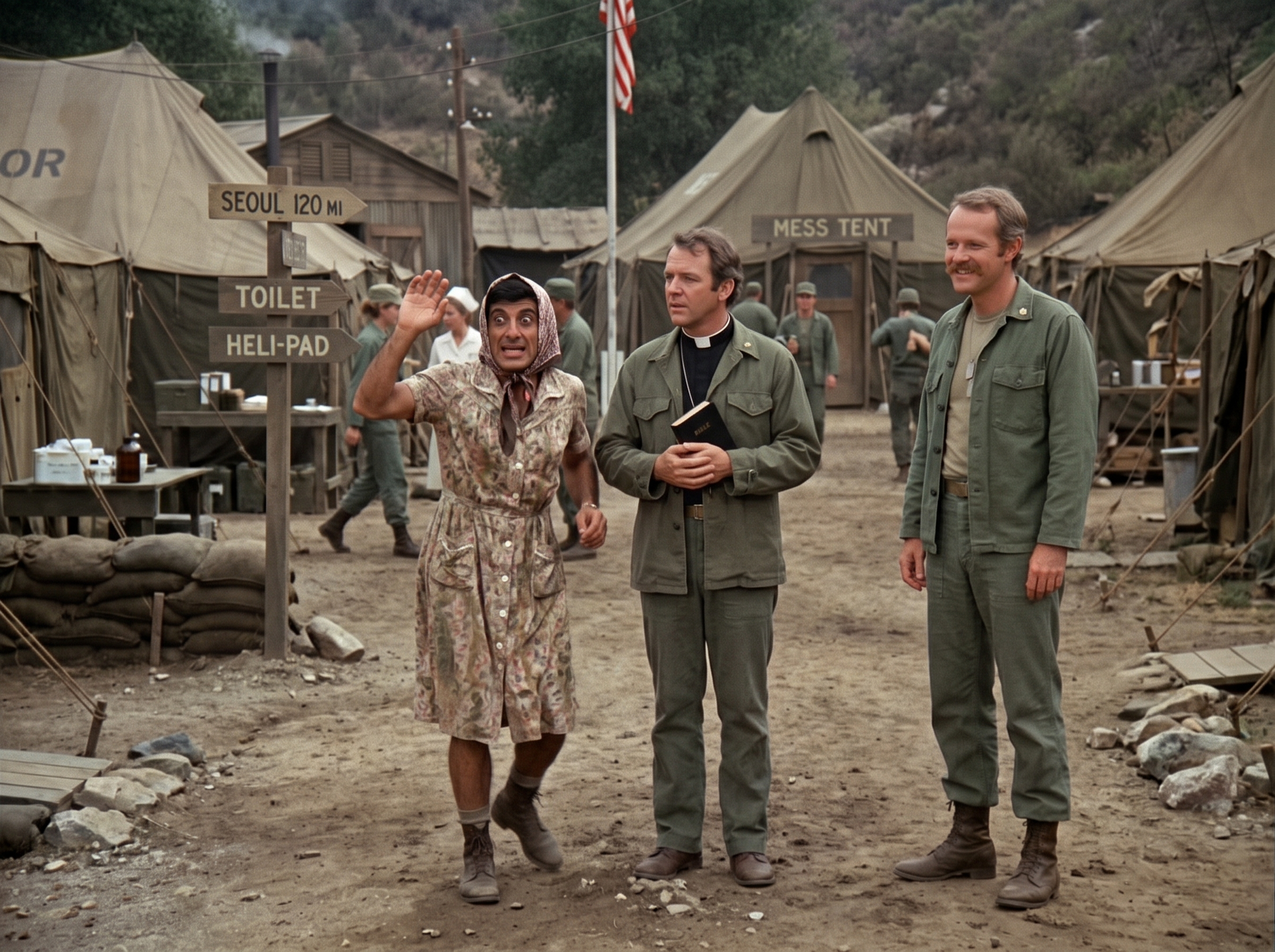
The late afternoon sun cast long, soft shadows across the 4077th, bathing the outdoor compound in familiar shades of dusty beige and faded olive drab.
For once, the camp was completely quiet. No incoming choppers. No distant artillery. Just the gentle, warm breeze rustling the canvas tents and the low hum of a distant jeep motor.
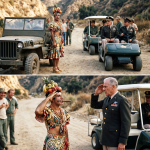
Captain B.J. Hunnicutt, Corporal Klinger, and Father Mulcahy were strolling down the main dirt path, enjoying a rare, fragile moment of peace.
They looked like three men who had been swallowed by the war and had somehow learned to live inside its belly. Their clothes were practical, worn, and lived-in.
B.J. wore his faded green fatigues, his hands tucked deeply into his pockets. Mulcahy had his collar on, holding a small, worn prayer book close to his chest. Klinger, forgoing his lavish gowns for the dusty afternoon, wore a mismatched but comfortable combination of baggy army trousers and a brightly colored floral scarf tossed dramatically over his shoulder.
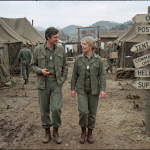
They were just passing the wooden signposts that pointed the way to Boston, Tokyo, and Toledo, when the PA speaker on the pole above them cracked to life.
A harsh whine of static shattered the quiet.
“Attention, all personnel,” Radar’s voice echoed across the compound, sounding uncharacteristically nervous. “Uh… attention.”
The three men slowed their pace.
“Colonel Potter has just received a very nice phone call from Sister Theresa over at the Saint Mary’s Orphanage,” Radar’s voice continued over the squawk box. “She wanted to thank the camp for the very generous donation.”
Father Mulcahy smiled softly, a look of genuine pleasure warming his gentle face.
“However,” Radar added, his voice dropping to a cautious whisper. “The Colonel would like to immediately see the individual who generously donated two dozen brand-new army cots, four crates of penicillin, and the officers’ entire monthly supply of canned peaches. Please report to the CO’s office before he calls the Military Police.”
Klinger halted mid-step.
His hands froze in the air in a grand, theatrical gesture. His eyes darted nervously from the speaker to the tents around him. His face contorted into a mask of sudden, dramatic panic, immediately followed by a look of deep, sly suspicion.
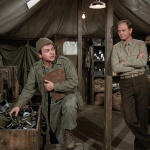
Beside him, Father Mulcahy stopped entirely. He clutched his small black book a little tighter. His gentle face showed mild confusion, which quickly melted into soft, quiet concern as he looked at Klinger’s paralyzed posture.
A few feet away, B.J. didn’t look shocked at all.
He stood with perfectly relaxed arms, shifting his weight slightly. A quiet, knowing smile spread beneath his mustache. He looked at Klinger with an expression of easygoing irony, entirely amused by the scene unfolding before him.
“It’s a trap,” Klinger whispered fiercely, his eyes narrowing at the wooden signpost as if it were bugged. “The old man is bluffing. He’s fishing for a confession.”
B.J. let out a low, warm chuckle. He pulled one hand from his pocket and rubbed his chin, his knowing smile never fading.
“You know, Max,” B.J. said with quiet irony, “usually when you steal from the United States Army, you’re supposed to try and make a profit. You’re the worst war profiteer in Korea.”
“I have no idea what you’re talking about, Captain,” Klinger shot back, smoothing his brightly colored scarf with trembling fingers. “I am an innocent man. I am a victim of circumstantial proximity. I don’t even like canned peaches!”
Father Mulcahy looked between the two men, the reality of the situation slowly dawning on him. The mild confusion in his eyes was replaced by a profound, radiant warmth.
He realized what Klinger had done. The Corporal had risked the stockade, sneaking past guards in the dead of night, just to make sure the orphans had warm beds to sleep in and medicine for the coming winter.
“Oh, Maxwell,” the Padre said softly. His voice was thick with emotion as his thumb traced the worn edge of his prayer book. “That was… remarkably decent of you.”
“Decent? Padre, please, don’t insult me,” Klinger hissed, looking around frantically. “If I took those things—which I firmly, legally deny—it was strictly a logistical error! A clerical oversight! I was sleepwalking!”
The squawk box above them clicked on again.
“Uh, addendum to the previous announcement,” Radar’s voice floated down, sounding slightly more relaxed. “The Colonel says whoever did it isn’t going to the stockade. He just really wants to know how you got twenty-four cots past the sentry post.”
Klinger didn’t blink. “Definitely a trap. They’re going to shoot me at dawn.”
B.J. laughed out loud this time, a rich, tired, genuine sound. He stepped forward and placed a steady, comforting hand on Klinger’s shoulder.
“Come on, Robin Hood,” B.J. said gently. “Let’s go face the music. We’ll be your character witnesses.”
“I’ll pray for leniency,” Mulcahy added with a warm, encouraging smile, stepping into stride beside them.
Reluctantly, Klinger let himself be guided down the dirt path. His theatrical panic slowly gave way to a resigned, nervous shuffle. The three men walked shoulder to shoulder through the dusty compound, moving past the Swamp and the mess tent.
When they reached the commanding officer’s tent, Klinger hesitated at the screen door. B.J. just gave him a gentle nudge forward.
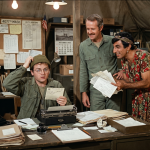
Inside, Colonel Potter was sitting behind his heavy wooden desk. He looked up over his spectacles as the three men walked in.
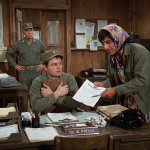
Potter didn’t yell. He didn’t look angry. He simply picked up a piece of paper from his desk. It was a handwritten letter from Sister Theresa.
“Corporal,” Potter said, his voice dry and fatherly. “I have a letter here thanking the camp for our generosity. Curiously, it mentions a ‘hairy angel in a beautiful floral scarf’ who drove a jeep full of supplies into their courtyard at three in the morning.”
Klinger stood rigidly at attention, his eyes fixed on the ceiling. “There are a lot of hairy angels in Korea, sir. It’s a very common phenomenon.”
Potter sighed, tossing the letter onto his desk.
“Klinger, I can’t have you requisitioning army property without my signature,” Potter said firmly. “It throws the whole inventory out of whack.”
Klinger swallowed hard. “Yes, sir. I understand, sir.”
Potter opened his top drawer and pulled out a blank supply requisition form. He picked up his pen, quickly filled out a few lines, and signed his name at the bottom with a flourish.
He dated it for three days ago.
“Which is why,” Potter continued, not looking up as he stamped the paper, “I am officially approving this retroactive transfer of obsolete surplus to the local civilian sector. Just… next time you decide to play Santa Claus, ask me first. I might have some extra blankets to add to the sleigh.”
Klinger stared at the Colonel, completely stunned. His jaw dropped slightly.
“Dismissed, Corporal,” Potter said quietly, a faint, proud smile tugging at the corner of his mouth.
“Thank you, sir,” Klinger whispered. For once, there was no theatricality. No grand gestures. Just quiet, honest gratitude.
The three men stepped back outside into the fading afternoon light. The air was a little cooler now, the dusty beige of the camp turning to a deep, rich gold.
Klinger let out a massive breath, sagging against the wooden railing of the porch.
B.J. shared a warm, silent look with him, leaning casually against the post. Father Mulcahy reached out and gave Klinger’s arm a gentle, affectionate squeeze.
They stood there together in the quiet dust of the 4077th. They were thousands of miles from home, exhausted, and surrounded by a war that seemed like it would never end. But in that small, shared moment, there was a fierce, protective kindness among them—a quiet humanity that no army regulation could ever strip away.
In a place surrounded by madness, the greatest rebellion of all was simply choosing to care.