A Toledo Transfer and a Texas Glare
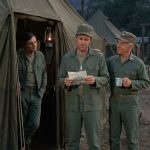
The 4077th Mobile Army Surgical Hospital ran on three basic elements: coffee that tasted like boiled canvas, sheer nervous exhaustion, and a mountain of paperwork that defied all human logic.
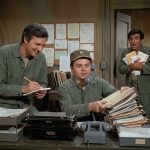
Inside Corporal Walter “Radar” O’Reilly’s office, the air was usually calm, smelling faintly of mimeograph ink and dusty olive drab.
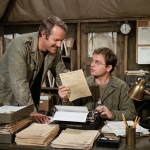
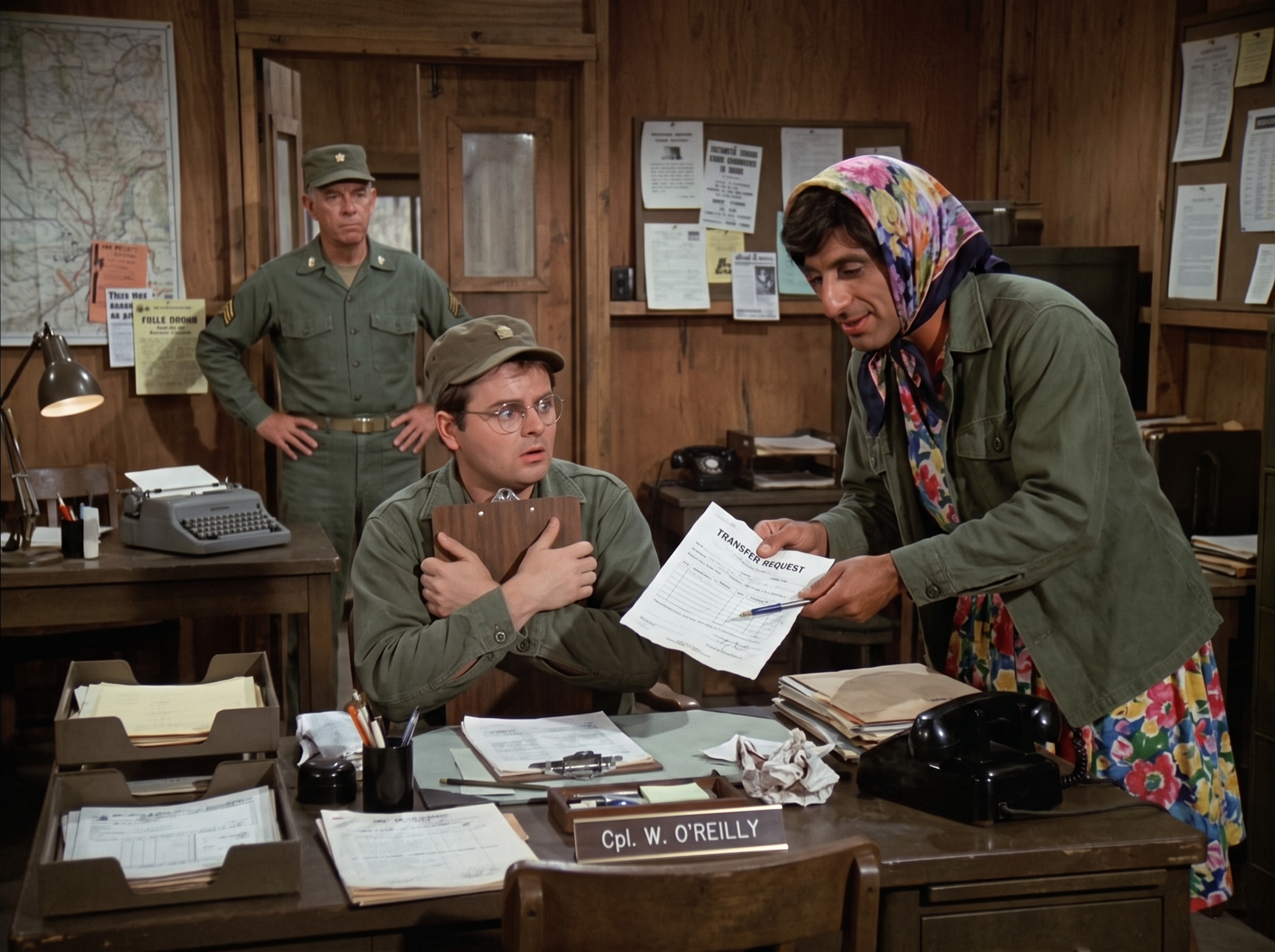
It was a modest clerk station, a tiny bubble of order in a world gone mad. The room was illuminated by the soft, warm glow of a desk lamp, casting long, familiar shadows against the wooden plank walls. Stacks of requisition forms, wire file trays, a heavy black field phone, and a trusty Royal typewriter turned the small desk into a fortress of bureaucracy.
This was Radar’s sanctuary. Here, amidst the beige paper and ringing phones, he made the impossible mechanics of the war run on time.
But even Radar’s sanctuary wasn’t safe from the swirling, unpredictable madness of the camp.
The wooden door didn’t just open; it was pushed aside with dramatic flair, bringing a gust of wind and the unmistakable, out-of-place rustle of civilian fabric.
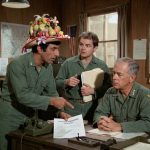
Corporal Maxwell Klinger glided into the room.
Today’s ensemble featured a bright, blooming floral dress in vibrant yellows and pinks, paired exquisitely with a matching headscarf tied neatly beneath his chin. He wore his standard-issue olive drab army jacket over the dress, looking entirely ridiculous, yet carrying himself with absolute, undeniable dignity.
“Ah, Radar, my boy,” Klinger cooed, leaning heavily over the wooden desk.
He invaded Radar’s safe zone with a sly, hopeful grin and a highly theatrical expression. He held out a crisp, beige sheet of paper, waving a blue pen in his other hand like a maestro commanding an orchestra.
It was a pristine, officially formatted ‘Transfer Request’.
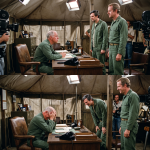
Radar shrank back instantly into his chair.
His round face became a portrait of wide-eyed concern and nervous confusion. He brought his wooden clipboard up, clutching it tightly to his chest with both hands as if it were a bulletproof vest protecting his very soul.
“Klinger, you know I can’t touch that,” Radar stammered, pressing himself deeper into the corner. “The Colonel gave strict orders. No more Section 8 paperwork unless it’s signed by a real psychiatrist, a priest, and a notary public from Iowa.”
“But Radar, this isn’t just any transfer request,” Klinger pleaded, his voice taking on a desperate, pleading vibrato.
“This one is an absolute masterpiece. I have documented a newly discovered, highly dangerous psychological condition. I call it ‘Toledo Separation Anxiety’. If I don’t get a Tony Packo’s hot dog within seventy-two hours, my brain will literally turn into chopped liver!”
Radar shook his head frantically, holding the clipboard higher. “I can’t, Klinger! I just can’t! You know he’ll yell at me!”
“Just a tiny stamp, Radar. Just slip it into the outgoing pile. Who’s going to know? It’s just you, me, and the administrative flies.”
Klinger thrust the paper closer, entirely focused on his grand pitch, pushing the absurd form toward the terrified clerk.
But Radar wasn’t looking at the paper anymore.
Radar was looking past Klinger’s floral-covered shoulder, his wide eyes fixing on the open doorway behind them.
Standing right there, framed perfectly in the doorway background, was Colonel Sherman T. Potter.
He wore his standard green fatigues and cap, his hands planted firmly on his hips. He didn’t shout. He didn’t interrupt. He just stood there in the silence, observing the utter chaos of his camp with a weary wisdom and a stern but loving authority.
Klinger, completely unaware of the Texas storm gathering right behind him, leaned in closer to Radar, grinning his most convincing, desperate grin.
“Come on, buddy,” Klinger whispered dramatically. “One little stamp and I’m on a boat to freedom…”
“Unless that boat is paddling its way across the typing pool, Corporal, I highly suggest you drop anchor.”
Colonel Potter’s voice wasn’t loud, but it cut through the dusty air of the clerk’s office like a surgical scalpel.
Klinger froze instantly.
The sly, hopeful grin melted off his face, replaced in a split second by the rigid, terrified posture of a man who had just stepped on a very active landmine.
Slowly, deliberately, Klinger turned around, pulling the transfer request to his chest in almost the exact same defensive manner Radar was holding his clipboard.
“Colonel Potter, sir!” Klinger chirped, his voice cracking slightly on the last syllable. “I was just… consulting with the company clerk. Official business. Administrative… floral… business.”
Potter didn’t move from the doorway. He just stood there, letting the silence stretch out, observing the sheer absurdity of the scene before him.
His eyes scanned the room, taking in Radar’s terrified posture behind the typewriter, the scattered piles of requisition forms, and finally settling heavily on Klinger’s brightly colored headscarf.
A heavy, profound sigh escaped the Colonel’s lips.
It was the deep sigh of a man who had seen two world wars, the cavalry, and now, a grown, hairy man from Ohio dressed like a confused babushka looking for a victory garden.
He stepped into the office, the wooden floorboards creaking under his heavy boots.
“At ease, Klinger,” Potter said, extending a weathered hand. “Let me see the masterpiece.”
Klinger hesitated, glancing nervously back at Radar, who was still silently hyperventilating behind his desk, eyes darting between the Colonel and the dress.
Reluctantly, moving in slow motion, Klinger handed over the beige paper.
Potter pulled his reading glasses from his shirt pocket, perched them deliberately on the end of his nose, and held the document up to the soft, warm light of Radar’s desk lamp.
The room was dead silent. Outside, the distant, dull hum of the camp generator and the muffled shout of a mechanic across the compound were the only reminders of the war.
“Toledo Separation Anxiety,” Potter read aloud, his tone completely flat and dry.
“Yes, sir,” Klinger said earnestly, trying to regain a shred of his theatrical momentum. “It’s a very serious, very tragic affliction. Early symptoms include sudden, uncontrollable urges to wear chiffon, a deep weeping longing for minor league baseball, and vivid hallucinations involving Hungarian hot dog chili.”
Potter lowered the paper and looked at Klinger over the rim of his glasses.
There was no anger in the Colonel’s eyes. There was no shouting, and no threat of a court-martial. Just a deep, profound weariness, softened by a glimmer of paternal understanding.
He knew exactly what this was. It wasn’t madness. It was survival.
It was just another way for a scared, exhausted kid from the Midwest to process the endless mud, the incoming choppers, and the bone-crushing fatigue of a mobile army surgical hospital. Klinger’s dresses were as much a shield as Radar’s clipboard.
“It’s a very compelling diagnosis, son,” Potter said gently, folding the paper neatly in half.
Klinger’s eyes lit up with a sudden, impossible flash of hope. “Sir? You mean…?”
“I mean,” Potter continued, his voice steady and calm, handing the folded paper back to the corporal, “that it belongs in the great medical journals of our time. Right next to ‘Seoul Sickness’ and ‘Pyongyang Panic’. But it absolutely does not belong in my outgoing mail pouch.”
Klinger deflated instantly, his floral shoulders slumping forward in total defeat. “Yes, sir.”
Potter stepped closer, reaching out and giving Klinger’s shoulder a firm, reassuring squeeze through the olive drab jacket.
“Look at me, Klinger,” Potter said, his voice dropping to a softer, more intimate register that didn’t leave the room.
Klinger looked up, expecting the usual reprimand about military discipline.
“We’re all tired,” Potter said softly, the Texas twang carrying a heavy weight. “We’re all a little crazy right now. If I had a hot dog from Toledo sitting on this desk, I’d kiss it right on the bun before I ate it. But I need you here.”
Potter looked at Radar, then back to Klinger.
“Radar needs you here. Hawkeye and B.J. need you here. The whole damn 4077th needs you here. Dress and all. Because if you jump ship, this whole place gets just a little heavier for the rest of us to carry.”
Klinger swallowed hard, his theatrical posture dropping completely as a flicker of genuine, quiet emotion broke through his facade.
He looked at the floor, then back up at the Colonel, and nodded slowly. “I understand, Colonel.”
“Good,” Potter said, his tone briskly returning to its usual authoritative, fatherly clip. “Now, take off that babushka, put on a proper cap, and go help Father Mulcahy inventory the new shipment of plasma. And Klinger?”
“Yes, sir?”
“That particular shade of yellow actually clashes terribly with your complexion. Next time, stick to the earth tones. It’s a combat zone, for Pete’s sake.”
A small, genuine smile tugged at the corner of Klinger’s mouth. “Thank you, sir. I’ll make a note of it.”
As Klinger shuffled out of the office, his floral dress swishing softly against his heavy army boots, Potter stood in the center of the room, watching him go, shaking his head slowly with a fond, tired smile.
Behind the desk, Radar finally lowered the clipboard from his chest, letting out a long, shaky breath that physically fluttered the papers in his outbox.
“Wow,” Radar breathed, wiping his forehead. “I thought I was going to have to file a casualty report for a minute there, sir.”
Potter turned back to his young clerk, the sternness completely gone from his face.
“Not today, son,” Potter said softly. He walked over to the small table in the corner and poured himself a cup of the terrible, sludge-like liquid Radar called coffee. “Not today.”
He took a sip, grimaced at the bitter taste, and looked out the small screen window at the dusty, sprawling compound.
The war was still raging just over the hills, relentless and cruel. But inside this small, cluttered office, under the warm glow of a single desk lamp, the world was exactly as it should be.
It was crazy, it was exhausting, and it was held together by the quiet strength of the people who simply refused to let each other fall apart.
Some days you survive the war with a scalpel, and some days you survive it with a floral headscarf and a friend who won’t let you give up.