Stuck in the Muck: A Moment at the 4077th
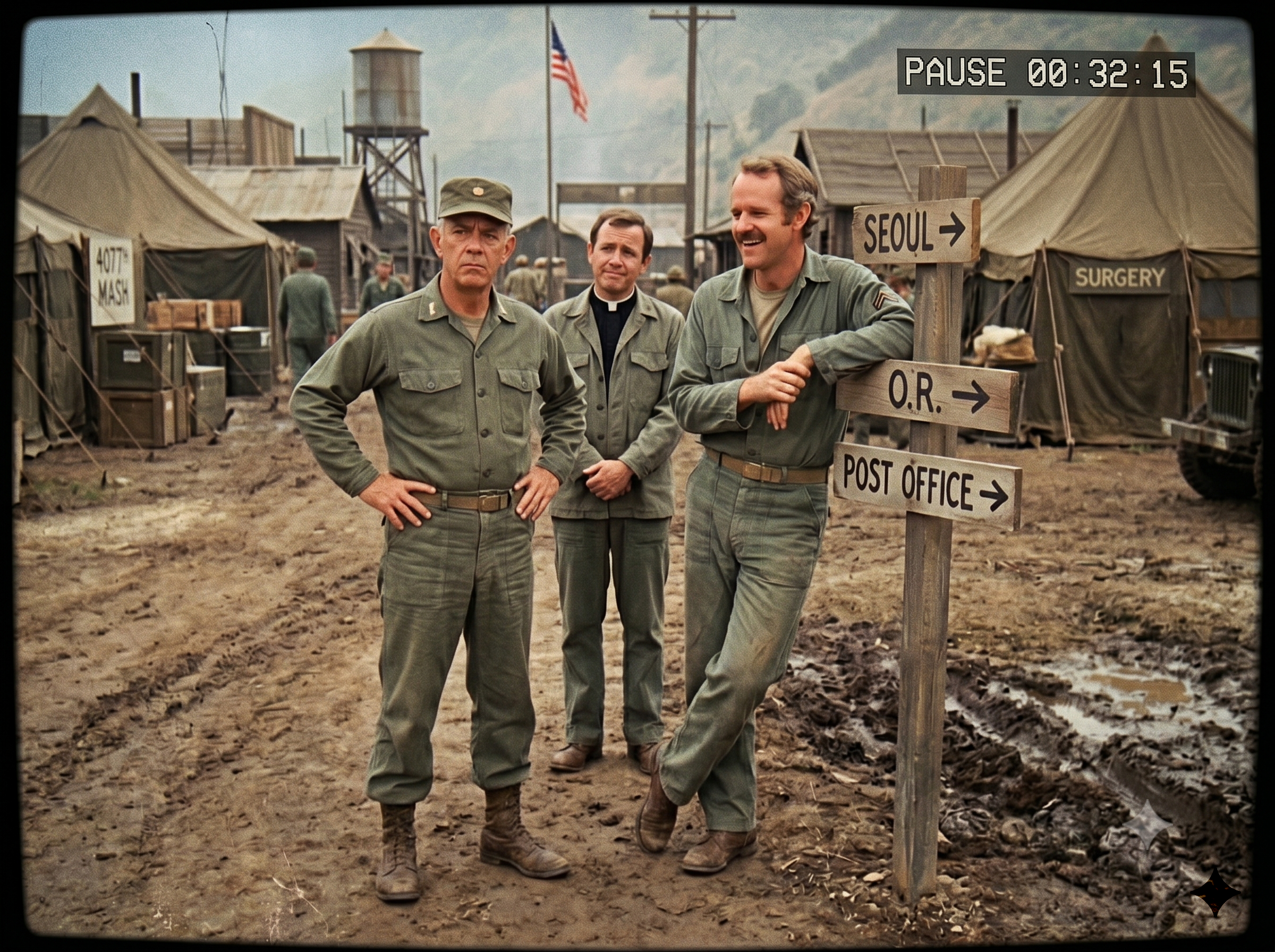
It was Tuesday in Korea, and the mud was making house calls.
If the mud in Korea had a personality, it would be a particularly sticky, determined, and deeply annoying kind of patient.
Today, it was taking its toll on the main thoroughfare of the 4077th, right between the Post Office and the O.R., where the intersection was rapidly becoming a graveyard for tires and hope.
The visual check of the camp’s main road was a grim routine, and today Colonel Potter was performing it with a seasoned, fatherly glaring at a particularly ambitious patch of ooze that had claimed a US Army Jeep.
His hands were planted firmly on his hips, a posture that signaled a deep, albeit dry, exasperation with the army’s logistical choices and the geography of the Far East.
Beside him, B.J. Hunnicutt, ever the grounded spirit, was leaning casually against a wooden signpost.
He watched the Jeep’s gradual, painful descent into the earth with a gentle, easygoing chuckle, his eyes twinkling with friendly amusement at the minor absurdity of it all.
Father Mulcahy stood just behind them, his face a quiet mirror of mild, innocent concern.
He clasped his hands modestly, a quiet prayer for the Jeep, and perhaps for the clean laundry that B.J. had been driving, now sinking slowly into the brown.
“This,” Colonel Potter muttered, not quite to anyone, “is why I preferred horses. They had the decency to keep their bellies dry.”
B.J. grinned, not breaking his lean. “Yes, Colonel, but you couldn’t put a spare tire on a stallion’s flank.”
Potter’s glare softened. Only just.
The Jeep groaned, a low, wet sound as the front axle disappeared.
It was sinking at an angle, the engine block angled towards the sky, like it was trying to escape the earth while being dragged under.
And that’s when they heard the noise.
It was a wet, sucking gasp, and a tire, B.J.’s spare, detached and was swallowed completely.
The Jeep listed harder to the right. The muddy earth was winning.
It wasn’t a medical emergency, but it felt like a vital sign failing.
“Good heavens,” Mulcahy whispered, taking a small step forward.
The Jeep was half gone, and the ground was thick enough that there was nowhere to stand to push.
It was a quiet, hopeless moment of small disaster.
“Well,” B.J. sighed, the amusement fading as his hands slipped from the signpost. “Looks like that laundry is just part of the local ecology now.”
The three of them stood there in the quiet. Just three tired men, facing a small, muddy truth.
They hadn’t spoken since the spare tire disappeared. It felt too final.
But then B.J. looked up at the signpost, still pointing: ‘SEOUL ->’.
He traced the arrow with his hand. “‘Seoul’ is still that way, Colonel. But the mud is definitely that way,” he pointed down.
“And ‘Post Office’…” he pointed to another sign. “The mail might get here, but it might take some very determined worms.”
Potter looked at the signs, then back at the Jeep.
A small smile finally broke the dry line of his face. “The ‘Surgery’ sign is the only one I believe anymore.”
“At least it doesn’t move,” he added quietly.
The comedy of the situation was fragile. The sight of a vehicle being swallowed whole by dirt was funny, until you realized it was your vehicle, and your supplies, and your way out.
But in that moment, the humor wasn’t a joke; it was a connection.
They were all stuck. Not just the Jeep.
Stuck in the muck, stuck in this place, stuck with a war that didn’t know how to end.
“I suppose we should try to save the radiator cap,” B.J. offered. “It’s a nice cap.”
Potter looked at his hands, then at the mud. The hands that healed so many lives.
He was the leader, the father figure, and he knew they couldn’t just stand there and watch a machine sink.
“Alright, Hunnicutt,” Potter said, and his voice held a soft command. “Stop admiring the mud, and let’s get our hands dirty. This isn’t a funeral; it’s an extraction.”
“Mulcahy,” he glanced back, “I don’t think a prayer is going to unstick it, but you’re welcome to keep an eye on the signpost. It seems reliable.”
Mulcahy smiled gently. “I’ll keep a watch, Colonel. And maybe a quiet word for the engine block.”
B.J. didn’t argue. He just rolled up his sleeves, a familiar motion, and stepped out onto the path toward the wreck.
They worked together. There were no straps, no winch. Just manpower.
Potter took the steering wheel, his experienced hands trying to find traction that wasn’t there.
B.J. and two orderlies, who had appeared from the shadows, put their backs into the mud, grunting and shoving.
It was messy. The mud flew. B.J.’s smile was hidden behind a mask of brown.
They didn’t get it out that hour. Or the next.
But they didn’t stop, and they didn’t watch it sink.
They didn’t win, not really, but they had a different kind of victory. They worked. Together.
The Jeep stayed stuck, but it stayed accessible.
As the sun began to dip, they stood on the muddy path, dirty but connected.
A single muddy tire was all that peeked above the surface, but it was above the surface.
And B.J., still smiling through the grime, looked at the signs.
“Well,” he said, and the warmth was back in his voice, “the sign to Seoul hasn’t moved an inch.”
“And the O.R. is right over there,” he pointed with a mud-caked finger.
“Seems like everything is just where it belongs. Right here. With us.”
He patted Colonel Potter on the shoulder, and Potter didn’t flinch.
It was a small, messy, bittersweet moment. A Tuesday at the 4077th.
Sometimes, the only direction that matters is forward, even when you’re sinking.