A Splash of Toledo Springtime
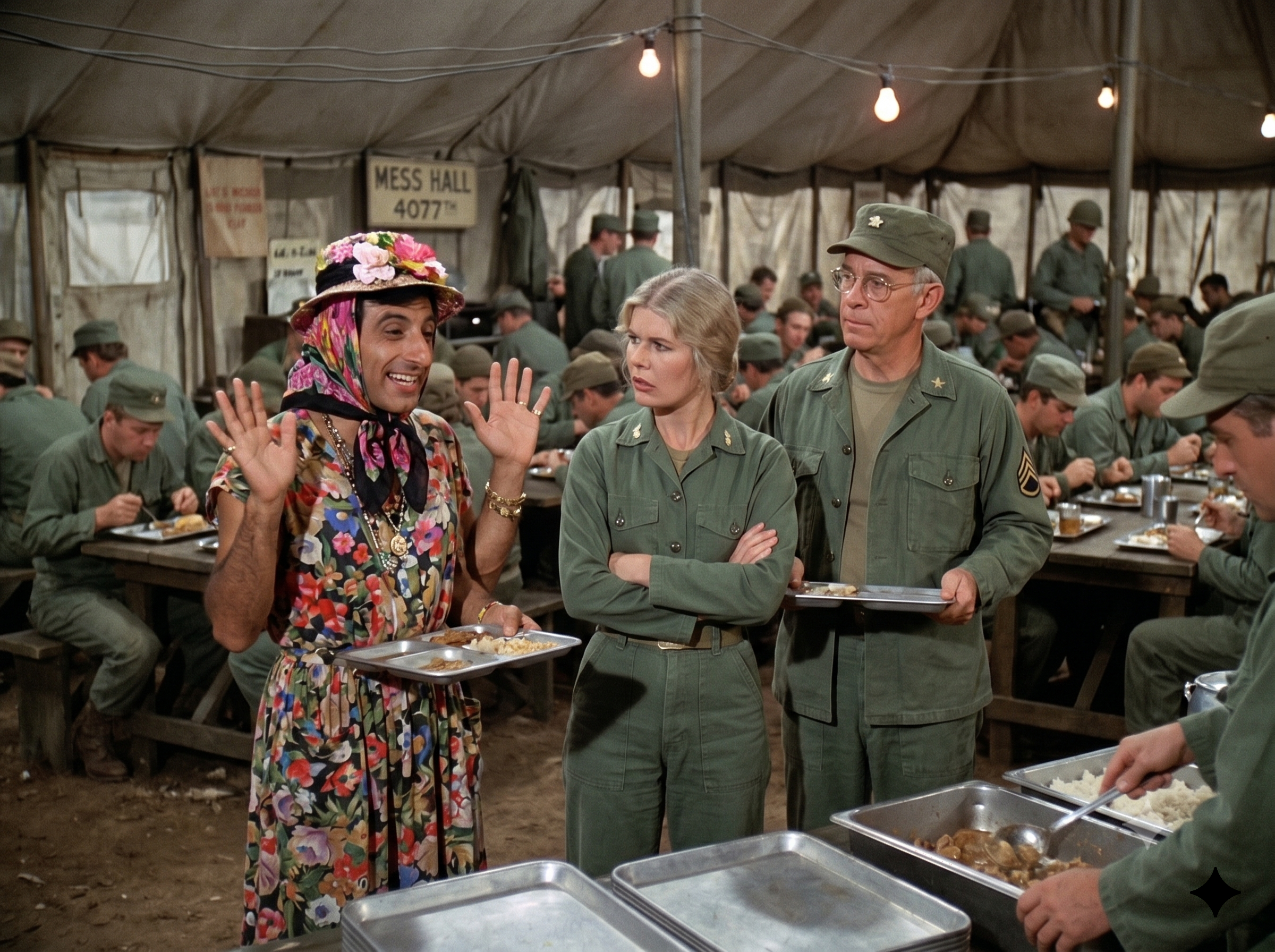
The dull roar of the mess tent on a Tuesday afternoon was a sound the staff of the 4077th knew in their bones. It was a blend of clattering metal trays, the hiss of the steam tables, and the low, exhausted murmurs of people who had seen too much.
The canvas walls offered no real shelter from the biting Korean wind, only a temporary illusion of safety. Inside, the air smelled heavily of powdered eggs, boiled coffee, and the lingering scent of antiseptic that seemed to cling to everyone’s skin.
In the chow line, Major Margaret Houlihan stood with a posture that would make a drill sergeant proud. But beneath the crisp lines of her olive drab fatigues, she was running on fumes. She had spent the last fourteen hours in post-op, fighting to keep a fragile peace among the wounded.
Her arms were folded tightly across her chest, a physical barrier against the exhaustion trying to pull her down. She just wanted a hot cup of terrible coffee and five minutes of silence.
Instead, she got Corporal Maxwell Klinger.
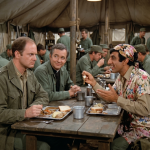
Klinger didn’t just walk into the mess hall; he made an entrance. Against the sea of dull greens and muddy browns, he was a sudden, jarring explosion of springtime.
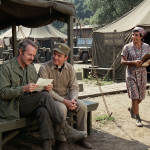
He was draped in a loud, vibrant floral print dress that looked like it had been stolen from a particularly bold aunt in Toledo. A brightly colored silk headscarf was tied firmly under his chin. Resting atop the scarf was a straw hat blooming with a ridiculous assortment of pink and yellow artificial flowers. Heavy, golden necklaces clinked against his chest with every step he took.
He pranced up to the serving counter, tossing his hands into the air in a grand, theatrical gesture of arrival. “Voila, my fellow prisoners of war!” he announced to the line. “Spring has officially sprung in the 4077th!”
Margaret’s eyes narrowed instantly. The professional, controlled facade clamped down hard. She looked at Klinger with a profound, skeptical frustration. “Corporal,” she said, her voice a low, dangerous warning. “What in the name of all that is military are you wearing in my mess tent?”
Klinger didn’t flinch. His face beamed with comic pride and an eccentric charm that was entirely his own. “It’s a therapeutic ensemble, Major,” he declared, his expressive eyes wide with feigned innocence. “My morale was hovering somewhere around my combat boots. I felt a severe bout of khaki-induced melancholy coming on.”
He gestured grandly to his floral dress. “The brass is always saying we need to boost our spirits. I ask you, Major, what is more uplifting than a garden party aesthetic?”
“It is a violation of uniform regulations, it is a health hazard around food, and it is giving me a migraine,” Margaret snapped. Her arms remained rigidly crossed. “You are wildly out of uniform. I want you in fatigues before you even look at those serving trays, or I will personally see to it that you scrub the latrines until Christmas.”
Klinger’s hands stayed up, pleading his case with theatrical desperation. “But Major, to stifle my sartorial expression is to invite the dreaded Section 8! You wouldn’t want to deny a man his hard-earned insanity, would you?”
Behind them, the food line had stalled entirely. The exhausted doctors and nurses were watching the show, too tired to laugh, but grateful for the distraction.
Standing quietly directly behind Klinger and Margaret was Colonel Sherman Potter. He held his dull metal tray with steady hands. He didn’t interrupt immediately. Instead, he watched the spectacle unfold with a dryly amused, yet stern expression, radiating the calm authority of a man who had seen everything.
Margaret took a step closer to Klinger, her voice rising. “I don’t care if you’re trying for a Section 8 or a feature in a fashion magazine, Corporal. You will follow regulations!”
Potter took a slow, deep breath. He adjusted his glasses slightly, the faint hint of a smile tugging at the corner of his mouth. It was time to step in.
“Let’s hold the phone right there,” Colonel Potter’s voice cut through the clamor.
It wasn’t a shout. It was just that steady, unmistakable tone of fatherly command that made everyone in the room instinctively stand a little straighter.
Margaret stiffened, turning her head slightly but keeping her arms firmly crossed. “Colonel,” she said, her tone sharp but respectful. “I was just instructing the Corporal on proper mess hall attire. This… this walking greenhouse he’s wearing is completely unacceptable.”
Klinger pivoted, turning his wide, expressive eyes to the Colonel. He knew Potter was his last line of defense. “Sir, you understand the delicate nature of the human spirit. A man of fashion cannot survive on olive drab alone. The soul starves! I am merely trying to bring a little elegance to our humble hash slinging.”
Potter looked Klinger up and down. He took in the bright floral patterns, the clinking costume jewelry, and the ridiculous flower-covered hat. His eyes remained strictly military, but the dry amusement on his face deepened.
“Klinger,” Potter said slowly, letting the syllables roll out. “I’ve been in this man’s army for a very long time. I’ve seen men try to eat their way out of the draft. I’ve seen them pretend to be blind, deaf, and allergic to their own shoelaces.”
Potter paused, leaning forward just a fraction. “But I have never, in all my years, seen a soldier try to accessorize his way out of a combat zone with quite so much enthusiasm.”
Klinger beamed, his theatrical posture returning. “Does that mean it’s working, sir? A one-way ticket to a civilian wardrobe in Toledo?”
“It means,” Potter replied dryly, “that you look like a couch from a cheap roadside motel. And while I appreciate the effort to brighten up this canvas dungeon, Major Houlihan is right. This is a mess tent, not a Fifth Avenue runway.”
Klinger’s shoulders slumped. The theatrical pride melted away, leaving behind a flash of genuine, tired disappointment. He looked down at his floral hem.
For a fleeting second, he wasn’t a scam artist looking for a discharge. He was just a young man, thousands of miles from home, desperately trying to feel like himself in a place that tried to strip away every ounce of individuality.
Margaret watched him. Her jaw was still tight, but the fierce, skeptical frustration in her eyes softened. Just by a fraction.
She knew the crushing weight of this place as intimately as anyone. She knew that beneath Klinger’s ridiculous dresses and elaborate schemes was a soldier who never once missed a shift in the OR. He drove the ambulance through artillery fire and scrubbed blood off the floor without complaint. He was a nuisance, yes, but he was their nuisance.
“Colonel,” Margaret said quietly. Her voice had lost its sharp, regulatory edge. She didn’t uncross her arms, but her posture lost its rigidity. “Perhaps… given the current influx of casualties we’ve had this week, the Corporal’s mental fatigue is showing more than usual.”
It was a subtle defense. Margaret would never openly condone breaking the rules, but her tone was surprisingly protective. “It is a minor infraction,” she added, “under the current circumstances.”
Potter nodded slowly. His eyes crinkled with quiet, profound understanding. He looked from Margaret’s tired, resolute face to Klinger’s hopeful, eccentric one.
He knew exactly what was happening. This wasn’t just a military unit functioning by the book. It was a family of castaways, clinging to whatever humor and humanity they could find to survive the daily horror of the war.
“I agree, Major,” Potter said warmly, his voice a steady anchor in the noisy tent. “Combat fatigue takes many strange forms. Sometimes it looks like a thousand-yard stare. Sometimes it looks like a petunia-covered sun hat.”
He stepped up to the serving line and pushed his metal tray toward the bewildered cook. “Here’s my ruling. You can wear the garden party ensemble to lunch, Klinger. I suppose we could all use a little color with our mystery meat.”
Klinger gasped, a hand flying to his chest in delight.
“But,” Potter continued, raising a stern finger. “The minute you step out of this tent, you’re back in olive drab. And if a single artificial petal falls into my powdered eggs, you’ll be digging a latrine halfway to the Yalu River. Understood?”
Klinger’s face lit up with a brilliant, victorious smile. He brought his hands together in a dramatic gesture of gratitude. “Bless you, Colonel! Bless you, Major! You won’t regret this. I will dine with the grace of a duchess!”
Margaret let out a long, exhausted sigh. She finally dropped her arms, letting them rest at her sides. A tiny, almost invisible smile touched the corner of her mouth as she picked up her tray and moved down the line. She was too tired to fight, and secretly, too fond of him to care.
Potter just shook his head, looking like a weary father indulging his eccentric children. He accepted his plate of unrecognizable food with a stoic nod.
The three of them moved forward in the line. The brief moment of tension dissolved back into the familiar, comforting routine of the 4077th.
They were surrounded by the smell of bad coffee and the endless dust of Korea. But in that small, shared moment, there was a quiet, undeniable warmth. It was the comfort of knowing that no matter how absurd things got, they were always looking out for each other.
In a place designed to break the human spirit, a little bit of borrowed springtime was sometimes the only medicine that worked.