The Bureaucracy of Home
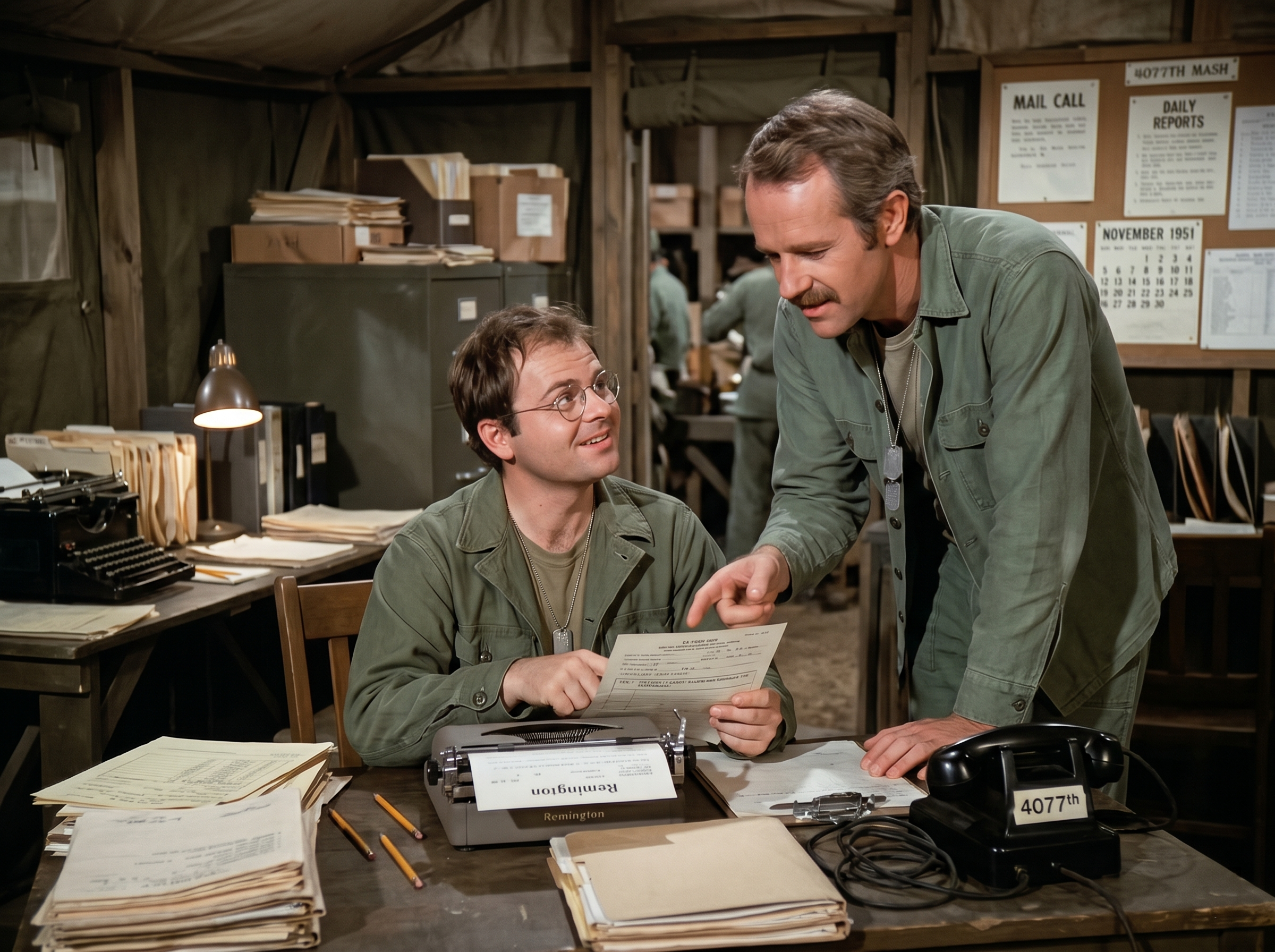
The war never stopped for paperwork; it just paused to let the ink dry.
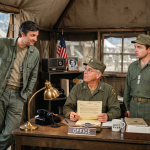
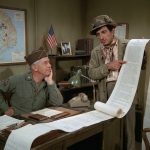
In the quiet, cluttered heart of the 4077th, the clerk’s office was a modest sanctuary of organized chaos.
Stacks of beige requisition forms, carbon copies, and dog-eared supply lists teetered precariously on the edges of the wooden desk.
A battered olive-drab field phone sat silently, taking a rare breath between incoming disasters.
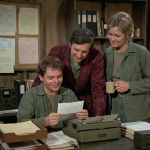
Under the warm, golden glow of a single desk lamp, Corporal Walter “Radar” O’Reilly sat hunched over a terrifying piece of paper.
He wore an earnest, wide-eyed look of deep concentration, chewing nervously on the inside of his cheek.
Usually, Radar could play the Army’s bureaucratic system like a maestro on a grand piano.
But tonight, the Army had sent something back that he couldn’t just stamp and file.
Captain B.J. Hunnicutt wandered into the office, holding an empty tin mug and looking for the last dregs of morning coffee.
He was clad in his lived-in, worn fatigues, his shoulders slumping with the familiar exhaustion of a man who had spent too many hours on his feet in the OR.
Seeing the young corporal looking like a deer caught in the headlights of a jeep, B.J. stopped.
“You look like you’re trying to defuse a bomb, Radar,” B.J. said gently, leaning over the edge of the cluttered desk, his arms relaxed.
Radar looked up, offering a tight, shy, nervous smile that didn’t quite reach his eyes.
“It’s worse, Captain. It’s a ‘Re-evaluation of Dependent Status and Allotment Certification’ form.”
B.J. raised an eyebrow, his weight resting comfortably against the wood. “Sounds serious. Did they find out your teddy bear isn’t an actual tax deduction?”
Radar didn’t laugh. He swallowed hard, his fingers gripping the edges of the beige paper.
“It’s about my Uncle Ed and my mom, sir. The Army sends them a portion of my pay every month. It keeps the farm running while I’m stuck over here.”
B.J.’s dry amusement shifted instantly into thoughtful, quiet concern.
He knew exactly what a few dollars meant to the folks trying to hold down the fort back home.
“They changed the rules, Captain,” Radar continued, his voice trembling slightly.
“If I don’t fill out Section C correctly, they cut off the allotment. But Section C is written in some kind of secret code. I’ve read it four times, and I think I just accidentally enlisted the family cow.”
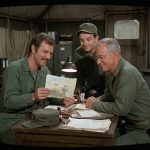
B.J. set his mug down and leaned further over the desk, squinting at the dense, mimeographed text.
He read in silence for a long moment, his eyes scanning the endless paragraphs of military jargon.
The small office was quiet, save for the distant, low hum of a generator outside.
Suddenly, B.J.’s expression tightened.
He traced a line with his finger, his jaw setting as he realized exactly what the bureaucrats in Tokyo had done.
“Radar,” B.J. said quietly, his voice losing all its usual easy warmth. “Did you already sign this bottom section?”
Radar’s face went pale, his shy smile vanishing completely into a mask of pure panic.
“Yes, sir. I always sign them first so I don’t forget. Why? What does it say?”
He pushed his glasses up his nose, his eyes darting frantically between B.J.’s face and the document.
“Did I break the farm, Captain? Are they going to take the check away? My mom can’t run that place by herself, and Uncle Ed’s back is no good since the tractor accident…”
Radar’s words spilled out in a rushed, terrified breath, the heavy weight of his family’s survival suddenly crashing down onto his narrow shoulders.
He was thousands of miles away, trapped in a war zone, completely helpless to pull weeds, fix a broken fence, or carry the harvest.
This small piece of paper was his only way to protect them, and he was convinced he had ruined it.
B.J. held up a hand, steady and calm.
“Whoa, slow down, Walter,” B.J. said, his voice dropping into that quiet, reassuring tone he used when calming a scared patient in post-op.
“Nobody is taking the farm. But the Army, in its infinite wisdom, has slipped a little trapdoor into Paragraph 4.”
B.J. turned the paper around so Radar could read it alongside him.
He pointed to a densely worded sentence buried deep in the fine print.
“See this? By signing here, you’re confirming that your dependents have alternative means of agricultural income exceeding fifty dollars a month.”
Radar gasped, his eyes widening in horror.
“But they don’t! The only thing making money right now is me, and maybe the chickens if they feel like laying!”
B.J. gave a soft, dry chuckle, his eyes warm with understanding.
“I know, Radar. The Army doesn’t know that. They just want to save a few bucks by tricking tired soldiers into checking the wrong box.”
B.J. pulled a pencil from the cluttered cup on Radar’s desk.
“But they made one fatal mistake,” B.J. said, a subtle, rebellious glint appearing in his eye.
“What’s that?” Radar asked, his voice barely a whisper.
“They sent this form to a place full of doctors who spend their entire lives fixing things that are broken.”
B.J. turned the form over, his medical mind shifting gears to tackle the bureaucracy.
“Alright, let’s operate. We’re going to cross out this signature, and I am going to initial it.”
Radar looked nervously at the stacks of Army regulations sitting on his desk.
“Can you do that, Captain? Is that legal?”
B.J. smiled, a warm, genuine expression that reached all the way to his tired eyes.
“Radar, I’m a Captain in the United States Army Medical Corps. If I say your signature was obtained under the medical duress of extreme fatigue, who’s going to argue with me?”
Radar’s shoulders dropped half an inch, the first sign of tension finally leaving his body.
“Now,” B.J. continued, leaning comfortably on his elbows over the tan canvas of the desk, “let’s tackle Section C together. We have to prove your Uncle Ed is a vital dependent.”
For the next twenty minutes, the modest clerk’s office became a quiet sanctuary of teamwork.
B.J. read the impenetrable Army language aloud, translating it piece by piece into plain English.
Whenever the jargon got too thick, B.J. would rephrase it, using his own deep well of homesickness to find the right words.
He thought about his wife Peg, managing their home in Mill Valley, balancing checkbooks and raising a daughter without him.
He knew exactly how terrifying it was to trust your family’s safety to a mail call and a piece of carbon paper.
“Question seven,” B.J. read softly. “Does the dependent require ongoing physical assistance for daily sustenance?”
Radar frowned, thinking hard. “Well, Uncle Ed needs help getting his heavy boots off, and my mom has to carry all the heavy feed sacks.”
“Perfect,” B.J. nodded, his pencil scratching across the paper. “Physical assistance required due to chronic agricultural strain. Check.”
They moved down the list, box by box, line by line.
Every time Radar felt overwhelmed by the sheer size of the military machine, B.J. was there to ground him.
It wasn’t just about filling out a form; it was an act of quiet defiance against a war that tried to strip away their connections to home.
“Alright,” B.J. said finally, tapping the pencil gently against the desk. “Look at Question twelve. ‘Is there any secondary guardian capable of financial support?'”
Radar shook his head emphatically. “No sir. It’s just me.”
B.J. marked a bold, dark ‘X’ in the ‘NO’ box.
“Then that’s it,” B.J. announced, sliding the paper back across the desk. “You are officially their sole means of support, certified and witness-stamped by Captain Hunnicutt.”
Radar picked up the document, holding it as gently as if it were spun glass.
He looked at the neatly checked boxes and the reassuring initials in the margins.
That nervous, shy smile slowly returned to his face, but this time, it was real.
It was a smile of profound relief and deep, unspoken gratitude for a friend who took the time to care.
“Thank you, Captain,” Radar said softly, his voice thick with emotion. “I really didn’t want them to lose the tractor.”
B.J. stood up, his joints popping slightly as he stretched his tired back.
He looked down at the young corporal, seeing the heavy burden of manhood sitting awkwardly on a boy who had grown up too fast in a foreign country.
“They aren’t going to lose anything, Radar,” B.J. said warmly, his voice filled with gentle conviction. “Not on our watch.”
B.J. reached over and gave Radar a reassuring pat on the shoulder, a simple gesture that spoke volumes in the quiet room.
“Now, type that up, get it in the outgoing mail pouch, and try to breathe,” B.J. advised, turning toward the door.
“Yes, sir. Right away, sir,” Radar replied, his hands already moving to roll a fresh carbon sheet into his typewriter.
B.J. paused at the doorway, looking back at the modest, chaotic office.
The golden light of the desk lamp seemed a little warmer now, pushing back the shadows of the olive-drab walls.
“And Radar?” B.J. added with a tired, affectionate grin. “If the Army ever asks, your Uncle Ed’s boots are a medical emergency.”
Radar chuckled, a genuine, boyish sound that cut through the heavy air of the camp.
As B.J. walked back out into the dusty compound, the familiar, steady clack-clack-clack of Radar’s typewriter began to ring out behind him.
It was a small, rhythmic sound, but in the middle of a war, it sounded exactly like a heartbeat.
In a place where everything was broken, sometimes the greatest medicine was just helping someone hold the pieces together.