A Quiet Corner at Rosie’s
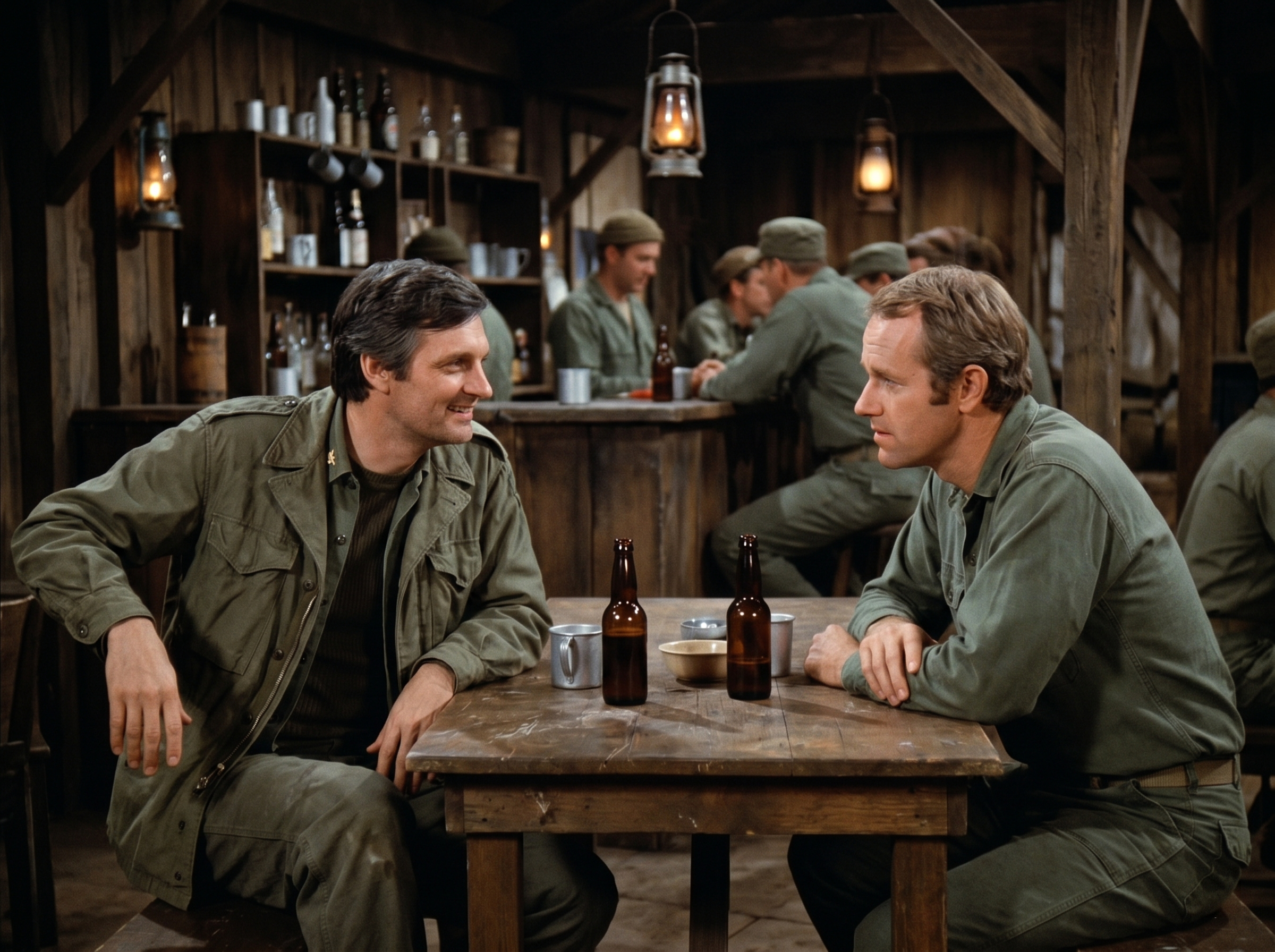
The generator’s mechanical hum was the steady heartbeat of the 4077th, but inside Rosie’s Bar, it was mercifully muffled by the sound of clinking glasses and tired murmurs.
It was a Tuesday. Or maybe a Thursday. The days had a habit of bleeding together into one long, olive-drab smear, especially after a grueling eighteen-hour marathon in the operating room.
Rosie’s wasn’t much to look at. It was a small, rustic haven built of rough pine, smelling faintly of old smoke, damp earth, and whatever questionable ingredients went into the local brew. But to the doctors and nurses of the mobile army surgical hospital, it was the Waldorf Astoria.
Hawkeye Pierce sat casually on a wooden bench, leaning back just enough to let the tension drain from his spine. His heavy, olive-drab field jacket was half-zipped over a dark sweater, practical and deeply lived-in.
Despite the exhaustion carved into the corners of his eyes, Hawkeye was trying. He offered a spontaneous, lopsided smile across the rough-hewn table. It was a warmly teasing expression, the kind of charismatic grin he deployed to soften the room and keep the darkness at bay.
Directly across from him, B.J. Hunnicutt wasn’t quite ready to join the comedy hour.
B.J. sat leaning forward, his elbows resting heavily on the scarred wooden tabletop. He wore his simple green fatigues, the fabric soft from countless trips through the camp laundry.
There was a profound, quiet empathy in B.J.’s posture, but also a deep, unmistakable melancholy. His brow was slightly furrowed, his eyes fixed on some invisible point in the middle distance, thousands of miles away from Korea.
Between them sat the meager spoils of their off-duty hours: two brown bottles of warm beer, two battered metal canteen cups, and a small, empty bowl.
The lighting in the bar was dim and practical, casting a soft, amber glow over the scene. Oil lanterns hung from the wooden rafters, throwing gentle shadows that danced across B.J.’s face, highlighting the quiet homesickness he usually tried so hard to hide.
“I’m telling you, Beej,” Hawkeye said, his voice dropping into that familiar, rhythmic cadence. “If we just pool our resources, we can buy Rhode Island. I hear it’s lovely this time of year, and perfectly sized for two exhausted surgeons who want to outlaw the color green.”
B.J. offered a faint, polite half-smile, but it didn’t reach his eyes. He reached out and wrapped his fingers around the neck of his beer bottle, feeling the condensation gather against his palm.
“Rhode Island’s too crowded, Hawk,” B.J. murmured softly, his voice lacking its usual sturdy warmth.
Hawkeye tilted his head, his own smile fading just a fraction. He recognized that tone. It was the sound of a man standing on the edge of the Pacific Ocean, trying to shout all the way to San Francisco.
“Alright, we’ll take Montana,” Hawkeye pivoted smoothly, leaning slightly closer. “Plenty of elbow room. We’ll raise sheep. I’ve always felt I had a deep, spiritual connection to wool.”
B.J. didn’t answer. He just stared at the battered metal cup in front of him. In the blurred background of the bar, other soldiers sat in their green fatigues, hunched over the counter, lost in their own worlds. But at this table, the silence was growing heavy.
“It’s Erin,” B.J. finally whispered, his voice cracking just slightly in the warm, smoky air.
He looked up, meeting Hawkeye’s gaze. The look in B.J.’s eyes was raw and unguarded, stripped of all defenses.
“Peg sent a letter today,” B.J. continued, his knuckles turning white against the brown glass of the bottle. “Erin learned how to say ‘airplane.’ Every time one flies over the house, she points up and looks for me.”
Hawkeye’s teasing smile vanished entirely, replaced by the heavy, silent weight of a war that stole everything.
The ambient noise of Rosie’s Bar seemed to fade away, leaving only the soft crackle of the lantern above them.
Hawkeye let out a slow, quiet breath, the witty comeback he usually kept chambered dissolving before it could reach his tongue. There was no joke in the world strong enough to fix the pain of a father missing his little girl growing up.
“An airplane,” Hawkeye repeated softly, the word feeling heavy and metallic in the dim room.
B.J. nodded, his gaze dropping back down to the wooden table. He traced a gouge in the pine with his thumb.
“Yeah. She thinks I’m up there. She thinks I’m flying around, just… waiting to come down.” B.J. let out a short, humorless breath. “I’ve been gone so long, Hawk, I’m not a person to her anymore. I’m just a story Peg tells her at bedtime. I’m a concept.”
Hawkeye shifted his weight on the wooden bench. The charismatic army surgeon was gone, leaving only Benjamin Franklin Pierce, a man who loved his friend deeply and hated watching him bleed out emotionally.
“You’re not a concept, Beej,” Hawkeye said firmly, keeping his voice low and steady. “You’re a legend. There’s a difference.”
B.J. looked up, his expression a mixture of profound fatigue and desperate hope.
“Listen to me,” Hawkeye continued, leaning forward until his chest nearly touched the edge of the table. He didn’t offer a manic grin this time. Just a fiercely loyal, grounded look.
“Kids are smart,” Hawkeye said, gesturing vaguely with one hand. “Smarter than generals, anyway. She looks at the sky because she knows you’re somewhere big. She knows you’re out there. And when Peg tells her stories about you, she’s building a mold. A perfect, B.J. Hunnicutt-shaped mold.”
Hawkeye reached out and nudged B.J.’s metal cup a fraction of an inch closer to him.
“And one of these days, this ridiculous, idiotic, senseless war is going to pack up its tents and go to hell where it belongs,” Hawkeye said, his voice carrying the quiet, absolute certainty he usually reserved for diagnosing a patient.
“And when it does,” Hawkeye added softly, his eyes locked onto B.J.’s, “you’re going to walk through that front door in Mill Valley. And you’re going to fit right into that mold perfectly. Like you never left.”
B.J. stared at Hawkeye for a long moment. The lantern light caught the faint sheen of moisture in his eyes, but the tightness in his jaw began to relax.
The oppressive weight of the thousands of miles separating him from California didn’t disappear—it never did—but it shifted, becoming just a little easier to carry. That was the magic of the 4077th. They couldn’t cure the disease of the war, but they could treat the symptoms of the heartbreak.
B.J. let out a long, shuddering sigh and leaned back from his hunched position over the table.
“A legend, huh?” B.J. muttered, a tiny, genuine spark returning to his voice.
“Absolutely,” Hawkeye said, sitting back in his field jacket and allowing a small, familiar smirk to return to his lips. “Paul Bunyan. Johnny Appleseed. B.J. Hunnicutt. Although I think Johnny had a better mustache.”
B.J. actually chuckled. It was a small sound, barely audible over the hum of the distant generator, but to Hawkeye, it was louder than artillery fire.
“My mustache,” B.J. said, reaching up to touch his upper lip with a hint of mock offense, “is a symbol of dignity in a chaotic world, Pierce.”
“It looks like a caterpillar died of exhaustion on your face,” Hawkeye replied smoothly, picking up his metal cup. “But I’ve grown accustomed to it. It gives you that distinguished ‘tired lumberjack’ look.”
The heavy, suffocating tension that had gripped their small table finally broke. The air in Rosie’s suddenly felt a little warmer, a little more breathable.
They were still in Korea. They were still miles from home, wearing muddy boots and clothes that smelled like canvas and antiseptic. Tomorrow, the choppers would likely come again, bringing more wounded, more chaos, and more blood.
But for tonight, in this quiet, amber-lit corner of a rough wooden bar, they had each other.
B.J. reached for his own canteen cup. He lifted it slowly, the metal catching the lantern light. He looked at Hawkeye, the deep homesickness in his eyes now tempered by a profound, brotherly gratitude.
“To airplanes,” B.J. said quietly.
Hawkeye lifted his cup to meet B.J.’s, the two tin vessels clinking together with a dull, hollow sound that somehow felt like music.
“To airplanes,” Hawkeye agreed gently. “And to the guys who eventually come down from them.”
They both took a long, slow drink of the warm beer. It tasted awful, but in that moment, it was exactly what they needed. They sat together in the comforting silence, two exhausted men holding back the dark, finding their home in the quiet spaces between the jokes.
In the end, the only real medicine they had against the cold was the simple warmth of sitting across the table from a friend.