The Art of the Excuse
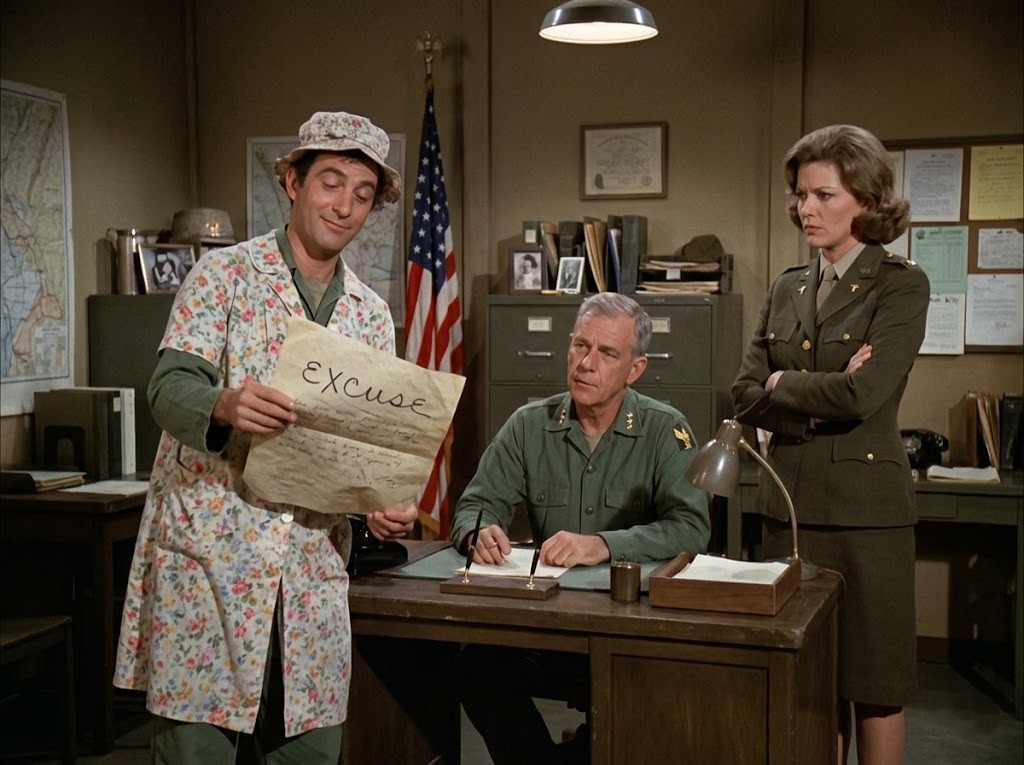
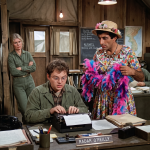
The afternoon sun was doing its best to bake the mud of the 4077th into a fine, choking powder, and inside the Colonel’s office, the air felt just as thick. Klinger stood in the center of the room, looking like a garden party casualty in a floral-print housedress and a matching floppy hat, his expression one of profound, calculated innocence.
In his hands, he clutched a crinkled, stained piece of paper as if it were a declaration of independence. Colonel Potter sat behind his desk, his hands clasped over some paperwork, his brow furrowed in that familiar “I’m too old for this” squint. Major Houlihan stood to the side, arms crossed tightly over her chest, her jaw set with a mixture of practiced irritation and the underlying exhaustion that everyone in Korea seemed to wear like a second uniform.
“Sir,” Klinger began, his voice taking on that specific, high-pitched tremor he reserved for his more creative appeals for a Section 8. “I don’t mean to burden you, truly. But this… this is a medical necessity. A matter of the spirit, if you will.”
He held up the paper. Across it, written in sprawling, shaky letters, was the word “EXCUSE.”
Potter sighed, a sound that seemed to come from the very bottom of his boots. He took off his glasses and rubbed the bridge of his nose. “Klinger, if this is another note from a cousin in Toledo who claims you’re allergic to the concept of khaki, I’m going to have you scrubbing the latrines with a toothbrush.”
“Not a cousin, Colonel,” Klinger insisted, waving the paper gently. “A vision. I’ve been told that my current wardrobe is stifling my creative potential, and that only a trip to the nearest stateside tailor—via a discharge—will cure it.”
Margaret stepped forward, her eyes narrowing. “Colonel, if you indulge him for one more second, I am going to personally see to it that he spends the next month sorting bandages in the O.R. tent.”
Klinger didn’t flinch. He just held the paper closer to Potter, his eyes wide and pleading. He looked at the Colonel, then at Margaret, and finally at the desk, his bravado slipping for just a fraction of a second to reveal the genuine, tired human being underneath the floral print.
Potter reached out, his fingers hovering over the paper, his patience hanging by a thread that was about to snap.
Potter grabbed the paper. He didn’t read it immediately. Instead, he looked up at Klinger, and for a fleeting moment, the frustration in the Colonel’s eyes softened into something more complex—something like pity, or perhaps just the weary understanding of one man watching another try to survive an impossible situation in the only way he knew how.
“Klinger,” Potter said, his voice dropping an octave, losing its sharp edge. “You’ve worn dresses, you’ve worn bridal gowns, you’ve sat on a flagpole, and you’ve eaten a Jeep. Do you really think a piece of paper with ‘Excuse’ written in crayon is going to be the thing that gets you a ticket home?”
Klinger looked down at his feet, his shoulders slumping just a bit. The theatricality drained out of his posture, and for a second, he was just a kid from Toledo, thousands of miles away from everything he loved, terrified that he was losing his mind in a place that didn’t make any sense.
“It’s not about the paper, sir,” Klinger murmured, his voice finally dropping the charade. “It’s about… it’s about just needing someone to acknowledge that I’m still here. That I’m still me.”
Margaret, who had been ready to launch into a full-scale tactical lecture, let her arms drop to her sides. She looked at Klinger, then glanced at the Colonel, her expression shifting from annoyance to a quiet, uncomfortable empathy. She knew that look. She saw it in the mirror every time she caught her reflection after a twelve-hour shift in surgery.
Potter leaned back in his chair, tapping the paper against the desk. The silence in the office was heavy, filled with the hum of a distant helicopter and the soft clacking of a typewriter somewhere down the line. It was the sound of the 4077th—a place where people were pushed to their breaking points every single day, and somehow, by some miracle, held themselves together with humor, stubbornness, and a strange, jagged kind of love.
“Tell you what,” Potter said, finally breaking the silence. He didn’t smile, but he didn’t bark, either. “I can’t give you a discharge, Klinger. You know that. But… if you put away that floral eyesore and get back to the motor pool, I might be able to ‘lose’ your name from the KP roster for tonight. Just for tonight.”
Klinger blinked, genuinely surprised. A small, tentative smile tugged at the corner of his mouth. “You’d do that, sir?”
“Don’t make me regret it,” Potter grunted, already turning his attention back to his stack of papers. “And for heaven’s sake, stop writing ‘Excuse’ on everything. You’re giving me a headache.”
Margaret let out a short, sharp sigh, but the fire had gone out of her glare. She turned to leave, pausing only for a second to adjust Klinger’s hat—a small, almost imperceptible gesture of grace. “Don’t push your luck, Klinger,” she said, her voice softer than she probably intended.
Klinger nodded, clutching the paper to his chest like a trophy. He turned and walked toward the door, the floral dress swishing softly against his legs. As he stepped out into the blinding Korean sun, he didn’t look like a man trying to play a joke; he looked like a man who had just been granted a brief, beautiful reprieve from the weight of the world.
Potter watched him go, then looked over at Margaret. They didn’t need to say anything. They were all just people, doing their best to stay human in a place that tried its hardest to convince them otherwise.
The war was still outside the door, but in the quiet of the office, for a few minutes at least, there was only the sound of a team looking out for their own.
Sometimes, all you really need is to be seen.