The Weight of a Few Well-Chosen Words
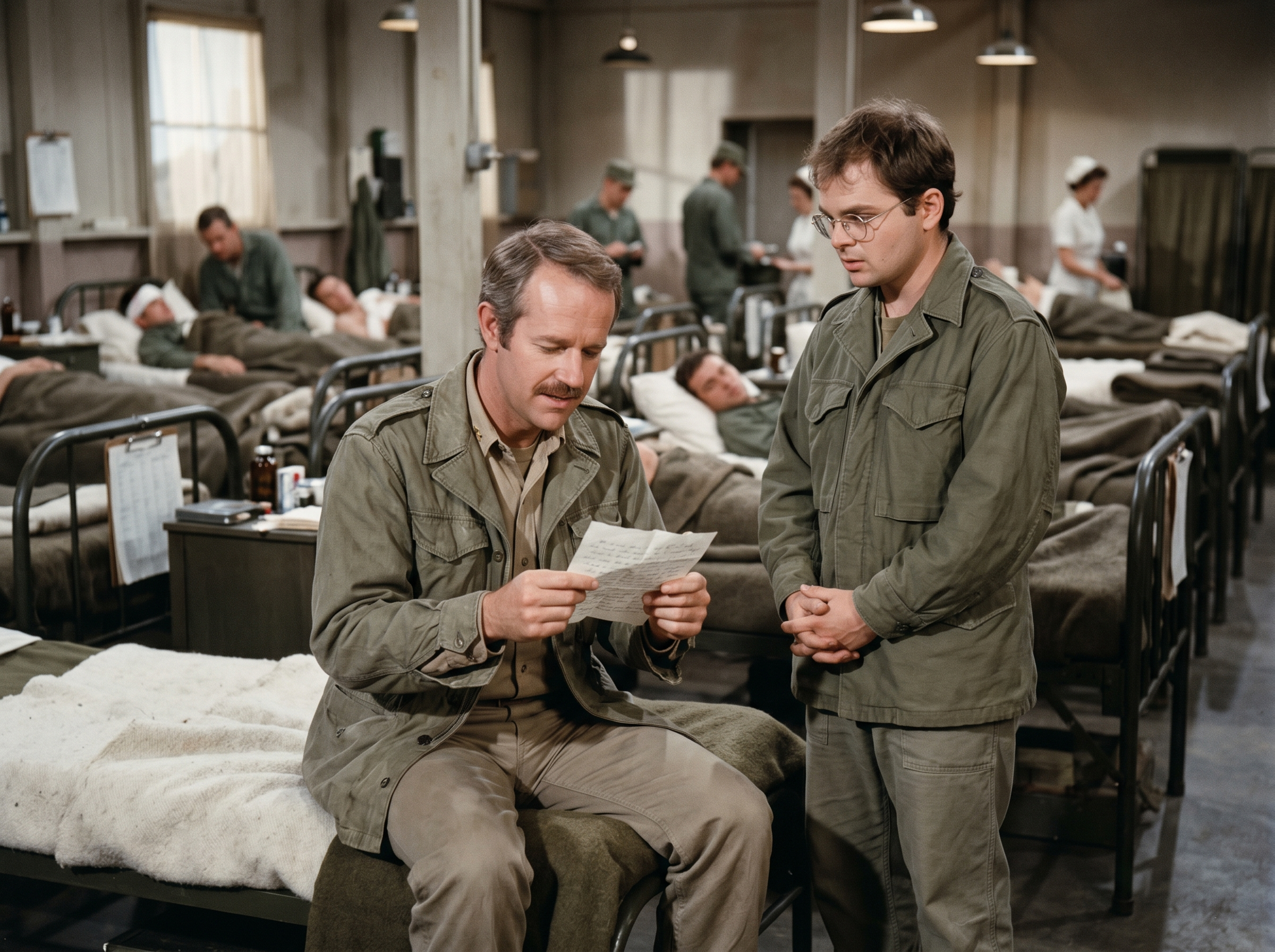
The air in the post-op ward always hung heavy, a thick mixture of antiseptic, stale coffee, and the quiet, rhythmic breathing of men who had seen too much. It was three in the morning, that strange, liminal hour where the war seemed to pause, held in suspense by the sheer exhaustion of everyone involved.
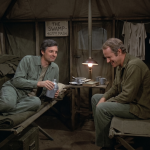
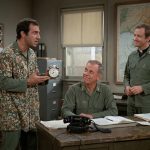
Captain Benjamin Franklin “Hawkeye” Pierce sat on the edge of a cot, his shoulders slumped under the weight of a day that had lasted forty-eight hours. Across from him stood Corporal Radar O’Reilly, looking as young and anxious as the day he’d first arrived, his hands clasped nervously in front of him.
In Hawkeye’s hands was a single, slightly crumpled piece of stationary—a letter Radar had spent the better part of the night trying to compose. It wasn’t an official report or a supply requisition; it was something far more fragile.
Hawkeye looked down at the paper, his usual sharp wit nowhere to be found, replaced by a quiet, searching expression. He read a sentence, then paused, his eyes tracing the ink as if looking for a hidden meaning between the lines.
“You really want to tell them this, Radar?” Hawkeye asked, his voice barely rising above the hum of the overhead lights.
Radar shifted his weight, his spectacles catching the dim glow of the ward lamps. “I just… I don’t know, Hawk. Is it too much? Do you think they’ll understand, or will it just make them worry even more?”
Hawkeye looked up, and for a fleeting second, the exhaustion in his eyes vanished, replaced by a raw, unfiltered vulnerability that he rarely let anyone see. He leaned in closer, the letter held steady in his hands, sensing that the answer he was about to give would change something fundamental between them.
He took a slow breath, looked at the final paragraph, and his jaw tightened.
“It’s not too much, Radar,” Hawkeye said, his voice softer now, stripped of its usual defensive sarcasm. “In fact, it might be the most honest thing anyone has written in this entire camp since we got here.”
He handed the letter back to the young corporal. Radar took it carefully, almost as if it were made of glass. The two of them sat in the center of the bustling, sleeping ward, an island of quiet conversation amidst the backdrop of recovering soldiers and the distant, muffled sounds of the 4077th winding down for the night.
“I just wanted them to know that I’m okay,” Radar whispered, looking down at his boots. “But I also wanted them to know that ‘okay’ here is… well, it’s a different language, isn’t it?”
Hawkeye nodded, reaching out to give Radar’s shoulder a firm, reassuring squeeze. “That’s the beauty of it, kid. You’re telling them the truth without breaking their hearts. That’s a delicate needle to thread, but you did it.”
Radar looked up, a small, tentative smile breaking across his face, his usual nervousness giving way to a quiet sense of relief. It was a small moment—a letter, a look, a shared understanding in the middle of a war that felt like it would never end—but it was everything.
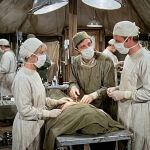
Across the room, the ward was settling into a deeper silence. A nurse adjusted a blanket on a nearby cot, and the soft clink of instruments against a tray sounded like a lullaby in the dark. In the grand scheme of the conflict, their conversation didn’t change the outcome or stop the clock, but for those few minutes, it made the world feel just a little bit smaller, and a little bit kinder.
They didn’t need grand speeches or heroic gestures to bridge the gap between their reality and the lives they had left behind. They just needed the validation of a friend who knew exactly how hard it was to keep one’s footing in the mud of Korea.
As Radar tucked the letter into his pocket, he looked at Hawkeye with a newfound confidence. “Thanks, Hawk. I guess I just needed to make sure it sounded like me.”
“It sounds exactly like you, Radar,” Hawkeye replied, standing up and stretching his aching back. “And that’s why it’s going to mean the world to them.”
They turned away then, heading back toward their respective corners of the camp, leaving the ward to its uneasy, temporary peace. The war was still out there, waiting for them at sunrise, but for this brief, quiet interlude, they had managed to hold onto a piece of themselves that the chaos couldn’t touch.
It was just another night in the 4077th, where the most profound battles were often the ones fought with ink, paper, and the stubborn insistence on remaining human.
Some stories aren’t written for the history books, but for the people who need to know we’re still here.