Where the Dust Settles: A Moment Behind the Lines at the 4077th
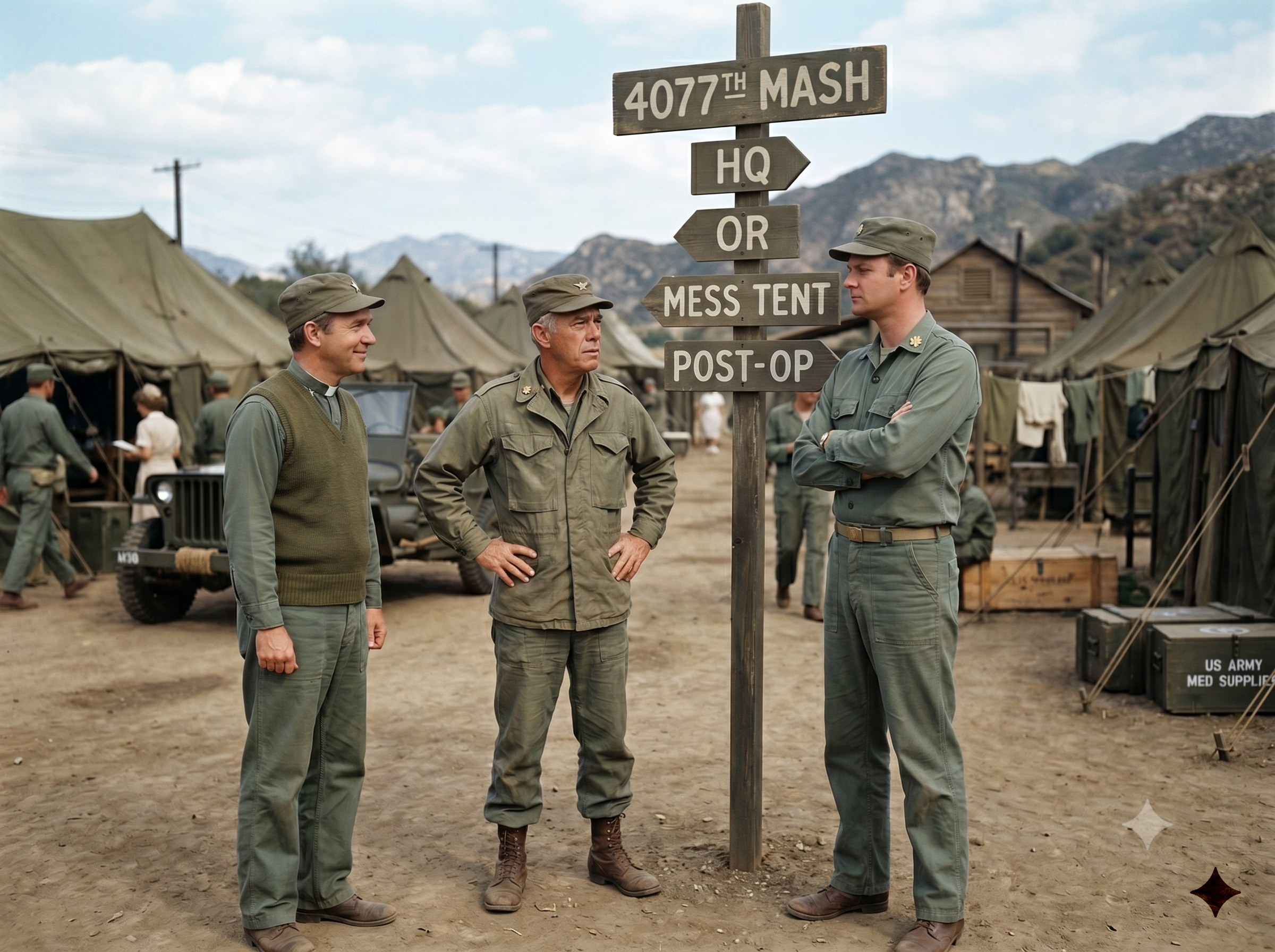
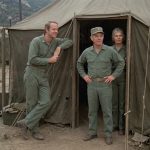
They say the dust of Korea never really settles. It just waits for you to stop moving so it can introduce itself. On an afternoon like this, when the operating room was finally quiet and the sky was a deep, deceptive blue, the dust was the only visitor we had. It clung to the olive drab canvas of the tents, it layered itself on the supply crates that arrived labeled “US ARMY MED SUPPLIES,” and it coated the three figures standing near the heart of the compound.
It was a strange, silent pause between duties. The morning had been brutal, a rush of casualties that had pushed everyone to the brink. Now, the camp was taking a breath, that fragile inhalation that always felt like it could shatter at any moment. And here they were, the father figure, the gentle shepherd, and the weary aristocrat, standing together around the iconic signpost.
Colonel Potter stood with his hands firmly on his hips, a pose that was half “I’ve seen everything” and half “I’m just waiting for the other shoe to drop.” He wore his fatigue jacket and cap, his eyes crinkling as he looked across the compound, observing the movement of weary soldiers.
On his right, Major Winchester was, as always, a study in controlled posture. His arms were crossed over his chest, his expression one of polite disdain for the lack of symmetry in the camp’s organization. Winchester’s gaze was fixed somewhere beyond the signpost, as if imagining a more refined, logical, and decidedly non-combat hospital.
Slightly to the left stood Father Mulcahy, the only light in the group. He wore his woolen vest over his clerical collar, a garment that had seen more laundry cycles than perhaps any other item in the compound. He was smiling gently, his hands clasped loosely, looking toward the other two men with that quiet warmth that always seemed to defuse the worst arguments before they began.
They were near the wooden signpost, the simple, weathered pointer that listed our coordinates, real or imagined. “4077TH MASH” at the top, followed by arrows for “HQ,” “OR,” “MESS TENT,” and “POST-OP.” The arrows pointed in definite directions, which was funny, considering how lost everyone here often felt.
Winchester was the first to speak, breaking the heavy silence that had settled. “Colonel, if I might, the ‘Mess Tent’ arrow appears to be a full five degrees off-center from its actual location.” He adjusted his crossed arms with a sniff of impatience.
Potter didn’t even turn his head. He just exhaled, a long, weary sound that contained more wisdom than entire textbooks. “Major, the day that arrow becomes the primary concern for any man in this camp is the day we can all go home. In the meantime, I trust the men can find the food, such as it is.“
Mulcahy smiled at the dry humor, looking from Potter to Winchester. He was used to managing Winchester’s delicate sensibilities.
The tension, however, wasn’t about the sign. It was about the exhaustion beneath the dust on their jackets. Winchester had spent the morning working with B.J. in Surgery, and B.J. had been quiet, unusually quiet. Winchester knew why. It was the anniversary of the day B.J. had left his daughter, Erin.
When Winchester had tried to make a typically cutting remark to distract B.J., Potter had seen it, and he had simply put a hand on B.J.’s shoulder in the scrub room. That small act of paternal understanding had done more than all of Winchester’s wit. And Winchester, though he would never admit it, had felt a sting of… what? Rejection? Misunderstanding?
Now, standing by the signpost, Winchester felt the isolation, the feeling of being the clever, refined, yet utterly lonely observer. He let the remark about the sign hang, a trivial defense against the larger, heavier things pressing down on him.
“This entire place,” Winchester began, his voice a low, resentful drawl, “is a monument to improvisation. We are fixing people with supplies that were obsolete twenty years ago, living in tents, and pointing our way to salvation with sticks.” He looked from Potter to Mulcahy, his eyes suddenly revealing a deep, weary frustration that had nothing to do with the signpost’s alignment.
The quiet, gentle noise of the camp—a truck rumbling, someone calling for a nurse—seemed to fade. Potter stopped looking across the compound and turned his eyes fully onto Winchester. The tension hung in the air, thick as the dust that coated their caps. This was more than a complaint; it was a cracking mask.
Potter did not snap. He did not issue an order. He simply continued to look at Winchester, his weary wisdom anchoring the moment. He let the major’s words settle, let them be part of the dusty landscape.
Potter’s gaze shifted, looking down at his own sturdy, dusty boots before looking back up at Winchester, and then, slowly, toward the signpost itself. He was not looking at the arrows, but at the idea of them.
“Salvation,” Potter said, his voice quiet, almost reflective. “Major, you may be right about the improvising. But you must remember, those arrows don’t just point to places. They point to the only thing that keeps us sane in this whole damn mess.”
He looked at Mulcahy, and the good Father, sensing the shift, moved a step closer to the Colonel.
“HQ isn’t just where I argue with generals,” Potter continued, gesturing with his hand on his hip. “It’s where we try to find a little sanity in the chaos. The Mess Tent… that’s where we remember what a meal tasted like, even if it’s cooked by Igor. The OR… well, we both know what that is. It’s the closest thing to a temple we have.”
Mulcahy looked at the ‘Post-Op’ arrow. He had spent the previous night in Post-Op, just sitting with a young soldier from Iowa who was scared he wouldn’t get to see his brother again. He’d told the boy stories of his own family, of his sister, the nun. He hadn’t talked about God. He’d just talked about home.
Winchester, still holding his posture, felt the defensive wall begin to buckle. He knew what the OR was. He knew that for all his complaints about the conditions, the surgical work was the most precise and essential he had ever done. It was the only part of this war that made sense to him.
“And Post-Op,” Mulcahy’s gentle voice added, taking the baton. “Major, just this morning, that arrow pointed toward hope. A young man, barely eighteen, saw his first sunrise after we thought we’d lost him. That little wooden arrow was the only map he needed.”
Winchester looked at Mulcahy. The gentleness of the chaplain always made him feel slightly… excessive. And yet, he saw the deep conviction in Mulcahy’s tired eyes. Winchester dropped his gaze.
The silence that followed was different from the tense one before. This one was full of recognition. They were three distinct men—the seasoned soldier, the holy man, the sophisticated surgeon—united by a circumstance they all hated and yet by a purpose they all served.
Just then, the compound sprang to life. A medical jeep, similar to the one parked near them, pulled in, carrying supplies. A nurse called out for assistance. A small figure—perhaps Radar—scurried toward the Colonel, holding papers and looking nervous, although he was still many yards away.
Potter straightened up, the moment of reflection ending. He was back in command. He looked from Mulcahy back to Winchester.
“I suspect you have work to do, Major,” Potter said, his voice dry but not unkind. “And I need to see what other bureaucratic hoops I need to jump through before dinner.” He tapped the ‘HQ’ sign with his hand on his hip, the action itself a dry acknowledgment of the triviality of Winchester’s previous complaint.
Mulcahy smiled and adjusted his cap. “I suppose the Mess Tent arrow will do for now,” he said, looking at Winchester, whose mouth twitched into a very, very slight, dry smile, almost imperceptible. He wasn’t giving an inch, but he wasn’t resisting, either.
“As you wish, Colonel,” Winchester replied, his arms relaxing slightly. He nodded, first to Potter, then to Mulcahy, a flicker of acknowledgement, perhaps even a brief moment of respect, crossing his face before his habitual expression of controlled distaste returned.
He turned to leave, walking with that measured, almost theatrical grace that was so distinctly Charles Emerson Winchester III. He had duties in Post-Op. He needed to check on a young man from Iowa.
Potter and Mulcahy watched him go, then turned to each other. The tension was gone, resolved into that warm, complicated, bittersweet affection that was the hallmark of the 4077th MASH.
“The dust never really settles,” Mulcahy repeated, looking at the distant mountains.
“No, Father,” Potter agreed, his voice steady. “But sometimes, it just lets you see the arrows a little more clearly.”
They turned, one toward HQ, the other toward Post-Op, as the sounds of the camp resumed their steady rhythm, the iconic signpost standing witness to the human spirit enduring in the middle of nowhere.
The arrows pointed in four different directions, but on that dusty afternoon, they all led back to the heart of the 4077th, where found-family was the only compass that truly worked.