A Letter for Post-Op
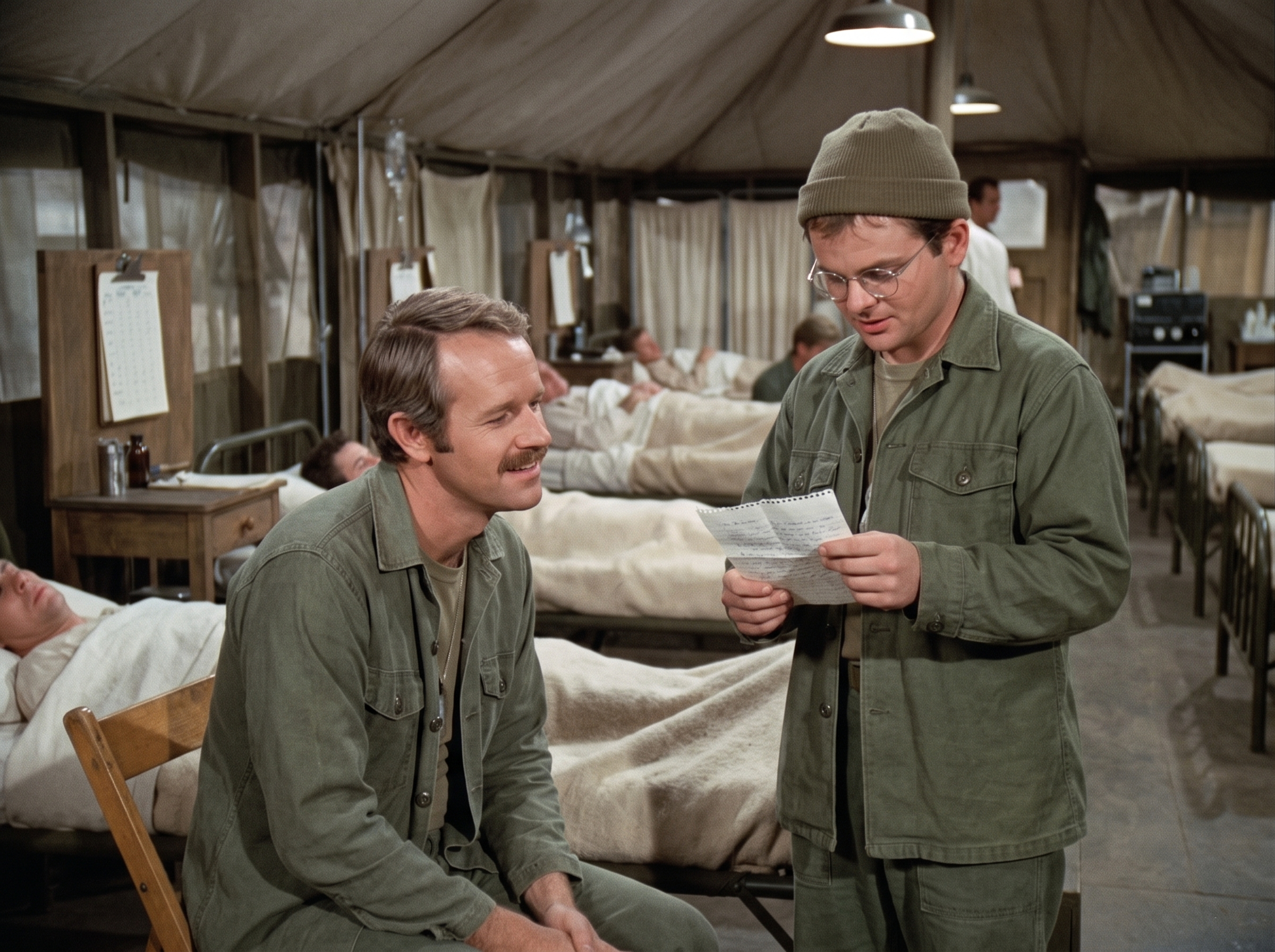
The Post-Op tent at the 4077th never truly slept, but around two in the morning, it was as quiet as a battlefield could get. The low buzz of the overhead lights provided the only steady sound, cutting weak, yellow circles against the oppressive olive drab canvas. Inside that dim quiet, the air was heavy with the scents of sweat, stale coffee, and the unique, sharp tang of antiseptic that defined their world.
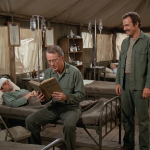
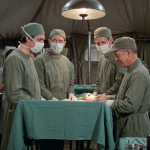
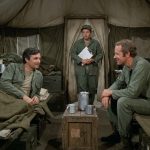
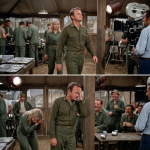
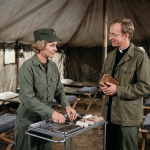
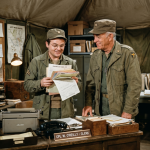
It was in this specific hush that two of the camp’s stalwarts were found, just as you can see them in `image_0.png`. Captain B.J. Hunnicutt, his prominent mustache matching his patient, slightly weary gaze, was seated on a rickety wooden folding chair. He had claimed the spot next to a soldier who had spent the last eight hours fighting the long war on a different front, finally sleeping the deep sleep of exhaustion.
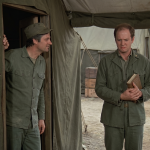
Standing right before him, appearing smaller than usual under the weight of his task, was Corporal Walter “Radar” O’Reilly. He wore his trademark watch cap, pulled low over his ears, and the round frames of his glasses reflected the dim light. Radar wasn’t sorting mail or waking the Colonel. He was holding a small, crumpled piece of lined paper, and his full attention was locked on reading its handwritten contents.
“It’s not just any letter,” B.J. had told a passing orderly who glanced in earlier. “Radar found it. It slipped out of someone’s locker near an empty bunk. He figured it must belong to one of these guys, so he decided to read it to them.” Radar took this unofficial duty with immense seriousness.
To B.J., watching Radar read was like watching a small act of mercy. Radar didn’t have much connection to the soldier in the bed, but he understood the value of words from home. B.J. sat there, listening, a soft smile playing under his mustache. He needed to hear it too, perhaps just as much as the sleeping soldier.
Radar read slowly, his voice a quiet, earnest monotone that carried perfectly in the still air. He read about mundane things: how the corn was doing in Iowa, how the neighbor’s dog had had puppies, how the mother writing the letter was worried about the draft and missed her boy. Each simple detail was like a warm wind from a far-off place, blowing through the cold reality of the tent.
He read and read, the small details filling the space. B.J. found himself drifting, imagining a world where corn and puppies were the biggest concerns. Radar was getting near the end of the letter. He took a breath, his fingers tightening on the small paper.
But as he started the next sentence, his voice wavered. It was slight, just a hitch, but B.J. noticed it instantly. He looked at Radar, the smile fading into genuine concern. Radar paused, swallowing hard. The words were there on the paper, but he couldn’t form them.
“We just want you to know how proud we are…” Radar began, but his voice cracked, thick with an emotion he couldn’t contain. Tears started to pool behind his round spectacles. He stopped completely, unable to make the next sound. He looked up at B.J., searching for an anchor, his expression in image_0.png just beginning to twist with heartache. He was silent, the silence in the tent suddenly absolute, pressing in on both of them with unbearable weight. B.J. didn’t move from his chair. He didn’t speak. He just sat there under the low light, watching his young friend collapse in the face of simple, powerful love.
The silence in the Post-Op tent stretched, thicker than the canvas walls surrounding them. For what felt like an hour, but was only a single, heavy minute, B.J. said nothing. He didn’t offer a platitude. He didn’t try to crack a joke to dissolve the tension. He simply watched the young corporal from Iowa.
Radar’s glasses were beginning to fog with the heat of his tears. He held the letter with both hands, but his gaze was locked onto B.J.’s, begging for permission, for understanding, for someone else to carry the load of this mundane love.
B.J. finally broke the quiet, his voice low, steady, and full of a fatherly tenderness. “Go on, Radar,” he said softly, nodding encouragement. “Read it. We’re all listening.”
Radar’s eyes darted toward the sleeping soldier, then back to B.J. He took a shallow breath, composed himself by staring intently at the page, and forced his voice through the emotional block. He read the next lines quickly, as if afraid he wouldn’t make it if he lingered.
“‘…proud we are of you. Every day. We have your picture on the mantle, and we talk to you. The fourth of July picnic is coming up next month, and the whole town is going. The Mayor’s even making a speech. But it won’t be the same without you. We just pray you get to come home to it.’”
Radar stopped, his eyes glistening. B.J. let a soft, slightly painful sigh escape his lips. He understood. It was the simple detail that hurt the most. The fourth of July picnic. In this godforsaken swamp, where time was measured in surgeries and casualties, a picnic felt like a rumor from a past life.
“They want him to come home for a picnic,” Radar whispered, his voice still thick. “Just a picnic.”
B.J. nodded slowly, his smile from the start of the scene returning, now touched with a profound, quiet wisdom. He could make a joke about the food at the picnic vs. the mess tent, but he wouldn’t. This was the heart of what they were all doing here.
“That’s exactly what we’re trying to do, son,” B.J. said, his voice deep and comforting. He sat forward slightly on the rickety chair. “We spend all day fighting to keep them alive so they can get back to things like fourth of July picnics. Things that really matter.”
He looked at the sleeping soldier, whose chest was rising and falling in a peaceful rhythm, unaware that his parents’ love was a comforting ghost in the tent. B.J. understood the power of those generic, handwritten sentiments. In a place where identity was stripped down to a serial number on a tag, those mundane words re-humanized every soul they touched.
“I have letters like that from Peg,” B.J. said, his voice a quiet confession, the dry humor momentarily replaced by profound sincerity. “I read them all the time. But I guess you don’t really know that feeling yourself, yet.” He meant no malice; he simply realized the different stages of life they were in.
Radar adjusted his glasses, composed now, his innocence still intact but layered with the maturity that a war zones force upon a young soul. He nodded slowly. “I get letters from my mother,” he said. “And from my aunt. But… it’s different.”
“Maybe,” B.J. conceded, leaning back on the hard wooden slats. “But the feeling behind them isn’t. Not when they are from family. And you, Radar O’Reilly, have become family for all of us here.”
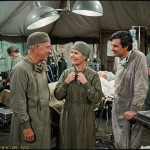
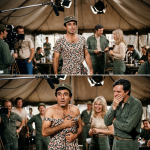
He watched the background, where the blurred figure from `image_0.png`—whom B.J. now recognized as Klinger, who had silently entered carrying a fresh IV bag—had stopped. Klinger’s flamboyant scarf looked absurd against the olive drab, but his head was lowered. He had listened to the entire conversation, and he too understood. The theatricality was for the day; this quiet sentiment was for the long, dark night.
B.J. put a hand on Radar’s forearm. “You did a good thing tonight, Radar. For him. And for me. This isn’t just about medicine, and it isn’t just about the mail. It’s about remembering.”
Radar nodded, the smallest smile touching his lips beneath the beanie. He carefully refolded the small letter into its perfect squares. “I’ll put it back where I found it,” he said, already reverting to his duties. “So he finds it himself in the morning.”
“Good plan,” B.J. agreed. He sat back, his gaze returning to the sleeping soldier.
Radar walked silently towards the empty bunks, his footsteps light on the wooden slats. The Post-Op tent returned to its original quiet, the only sound the steady, comforting breath of the recovering men. B.J. remained on the hard chair, watching over the soldier who would one day make it home to a simple picnic. He felt the weight of his own letters from California pressing against his chest, and for a small, warm moment, the war felt just a little bit farther away.
In this tent, under the dim lights of memory, we found family, we shared hope, and we remembered that even the simplest letter was a promise that someday, the picnics would start again.