Midnight in Post-Op: The Quiet Watch
The generator’s low, steady thrum was the heartbeat of the 4077th.
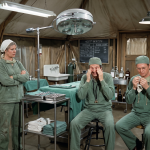
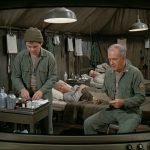
Here in the Post-Op ward, long after the chaotic, roaring screams of the incoming choppers had faded and the blinding lights of the surgical tent had finally been switched off, the entire war seemed to shrink down to the size of a single canvas room. It was a quiet, shadowy place, filled only with the soft, ragged breathing of young men who had somehow survived another terrible day. The air inside the tent always smelled heavily of sharp iodine, damp wool blankets, and the metallic tang of fear. But at three o’clock in the morning, under the pale glow of the hanging lanterns, it also carried a strange, heavy, and fragile peace.
Major Margaret Houlihan walked the narrow, wooden aisle between the long rows of cots. Her white nurse’s cap was pinned perfectly in place, defiant and crisp, but her green fatigue shirt was deeply rumpled from a grueling, relentless eighteen-hour shift. She held a scarred wooden clipboard against her chest like a protective shield. Every few feet, she stopped her silent pacing. She would adjust a slipping blanket, expertly check the steady drip of an IV bottle, or gently rest the back of her cool, steady hand against a soldier’s feverish forehead.
She paused beside the cot of a newly arrived private. He couldn’t have been more than nineteen years old, his face incredibly pale and slack in the dim, yellow light of the ward. He was resting quietly now, his dark hair messy against the white pillow, the pale green army blanket pulled securely up to his chest. Margaret clicked her pen and began to write her mandatory nursing notes, her handwriting as sharp, upright, and precise as her military posture.
“Vitals holding steady,” a quiet, familiar voice murmured from the shadows.
Captain B.J. Hunnicutt stepped up to the foot of the bed, his footsteps completely silent on the creaking wooden floorboards. He wore his usual worn, faded green fatigue shirt unbuttoned over a standard olive drab undershirt, his silver dog tags resting flat against his chest. His hands were shoved deeply into his pockets, and his shoulders slumped heavily with the familiar, bone-deep exhaustion they all carried.
Margaret didn’t jump or startle. She had already sensed him standing there.
“His temperature is down a full degree,” she replied softly, keeping her eyes firmly fixed on the clipboard. “And his breathing is much less shallow than it was in recovery.”
“He’s a tough kid,” B.J. said, stepping slightly closer to her side. He looked down at the sleeping boy with a fatherly, protective tenderness that always seemed to radiate naturally from the big Californian. “He fought us the whole way under the ether in pre-op, but he didn’t give up.”
Margaret nodded slightly and kept her eyes on the paper. She tried to write the next standard line: Patient resting comfortably.
But the dark ink wouldn’t flow. Or rather, her trembling hand simply refused to move across the page. She found herself staring blankly at the typed name on the medical chart. Private First Class Thomas Miller. Peoria, Illinois. Suddenly, the absolute, terrifying fragility of the sleeping boy, the heartbreaking youth of him, seemed to rise up from the beige paper and grab her tightly by the throat.
She tightened her grip on the silver pen until her knuckles turned a stark white. She took a slow, highly controlled, trembling breath, fighting a sudden, unexpected wave of overwhelming sadness that threatened to drown her. The rigid professional armor she wore so proudly—the crisp military discipline, the brass rank, the required emotional distance—was visibly fracturing under the crushing weight of a hundred sleepless nights.
She couldn’t let the tears fall here. She was the Head Nurse. She had to hold the line for her nurses, for the surgeons, and for the boys.
Beside her, B.J. noticed the sudden, frozen stillness. He saw the tense, rigid slope of her shoulders, and he heard the subtle, sharp intake of her breath as her composure briefly cracked.
B.J. didn’t say a single word at first. He didn’t make a quick, deflecting joke to break the heavy tension, and he certainly didn’t walk away to give her isolated privacy.
Instead, he simply moved a half-step closer, standing just slightly behind her right shoulder. He didn’t crowd her space, but he made absolutely sure she knew he was there, offering a solid, steady, and anchoring presence in the drafty, lonely tent. He looked down quietly at the clipboard shaking slightly in her hands, and then he looked up at her face. A soft, deeply empathetic smile touched the corners of his mustache.
It wasn’t a smile of pity; it was a smile of complete, profound, and shared understanding.
“Peoria,” B.J. whispered gently into the quiet space between them, reading the boy’s hometown on the chart. “My Uncle Roy used to live right near Peoria. It’s really good farm country out there. Lots of wide open sky, good soil.”
Margaret blinked rapidly, her moist eyes remaining stubbornly fixed on the paper.
“He… he had a small photograph of a golden retriever tucked in his wallet when they brought him in from the chopper pad,” she managed to say. Her voice was tight, strung like a wire, but remarkably steady. “It was completely covered in mud.”
“I saw that in the O.R.,” B.J. nodded softly, his tone effortlessly conversational and warm. “Hawk actually cleaned it off with a damp sponge before we sent his personal effects over to the clerk’s desk. Good looking dog. Looked like a real loyal, friendly mutt.”
The gentle, grounding normalcy of B.J.’s voice acted like a soothing medical balm. He wasn’t addressing her near-tears or calling attention to her momentary weakness. Instead, he was simply acknowledging the beautiful humanity of the broken boy in the bed. He was willingly sharing the massive emotional load, taking half the crushing weight of the midnight moment directly onto his own tired shoulders.
Margaret felt the tight, suffocating knot in her chest begin to slowly loosen. She allowed herself a small, almost imperceptible sigh. The rigid, military tension in her spine relaxed just a fraction, returning her to a calm posture. She tilted her head slightly, her iron composure returning, but it was much softer now, beautifully stripped of its usual defensive bravado.
“He asked me if the dog would remember him if he was gone a very long time,” Margaret said quietly, finally looking up from the wooden clipboard.
B.J. kept his warm, kind eyes on the sleeping soldier. “And what did you tell him, Major?”
“I told him that dogs never, ever forget the people who truly love them,” Margaret replied, her voice dropping to a tender, honest whisper. “And I promised him that he’d be throwing a baseball for that dog in his own backyard before the winter snow flies.”
“That’s a highly accurate medical opinion,” B.J. smiled softly, the warmth crinkling the corners of his eyes. “I fully concur with the Head Nurse.”
Margaret finally turned her head slightly to look directly at B.J. She saw the deep, purple circles of exhaustion under his eyes, the fine gray dust of Korea clinging stubbornly to his collar, and the quiet, radiant kindness that made him such a brilliant, irreplaceable doctor.
In that brief, fleeting second, she wasn’t the demanding Regular Army brass, and he wasn’t a drafted, insubordinate civilian surgeon. They were just two desperately tired people, standing side by side, holding back the immense darkness together.
“Thank you, Captain,” she said simply. The four short words carried a massive world of unspoken, profound gratitude.
“Anytime, Margaret,” B.J. replied, his tone effortless, steady, and deeply sincere. “Anytime at all.”
Margaret looked back down at the medical chart. Her hand was completely steady now, the tremor entirely gone. She finished her nursing notes with a few quick, decisive, and confident strokes of her silver pen. She tucked the chart neatly at the foot of the iron bed and gave the Private’s pale green blanket one final, incredibly gentle, maternal tuck.
The boy let out a soft, sleeping sigh, shifting slightly and comfortably on the narrow canvas mattress. B.J. reached out and briefly checked the boy’s pulse at his wrist, a gentle, confirming, and reassuring touch. He gave Margaret a slight, satisfied nod.
They moved on to the next canvas cot together, stepping quietly in unison over the uneven wooden floorboards. The Korean wind howled loudly outside, rattling the heavy canvas walls of the Post-Op ward, but inside the tent, the air felt just a little bit warmer. In the middle of a senseless war, these small, stolen, quiet moments of shared human grace were the only things that kept any of them sane.
They were a million miles away from everything they knew, but in the quiet, fading shadows of the 4077th, they never had to carry the heavy burdens alone.