The Weight of the Signpost
The mud in Uijeongbu had a way of clinging to your boots like an unwanted memory, heavy and impossible to shake. But on days like today, when the OR had finally gone quiet after a thirty-six-hour stretch, it was the silence that felt the heaviest.
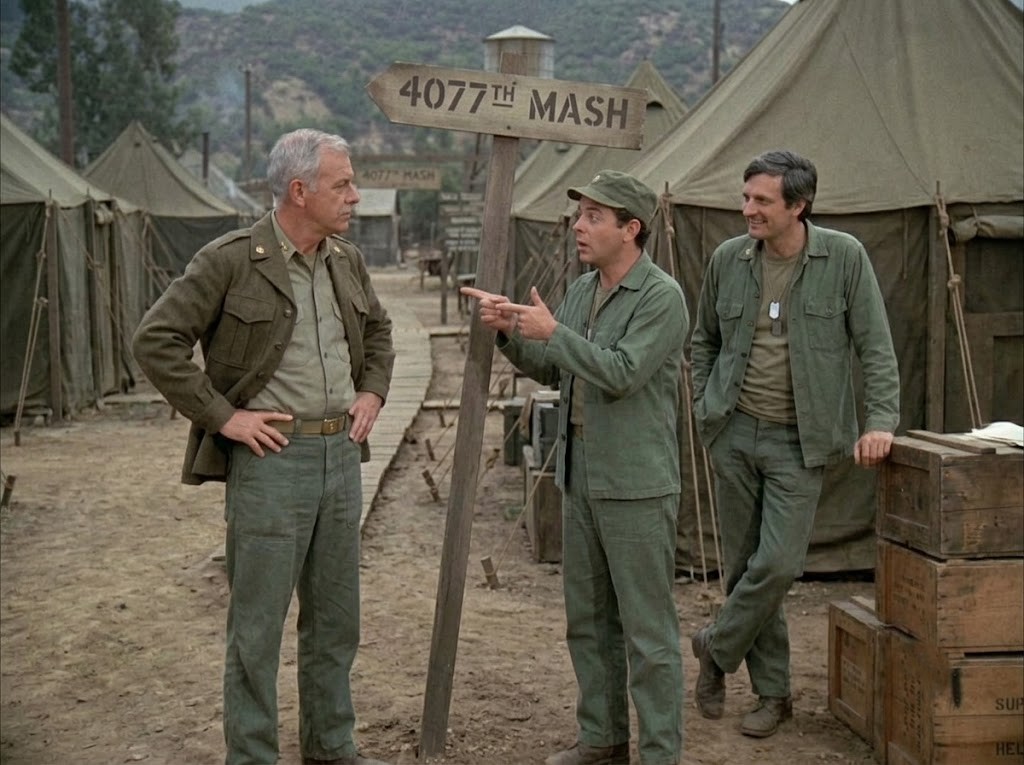
Colonel Sherman Potter stood in the compound, his hands resting firmly on his hips, staring up at the familiar wooden signpost. His olive-drab jacket was rumpled, his cap missing, and the silver eagles on his collar looked slightly tarnished by the relentless Korean dust. He looked less like a career military man and more like a tired father wondering how his family had managed to drift so far from home.
Next to him, Radar O’Reilly was practically vibrating with nervous energy, his combat cap pushed back just enough to reveal his anxious brow. He was pointing a pair of index fingers directly at the wooden board marked “4077th MASH,” gesturing frantically as if the sign itself had just committed a court-martial offense.
A few feet away, leaning casually against a stack of supply crates, Hawkeye Pierce watched the exchange with a faint, bittersweet smirk. His dog tags dangled loosely against his chest, and his hands were buried deep in the pockets of his unbuttoned fatigue shirt. To anyone else, Hawkeye looked completely detached, but the tight lines around his eyes gave away the exhaustion tearing at his ribs.
“Colonel, I’m telling you, it’s not just a couple of inches,” Radar insisted, his voice cracking slightly in that familiar, earnest cadence. “I measured it with the clerk’s rule from the office. It’s leaning exactly four degrees to the southwest, right toward the swamp.”
Potter sighed, a low, gravelly sound that seemed to come from the very bottom of his boots. “Radar, three hours ago, I was holding a boy’s beating heart in my hand while Pierce here sewed up his vena cava. Right now, a four-degree lean on a piece of pine doesn’t quite make my emergency list.”
“But it’s the anchor, sir!” Radar’s eyes widened behind his glasses, his fingers still locked in their rigid, pointing position. “If the signpost goes crooked, the whole camp looks like it’s sliding downhill. Sparky called from Seoul this morning, and he said if a general drives in and sees a lopsided camp, the first thing they check is the paperwork. And our paperwork is already three weeks behind because Klinger accidentally used the supply requisitions to line the birdcages!”
Hawkeye let out a dry, breathy chuckle, shifting his weight against the crates. “Relax, Walter. If a general comes in here, the smell of Winchester’s French horn practice will drive him away long before he notices the geometry of our signage. Besides, a little lean gives the place character. It matches the moral trajectory of our leadership.”
Potter didn’t laugh. He kept his eyes fixed on the weathered wood, his expression hardening into something deeply somber. The signpost wasn’t just a marker; it was the only thing connecting this godforsaken patch of dirt to the rest of the civilized world, pointing the way toward Seoul, Tokyo, and Death Valley.
“It’s not about the generals, Pierce,” Potter said softly, his voice dropping an octave as he stepped closer to the base of the pole. He reached out, his calloused palm resting against the rough, splintered wood. “This post has been hit by two shrapnel fragments, backed into by three different ambulance drivers, and peed on by every stray dog from here to the Han River. But it stood straight.”
Radar slowly lowered his pointing fingers, his earnest expression shifting into one of quiet concern. He could read the Colonel better than anyone in the compound, and right now, he could hear the unspoken weight in the old man’s breathing.
“Colonel?” Radar whispered, stepping closer. “Are you alright, sir?”
Potter didn’t answer right away. He grabbed the vertical post with both hands and gave it a firm, testing shove.
With a sickening, wet crunch, the earth beneath the post gave way completely. The ground, thoroughly rotted by weeks of heavy monsoon rains and shifting mud, could no longer hold the weight. The entire signpost tilted violently to the side, snapping the shallow root of its base, and began a slow, inevitable descent toward the dirt.
“Catch it!” Hawkeye yelled, his casual posture instantly vanishing as he lunged forward from the supply crates.
Before the heavy timber could crash into the mud, all three men threw themselves against it. Potter caught the main shaft against his shoulder, his teeth gritted with the sudden strain. Radar dove low, wrapping his arms around the base to stabilize the splintering wood, while Hawkeye grabbed the top crossbar right beneath the “4077th” lettering, his boots sliding in the loose dirt.
For a long, tense moment, the three of them stood frozen in the middle of the compound, locked in a bizarre, desperate embrace with a piece of army-issue lumber.
“Don’t let it touch the ground,” Potter growled, his face reddening as he took the brunt of the weight. “If the name falls in the mud, we’ll never get the stink out of it.”
“My back, Colonel!” Radar squeaked from down below, his face pressed against Potter’s trousers. “My lumbar region is staging a mutiny!”
“Hold your horses, son,” Potter muttered, adjusting his grip. “Pierce, stop posing for a statue and give us some leverage.”
“I’m trying, Colonel, but I think the sign has developed a sentimental attachment to the earth,” Hawkeye strained, his wit returning even as his muscles burned. “You know, technically, if the sign falls, the 4077th ceases to exist legally. We could all just pack up, catch the next bus to Incheon, and tell the Pentagon we couldn’t find the place.”
“Not on my watch,” Potter snapped, though there was no real anger in it—just the fierce, stubborn resilience that kept the unit alive. “Radar, get out from under there and find me a couple of those empty ammunition crates by the motor pool. We need to wedge the base before the whole thing snaps.”
“Yes, sir! Right away, sir!” Radar scrambled out from the huddle, nearly tripping over his own boots as he sprinted toward the supply tents, his frantic shouting echoing across the compound.
Left alone, Potter and Hawkeye held the tilting post between them. The initial panic subsided into a quiet, grueling test of endurance. They stood chest-to-chest against the wood, their breathing synchronized, watching the rest of the camp carry on around them. In the distance, the faint sound of Margaret yelling at a clumsy corpsman drifted through the humid air, followed by the low, comforting hum of the generator.
Hawkeye looked at the Colonel, seeing the deep lines of exhaustion carved into the older man’s face. The humor faded from Hawkeye’s eyes, replaced by a quiet, protective tenderness.
“You’ve been carrying this whole place on your back since you got here, Sherman,” Hawkeye said softly, using the Colonel’s first name—a rare privilege reserved for the moments when the war felt too big for military titles. “You don’t have to break your back over a piece of wood.”
Potter looked up, his grey eyes meeting Hawkeye’s. For a second, the dry, crusty exterior vanished, revealing the profound fatigue of a man who had seen too many wars and buried too many boys.
“It’s the first thing the choppers see when they bring ’em in, Pierce,” Potter said, his voice steady but thick with emotion. “When those kids look down out of the sky, bleeding and terrified, they see this sign. It lets ’em know they made it. It tells ’em they’re safe. As long as I’m commanding this outfit, that sign stays up, and it stays straight.”
Hawkeye swallowed hard, the cynicism completely draining out of him. He tightened his grip on the timber, his knuckles turning white. “Then I guess we’re holding onto it.”
Radar returned a moment later, dragging two heavy wooden ammunition crates, with B.J. Hunnicutt following close behind carrying a shovel and a length of thick hemp rope. B.J. took one look at the tableau, a warm, knowing smile breaking across his mustache.
“I leave you two alone for ten minutes and you start building a monument to yourselves,” B.J. teased, though he immediately dropped to his knees next to Radar to dig out the collapsed hole.
“Save the monologue, Beej, and shove those crates under here before the Colonel and I become a permanent part of the landscape,” Hawkeye grunted.
Working together, the four of them managed to slide the heavy crates into the pit, wedging the base of the post securely between the thick timber walls. B.J. quickly shoveled the heavy, rocks-and-mud mixture back into the gaps, packing it down with the heel of his boot until it was as solid as the Korean earth would allow.
Slowly, cautiously, Potter and Hawkeye released their grip. They stepped back, wiping the sweat and dirt from their hands onto their fatigues.
The signpost stood tall once more. It wasn’t perfect—it still possessed a tiny, stubborn tilt that defied military regulations—but it was stable, anchored deeply into the ground by the makeshift community that surrounded it.
Radar took a step back, holding up his fingers again to gauge the angle, a relieved smile finally breaking across his young face. “Perfect, Colonel. It’s right as rain.”
Potter looked at the sign, then looked at the three men standing beside him—his surrogate sons, his colleagues, his sanity in a world gone mad. He reached over and gave Radar a gentle pat on the shoulder, before turning his sharp glance back to Hawkeye and B.J.
“Alright, the crisis is over,” Potter announced, his dry, authoritative tone returning. “Now clear out of here before I find a detail for all of you involving a toothbrush and the latrine floors. Pierce, go get some sleep. You look like death warmed over.”
“Only if you promise to dream of Missouri, Colonel,” Hawkeye said, his usual smirk returning as he offered a loose, decidedly non-military salute.
As Hawkeye and B.J. strolled back toward the Swamp, their arms thrown over each other’s shoulders, Potter stood by the signpost for one last quiet moment. The sun was beginning to dip below the hills, casting long, dramatic shadows across the tents of the 4077th.
He took a deep breath of the cool evening air, adjusted his belt, and walked back toward his office. The war would still be there tomorrow, but for tonight, the camp was holding together.
Sometimes, keeping a family from falling apart just means holding onto the signpost together until the mud dries.