The Weight of a Clipboard and a Cup of Cold Coffee
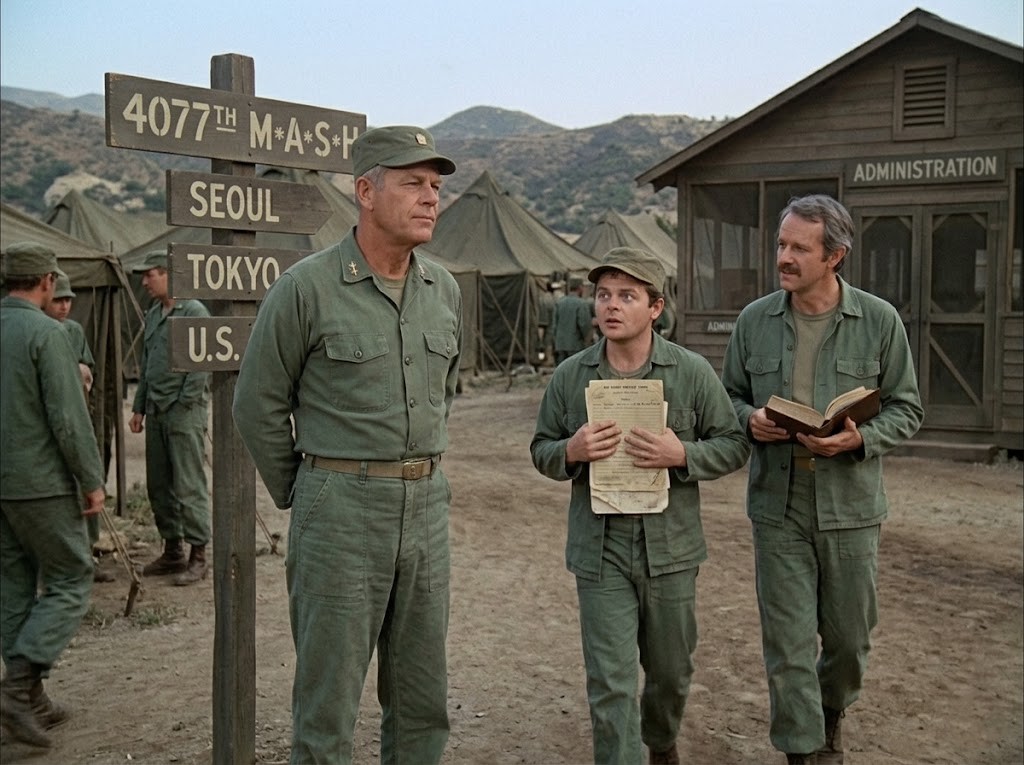
You can tell the mood of the 4077th just by looking at the signpost. Today, the arrows pointing to Seoul, Tokyo, and the U.S. felt less like geographical directions and more like cruel reminders of a world that existed only in our memories.
The dust of Uijeongbu had settled into the fabric of our olive-drabs, turning everything a uniform shade of tired. We had just come out of a thirty-six-hour session in the O.R., the kind that leaves your fingers cramping and your mind playing tricks on you.
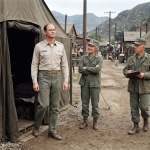
Colonel Potter stood near the signpost, his hands clasped firmly behind his back, staring off toward the barren mountains. His jaw was set in that familiar, unyielding line, but his shoulders carried the invisible weight of every casualty report that had crossed his desk that week.
Behind him, the rest of the camp moved like ghosts through the haze. A couple of corpsmen shuffled past the tents, too exhausted to even complain about the heat or the mud.
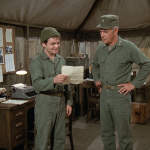
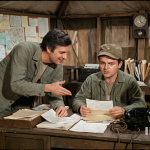
Radar came breaking through the silence, his boots crunching loudly on the dry dirt as he hurried over from the Administration building. He was clutching a stack of freshly mimeographed supply sheets against his chest as if they were the holy grail, his oversized cap tilted forward.
“Colonel, sir! Colonel Potter!” Radar gasped, catching his breath as he came to a halt. “I’ve got the new manifest from Supply in Incheon, and, well… you’re not gonna like it.”
Potter didn’t turn around immediately; he just let out a slow, heavy sigh that seemed to come from the very bottom of his boots. “Radar, if it’s about the missing penicillin or another shipment of left-handed tongue depressors, I suggest you bury it under a very large rock.”
B.J. Hunnicutt strolled up right behind Radar, an open book held loosely in his hands. He looked up from the pages, his mustache twitching with a faint, tired amusement that never quite reached his eyes these days.
“Come on, Colonel, let the kid break our hearts,” B.J. said, his voice laced with that quiet, grounded humor we all relied on to keep from losing our minds. “Maybe they finally approved my request for a grand piano or a personal swimming pool for the Swamp.”
Radar looked between the two officers, his face a picture of pure, earnest panic. “No, sir, it’s not the penicillin, and it’s definitely not a piano, Captain Hunnicutt. It’s… it’s a directive regarding the upcoming winter rotation, and I think there’s been a terrible mistake on the roster.”
The playful banter evaporated instantly from B.J.’s face, and Colonel Potter slowly turned his head, his sharp eyes locking onto the young corporal. The word ‘rotation’ had a way of freezing time at the 4077th, carrying the power to break a man’s spirit or give him just enough hope to survive another day.
“What kind of mistake, Radar?” Potter asked, his voice dropping into that low, paternal tone he used when things were truly serious. He didn’t move an inch, but the atmosphere around the signpost grew thick and suffocatingly quiet.
Radar shifted the papers in his arms, his knuckles white against the faded ink. “According to the official orders from Seoul, sir… Captain Pierce’s service extension wasn’t processed correctly by the clerk at Headquarters. They have him listed as ‘Inactive Surplus’ starting at midnight tonight.”
B.J. stared at Radar, the book in his hands suddenly forgotten. “Inactive surplus? What the hell does that mean? They can’t just lose Hawkeye in a filing cabinet.”
“It means,” Radar whispered, looking down at the top sheet, “that as far as the United States Army is concerned, Hawkeye doesn’t officially exist over here anymore. If he isn’t on a transport truck south by 2400 hours, he’s technically AWOL, but if he stays, we can’t legally feed him or give him O.R. supplies.”
For a long moment, nobody spoke. The thought of the 4077th without Hawkeye Pierce was like thinking of the camp without the tents; he was the cynical, brilliant, exhausting heart of the place, the man who kept everyone laughing when they wanted to cry.
Potter took a slow step forward, his eyes narrowing as he looked at the paperwork in Radar’s hands. “Mule corn,” the Colonel muttered, though there was no real anger in it—just a profound, bone-deep weariness at the bureaucratic absurdity of the war. “They can find a way to draft a man from a fishing boat in Maine, but they can’t keep track of the best surgeon in Korea.”
“What do we do, Colonel?” B.J. asked, his quiet humor completely gone now, replaced by a fierce, protective loyalty to his tentmate. “We can’t tell Hawkeye. You know what he’ll do. He’ll either pack his bags and march to Seoul in his bathrobe, or he’ll lock himself in the Supply tent with a bottle of gin.”
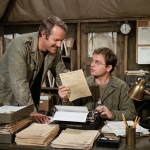
Potter reached out and took the clipboard from Radar, his fingers brushing against the kid’s sleeve in a brief, reassuring gesture. “We do what we always do, Captain. We do the Army’s job for them, quietly, and under the cover of darkness.”
The Colonel looked up at the mountains, then down at the signpost that pointed toward home. “Radar, you take these papers back into the office. I want you to find a bottle of scotch—the good stuff I keep hidden behind the loose floorboard in my quarters—and you send it down to the night clerk in Incheon via the next ambulance driver.”
Radar’s eyes widened, but he nodded quickly. “The scotch, sir? The one from your anniversary?”
“The very one,” Potter said with a faint, bittersweet smile. “Tell him that if Captain Pierce’s name isn’t back on the active roster with a corrected extension by tomorrow morning, I will personally drive a tank into his office and park it on his desk. Understand?”
“Yes, sir! Loud and clear, Colonel!” Radar said, a spark of hope returning to his eyes as he clutched the papers tightly and turned back toward the Administration building.
B.J. watched Radar hurry away, then looked at the Colonel, his expression softening into one of deep respect. “You’re a good man, Walter. Even if you do ruin a perfectly good bottle of scotch.”
“It’s just insurance, Pierce,” Potter said, turning his back to the signpost again and folding his arms. “Besides, if Hawkeye ever found out the Army tried to delete him, we’d never hear the end of it. I’m saving my own ears, not his life.”
B.J. chuckled softly, opening his book again as he began to walk back toward the Swamp, the heavy tension of the moment dissipating into the warm afternoon air. They hadn’t won the war, and they hadn’t changed the world, but for one more day, they had kept their family together.
Colonel Potter stood alone for a minute longer by the signpost, watching the dust kick up around the tents. He adjusted his cap, took a deep breath of the stale, smoky air, and walked back toward his office, ready to fight the paper war so his boys could keep fighting the real one.
In a place where everything felt temporary, the love we had for each other was the only thing that stayed permanent.