The Paperwork War of the 4077th
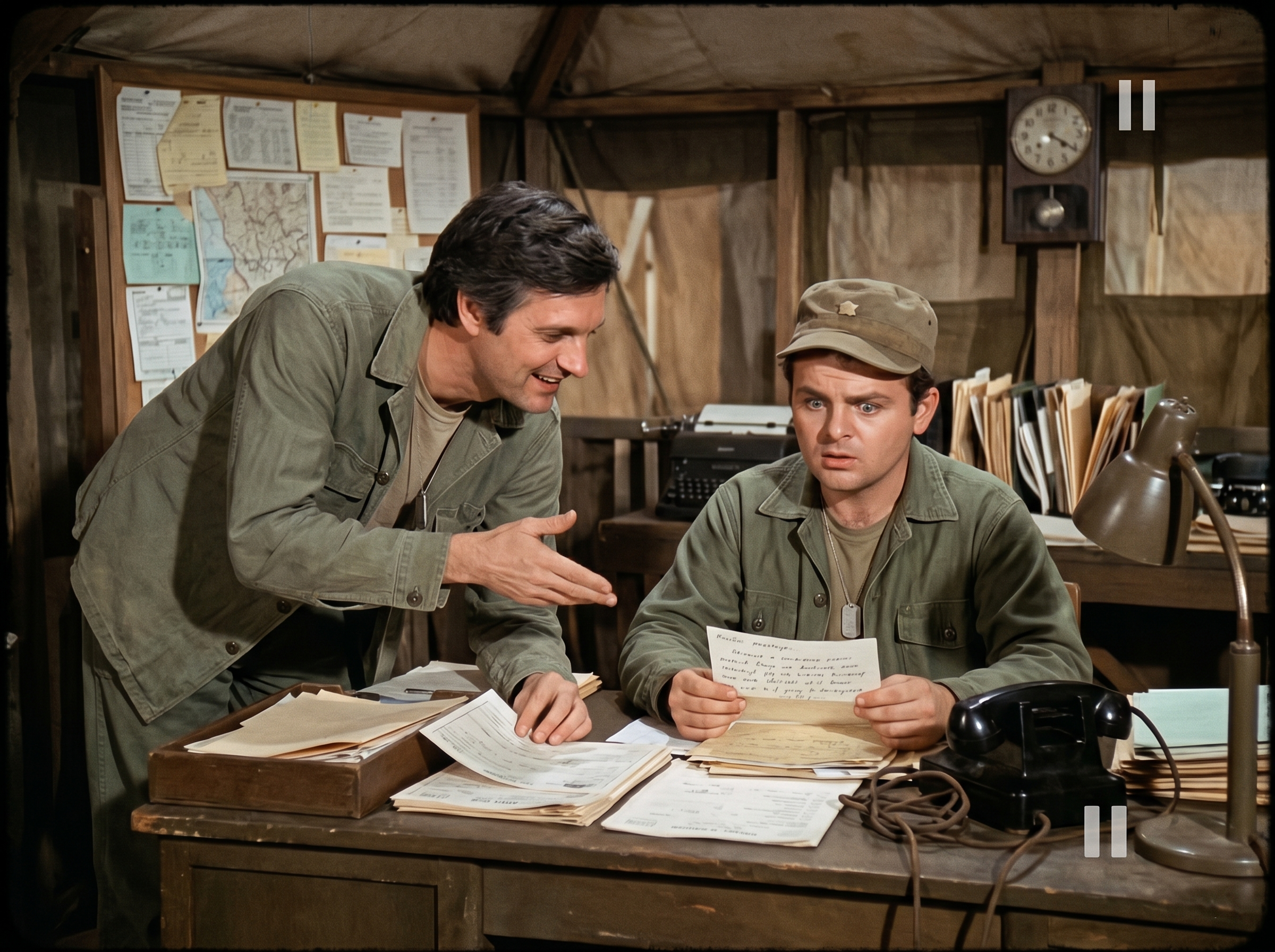
They always said the war was fought with bullets, but anyone stationed at the 4077th knew the real enemy was made of beige paper and carbon copies.
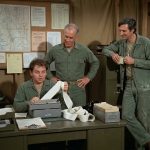
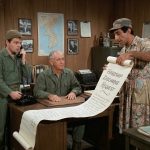
It was mid-afternoon, the quiet hour between the roar of the incoming choppers and the exhaustion of the night shift. Inside the company clerk’s office, the air was thick with the smell of stale coffee, mimeograph ink, and dusty tan canvas. The small clerk station was a masterpiece of practical chaos. Stacks of requisitions, personnel files, and supply forms teetered on the edge of the desk, forming a paper fortress against the madness of the war outside. A heavy black field phone sat like a sleeping guard dog, while a bulletin board heavily layered with forgotten memos took up the back wall.
Behind the desk sat Corporal Walter “Radar” O’Reilly, the young man holding the entire mobile hospital together with nothing but a clipboard and sheer nervous energy.
Right now, Radar was staring at a freshly decoded radio message. His signature cap was pushed back slightly on his head, and his face was frozen in an expression of profound, innocent earnestness mixed with absolute bewilderment. He looked like a boy who had just been handed a math problem where all the numbers were written in Greek.
The canvas door flap brushed aside, and Captain Benjamin Franklin “Hawkeye” Pierce wandered in.
Hawkeye wore his exhaustion like a tailored suit. His olive drab shirt was wrinkled, his dog tags jingled softly against his tan t-shirt, and he moved with a casual, slouching grace that defied the military rigidity expected of an officer. He had come to the office looking for a cup of coffee, or perhaps just a few minutes of quiet where nobody was bleeding, but he immediately spotted the terrified look in the clerk’s eyes.
“Radar,” Hawkeye said, his voice a low, gravelly drawl. “You look like you just found out the Easter Bunny was drafted. What’s the diagnosis?”
“It’s Seoul, Hawk,” Radar stammered, his eyes darting from the paper to the surgeon. “I sent them a priority requisition for the new clamps you and B.J. asked for. The ones we desperately need for vascular closures.”
Hawkeye drifted over, leaning heavily over the cluttered desk. He didn’t look worried. He looked intrigued. The warm, even light from the small desk lamp cast a soft glow over the muted gray equipment, highlighting the sharp, amused angle of Hawkeye’s jaw as he peered down at the paperwork.
“And let me guess,” Hawkeye said, pointing a finger at the typed message. “They denied it. They told us to use bobby pins and positive thinking instead.”
“Worse,” Radar said, his voice dropping to an anxious whisper. “They approved it. But they changed the order. The quartermaster said that due to a reclassification of surgical priorities in our sector, they aren’t sending us clamps. They’re sending us three thousand pairs of woolen dress socks.”
Hawkeye stared at the paper. The corners of his mouth twitched.
“Dress socks,” Hawkeye repeated, a slow, brilliant smirk spreading across his tired face. “Radar, do you realize what this means?”
“That we can’t do surgery, sir?” Radar asked, his panic rising as the doctor’s amusement grew.
“No, Radar,” Hawkeye said, leaning closer, his eyes dancing with the sheer absurdity of the bureaucracy. “It means that the next time a young kid comes in with shrapnel in his leg, we’re going to ensure his feet look absolutely fabulous for the General’s inspection.”
Radar clutched the paper to his chest, the reality of the situation entirely lost on the mocking surgeon. “But Captain, the choppers are coming tomorrow! What are we going to do?”
Hawkeye’s smile softened just a fraction, though the sharp wit remained in his eyes. He stood up straight, stretching his back, the worn, lived-in fabric of his fatigues pulling at the shoulders.
“What are we going to do, Walter?” Hawkeye asked, his tone dropping the theatrical edge and settling into something quieter, something reassuring. “We are going to do what we always do when the United States Army tries to help us. We are going to lie, cheat, and confuse them until we get exactly what we want.”
Radar blinked, his nervous confusion slowly giving way to that familiar, trusting earnestness. “We are?”
“Absolutely.” Hawkeye leaned back over the desk, pulling the beige paper from Radar’s hands and tossing it onto the pile of forms. “The military bureaucracy is a magnificent beast, Radar. It operates entirely on logic that makes absolutely no sense. Therefore, to defeat it, we must weaponize their own stupidity.”
Hawkeye pointed to the heavy black field phone. “Get me Major Thompson at I Corps Supply.”
Radar hesitated, his hands hovering over the rotary dial. “Sir, Major Thompson is a stickler for protocol. He’s the one who signed the dress sock order. If you yell at him, he might cancel our bandages, too.”
“Who said anything about yelling?” Hawkeye grinned, picking up a pencil and twirling it between his fingers. “I’m going to express my profound, patriotic gratitude. I am going to commend the Major for his visionary leadership.”
Radar swallowed hard, picked up the receiver, and began to crank the field phone. “Sparky? Yeah, it’s Radar. Get me I Corps… Major Thompson. Yeah, I’ll hold.”
The young clerk handed the receiver to Hawkeye, looking up at him like a child watching a magician about to perform a dangerous trick.
Hawkeye took the phone, his posture shifting instantly from a slouching, exhausted surgeon to a crisp, wildly enthusiastic officer. “Major Thompson! Captain Pierce here, 4077th MAS*H. Major, I just received your adjusted requisition. The three thousand woolen dress socks.”
Hawkeye paused, winking at Radar.
“Major, I just had to call and thank you personally. Colonel Potter was absolutely thrilled. We had no idea you knew about our top-secret frostbite initiative. Yes, sir! We’ve been using dress socks as makeshift tourniquets for weeks. They apply the perfect amount of pressure without damaging the tissue. It’s revolutionizing front-line medicine!”
Radar’s jaw dropped. He stared at Hawkeye, his innocent expression cracking into a look of sheer, awe-struck disbelief.
“The only problem, Major,” Hawkeye continued smoothly, his voice a melody of fake concern, “is that General MacArthur’s personal medical liaison is coming through tomorrow to inspect our new ‘Sock-Tourniquet’ method. And to properly demonstrate it, we really need those vascular clamps we originally ordered. If we don’t have them, we won’t be able to show the General’s man how the socks integrate with the clamps. It would be a disaster for the initiative. A disaster for your brilliant supply strategy.”
Hawkeye listened for a moment. The soft, warm light of the desk lamp caught the genuine fatigue etched around his eyes, even as he performed the comedy routine of his life.
“You can have the clamps on a jeep by midnight?” Hawkeye said, his voice dripping with admiration. “Major, you are a lifesaver. Literally. No, you keep the socks. We’ll need them for phase two. Thank you, sir.”
Hawkeye gently placed the receiver back onto the cradle. The chaotic little office was completely silent, save for the ticking of the wall clock.
Radar let out a breath he seemed to have been holding for five minutes. “Captain… did you just convince I Corps that we use dress socks to stop bleeding?”
“I didn’t convince them of anything, Radar,” Hawkeye said gently, his smile fading into a look of quiet, fraternal affection. “I just gave a bureaucrat a chance to take credit for a medical breakthrough. To a man behind a desk in Seoul, that’s worth more than a million surgical clamps.”
Radar looked down at his neatly organized, messy desk. A small, proud smile tugged at the corners of his mouth. “You know, Hawk… sometimes I think you’re completely crazy.”
“It’s the only way to stay sane in this place, kid,” Hawkeye replied. He reached over and clapped a hand softly on Radar’s shoulder. The fabric of his uniform was rough and worn, a testament to the endless, bloody hours in the OR.
For a brief second, the war faded away. There were no incoming choppers, no distant artillery, no shattered bodies waiting in the triage compound. There was only the quiet warmth of the clerk’s office, the faded colors of a temporary home, and the deep, unspoken bond between a frightened kid from Iowa and a heartbroken doctor from Maine. They were just two tired men, standing in the soft, glowing light of a desk lamp, finding a way to survive the madness one piece of paper at a time.
Hawkeye turned to leave, pausing at the canvas door. “Oh, and Radar?”
“Yes, sir?”
“When those three thousand pairs of socks get here, issue a pair to everyone in camp. If we’re going to be stuck in this purgatory, we might as well have warm feet.”
In a place where tomorrow was never promised, the greatest victories were often found in the quiet, shared laughter over a cluttered desk.