The Longest Request in Korea
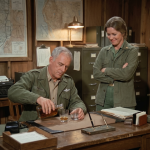
The air inside the Colonel’s office was thick with the usual cocktail of damp Korean earth, stale coffee, and the quiet, frantic energy of a war that refused to take a lunch break.
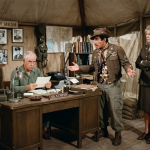
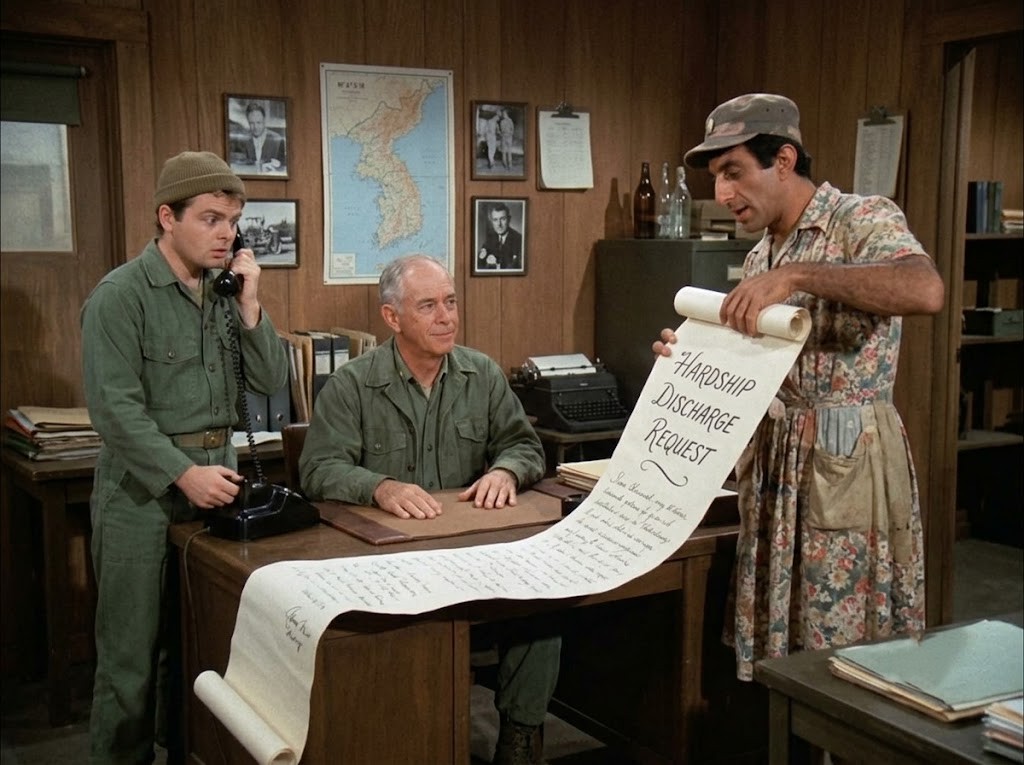
Colonel Potter sat behind his desk, his hands clasped firmly, his face a landscape of weary patience earned through decades of service. Beside him, Radar O’Reilly stood with the telephone receiver pressed tight to his ear, his eyes wide and darting, caught in the middle of some logistical crisis involving a shipment of fresh produce that had somehow ended up in Tokyo.
Then, the door creaked open, and in walked Klinger.
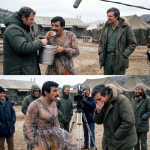
He wasn’t just walking; he was making an entrance. He wore a floral-patterned dress that looked like it had been salvaged from a very optimistic Sunday picnic in 1948. But it was the prop in his hands that stopped the room cold.
It was a scroll. A long, curling, relentless tube of parchment that spilled from his hands and unrolled across the floor like a runaway carpet. As Klinger lifted his hands, the paper unfurled, revealing, in elegant, painstaking calligraphy, the words: *Hardship Discharge Request*.
Radar hung up the phone with a soft click, his mouth dropping open. Colonel Potter didn’t even blink, though his jaw tightened just a fraction. Klinger stood there, dressed in his finest floral Sunday best, holding the beginning of a document that seemed to stretch all the way back to Toledo, Ohio.
“Corporal,” Potter started, his voice a low, gravelly rumble, “you’ve got to be kidding me.”
Klinger didn’t miss a beat. He offered a look of such profound, tragic sincerity that it bordered on the heroic. “Sir, this is a formal legal document. It covers my case, my family’s situation, the neighborhood grocery store’s lack of quality produce, and, if you’ll notice, a detailed post-script on the psychological effects of unseasoned mashed potatoes.”
Radar stepped forward, gingerly stepping over the paper as if it were a fragile snake. He looked at the scroll, then at the Colonel, his brow furrowed in that way that usually meant someone was about to get a headache.
The silence stretched, punctuated only by the distant, rhythmic *thwump-thwump* of a chopper blade somewhere over the hills. Potter sighed, a sound that carried the weight of every day spent in this godforsaken camp. He leaned forward, squinting at the endless scroll.
“Klinger,” Potter said, pointing a finger at the paper. “If that thing hits the floor, you’re going to be reading it until the next decade.”
“Sir,” Klinger replied, his voice dripping with theatrical dignity, “I have all the time in the world.”
The tension in the office hit a boiling point. Potter’s face went from weary to something dangerously close to amusement, yet his hand hovered near his stamp, as if debating whether to mark it ‘Approved’ or ‘Fire Hazard.’
Potter finally let out a short, sharp snort of laughter that broke the dam. He looked at the paper, then at the man in the floral dress, and then at Radar, who was now holding the end of the scroll to keep it from drifting toward the open door.
“Klinger,” the Colonel muttered, rubbing his eyes. “I’ve seen a lot of things in my time. I’ve seen men charge machine guns and I’ve seen nurses perform miracles in the mud. But I’ve never seen a man try to petition the United States Army with a manuscript that could double as a wallpaper.”
Klinger didn’t shrink. He straightened his shoulders, pulling the dress taut. “Efficiency, sir. I’m just trying to make sure you don’t miss any of the salient points. It’s all here. Every detail. Every tear. Every misplaced button on my uniform.”
Radar looked down at the sprawling script, his eyes tracing the lines. “Gosh, Klinger, you even included a diagram of your Aunt Mildred’s kitchen?”
“It’s context, Radar! It’s all about the environment!” Klinger insisted.
The door opened again, and Hawkeye and B.J. leaned in, drawn by the strange, quiet commotion. Hawkeye took one look at the scroll, then at Klinger’s outfit, and let out a long, low whistle.
“My god,” Hawkeye said, walking over to inspect the paper. “It’s the Dead Sea Scrolls of Desperation. Have you reached the chapter on the existential dread of surplus supplies yet?”
B.J. leaned over Hawkeye’s shoulder, a grin breaking across his face. “If you look closely, Hawk, it’s actually a very moving piece of prose. I think the part about the missing socks in the barracks is particularly poignant.”
The office, usually a place of grim duty and high-stakes decisions, was suddenly filled with the quiet, bickering, affectionate warmth of a family that had been together too long to ever truly leave one another. The ridiculousness of the scroll, the absurdity of the dress, and the sheer persistence of the man standing there—it was the glue that held the 4077th together.
Colonel Potter watched them all for a moment. His eyes weren’t angry anymore; they were soft, reflecting a grudging, deep-seated respect for the madness required to stay sane in the middle of a nightmare. He knew he wouldn’t sign it. He knew Klinger knew he wouldn’t sign it. And yet, there they were—all of them, huddled around a piece of paper, laughing in the face of everything that made them cry.
“Alright, alright,” Potter grumbled, finally waving a hand in dismissal. “Take your literary masterpiece out of my sight, Corporal. And for heaven’s sake, get a press. That thing is wrinkled.”
Klinger beamed, rolling up the scroll with a sense of immense, unearned accomplishment. “Yes, sir! Thank you, sir! I’ll get right on the revisions.”
As he turned to leave, his floral skirt swishing against the floorboards, Hawkeye and B.J. followed him out, already debating the literary merits of his next draft. Radar stood there for a second, looking at the empty spot where the scroll had been, then looked at the Colonel.
“He’s something, isn’t he, sir?” Radar asked softly.
Potter leaned back, looking out the window at the distant, grey hills of Korea. “He’s a pain in the neck, son. And I wouldn’t trade him for a full night’s sleep.”
He picked up a file, his hands steady once more, the brief moment of humanity tucked away into the deep, quiet corners of his heart. Outside, the camp went back to its business, the laughter trailing off into the rustle of the wind, leaving behind that familiar, bittersweet ache of knowing exactly who you are, and exactly where you happen to be.
In the heart of the 4077th, even the longest, most ridiculous requests were just another way of saying, “I’m still here, and I’m still me.”