A Message in the Dust
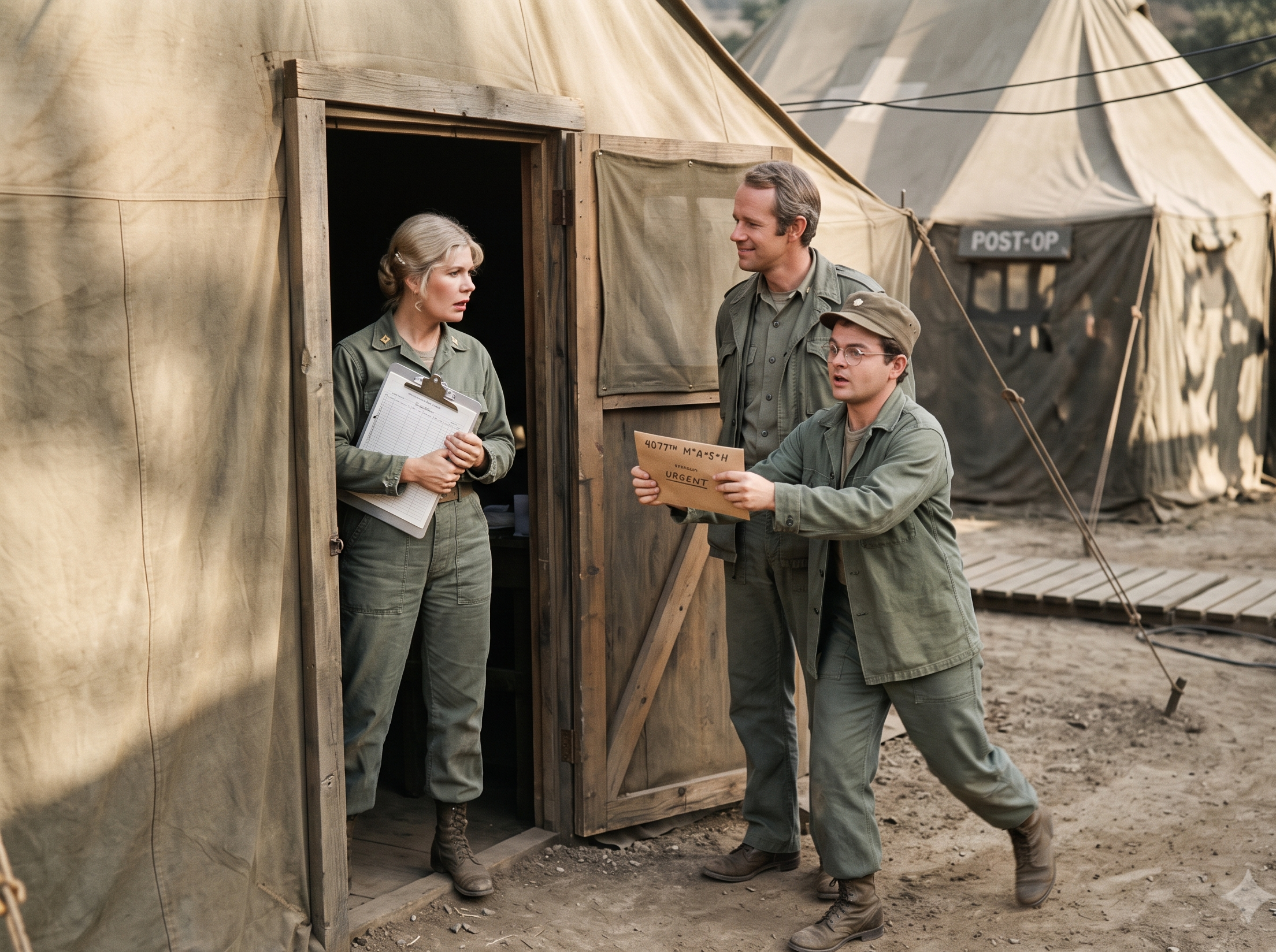
The dust of the 4077th had a peculiar way of settling on everything, including a person’s nerves.
It was mid-afternoon, caught in that quiet, heavy lull that occasionally blanketed the camp between the roar of the incoming choppers. The sun beat down mercilessly on the canvas roofs, turning the walkways into baked rivers of dirt.
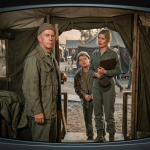
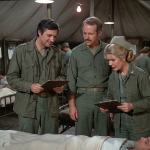
Major Margaret Houlihan stood just inside the shadow of the post-op doorway. She was clutching a metal medical chart to her chest, her posture as straight and uncompromising as ever. Yet, beneath the crisp authority of her uniform, the sheer exhaustion of a brutal eighteen-hour surgical shift lingered around the edges of her eyes.
Just outside the doorway, bathed in the soft, dusty daylight, stood Captain B.J. Hunnicutt.
He was slouching comfortably against the wooden frame of the tent in that effortless, wonderfully infuriating way he had. He looked perfectly at home in the dirt, his hands resting in his pockets, offering a quiet, dryly amusing monologue about the suspicious origins of the mess tent’s powdered eggs.
Margaret’s face held a sharp presence, her eyebrows arched in a surprised, skeptical expression. She was trying desperately to maintain her professional edge, refusing to admit that she was actually enjoying the momentary distraction of his gentle banter.
Then, the quiet rhythm of the afternoon was abruptly broken.
The rapid, frantic crunch of boots echoed down the dusty camp path.
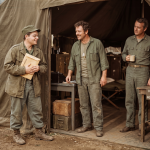
Corporal Radar O’Reilly came half-stumbling into the frame, coming to a sudden, screeching halt just outside the tent. He looked completely out of breath, his garrison cap slightly askew.
His eyes were wide as saucers behind his round wire-rimmed glasses, shining with an earnest, unblinking focus.
In his right hand, he held out a yellow radio message envelope like it was a live grenade with the pin pulled out.
“Major Houlihan, ma’am? Captain?” Radar stammered, his voice cracking slightly as he looked back and forth between the two officers.
Margaret’s skeptical amusement vanished instantly. Her spine stiffened.
At a mobile army surgical hospital in the middle of the Korean War, a breathless company clerk clutching a priority yellow envelope usually meant only one of three things: a sudden bug-out, an impending flood of mass casualties, or a furious general raining down military wrath.
“What is it, Corporal? Spit it out,” Margaret commanded, her voice snapping with sudden, braced tension.
Even B.J. stopped slouching quite as much. His easy smile faded into quiet, alert attention, his eyes fixed on the trembling paper in the boy’s hand.
“Well, ma’am,” Radar swallowed hard, holding the envelope out with trembling fingers. “Sparky just took this off the wire from Tokyo. It’s marked ‘Urgent and Personal,’ and… well, he said I better run it right to you before the Colonel or anybody else sees it.”
Margaret’s heart plummeted into her stomach.
A secret priority message? Had someone in command found fault with her nursing staff? Was she being transferred? Or worse, was it bad news from stateside?
She reached out slowly from the shadow of the doorway, her hand hovering over the yellow paper, holding her breath as she prepared herself for a disaster.
Margaret snatched the envelope from Radar’s hand. The crisp sound of the paper tearing open seemed incredibly loud in the heavy, warm air of the camp.
B.J. shifted his weight, sliding his hands back into his pockets. “Want me to go warm up the jeep for your court-martial, Margaret?” he asked. His tone was gentle, a subtle attempt to use a little dry humor to defuse the rigid tension suddenly gripping her shoulders.
She ignored him entirely, her eyes scanning the flimsy telegraph paper.
Radar was practically vibrating in place. He hugged his wooden clipboard tight to his chest as if it could serve as a shield against the incoming blast.
“I didn’t read the whole thing, Major, honest,” Radar pleaded quickly, his wide-eyed concern genuine. “Just the heading. Sparky was laughing so hard he could barely translate the Morse, so I thought it might be… delicate.”
Margaret’s eyes narrowed as she read.
The sharp, defensive presence of the head nurse was suddenly replaced by a look of sheer, unadulterated disbelief. Her jaw dropped slightly. A vivid flush of color began to rise from her collar, creeping all the way up to her cheeks.
“Major?” B.J. asked, his mustache twitching with a renewed sense of mild curiosity. “Is it a bug-out, or did you accidentally declare war on the Navy?”
“This…” Margaret stutters, her voice completely losing its crisp military cadence. She looked at Radar, then at B.J., and then back at the paper. “This is a requisition response from the Quartermaster General’s office in Seoul.”
Radar nodded furiously, his own face turning a deep shade of crimson. “Yes, ma’am. About the… the special medical supply order. From last month.”
Margaret closed her eyes, pinching the bridge of her nose as if staving off a sudden migraine.
“I submitted a discreet, medically necessary requisition for three pairs of specialized orthopedic support stockings,” Margaret said, her voice tight. “Because standing on a concrete floor in the O.R. for eighteen hours a day is ruining my arches, and Army boots are barbaric.”
B.J. nodded solemnly, though his eyes were dancing. “A noble and necessary request for the backbone of our surgical unit.”
“However,” Margaret continued, her voice trembling—not with fear, but with a bubbling, furious embarrassment. “It appears the telegraph operator in Seoul was either drunk or entirely illiterate. This message confirms the immediate dispatch of three hundred pairs of… of…”
She couldn’t bring herself to say it. With a frustrated huff, she shoved the paper at B.J.
B.J. unfolded the yellow sheet. A slow, magnificent, understated grin spread across his face. He cleared his throat and read aloud with perfectly timed, dry delivery.
“‘Priority dispatch confirmed. Three hundred pairs of orthopedic support… suspenders. Please advise if Major Houlihan requires matching bowties for her staff.'”
Radar let out a small, terrified squeak and hid the lower half of his face behind his clipboard.
For a long moment, there was dead silence in the dusty walkway.
Margaret looked completely stunned. She had braced herself for a tragic emergency, a brutal transfer, or the end of her military career. Instead, she was about to become the proud owner of three hundred pairs of elderly men’s suspenders.
B.J. looked up from the paper, his blue eyes warm with quiet delight. “Well, Margaret. Look on the bright side. If this war lasts another forty years, your trousers will be incredibly secure.”
The tension in the air simply snapped.
Margaret let out a sound that was half-gasp, half-snort. She brought a hand up to cover her mouth, trying desperately to maintain the dignity of her rank. But the sheer absurdity of the moment was entirely too much.
The bone-deep fatigue of the last forty-eight hours, the stifling heat, the endless stream of wounded—it all suddenly crashed head-first into this ridiculously mundane, bureaucratic camp misunderstanding.
She leaned against the canvas wall of the doorway, and to Radar’s utter shock, she began to laugh.
It wasn’t a polite, military chuckle. It was a deep, genuine, helpless laugh that made her shoulders shake and her eyes water.
B.J. smiled, a warm, genuine smile that reached the crinkles around his eyes. He didn’t mock her. He just leaned back against the tent pole, slouching comfortably, happy to share the weightless relief of the moment.
“It’s not funny, Captain,” Margaret wheezed, wiping a tear from her eye with the corner of her medical chart.
“It’s a little funny, Margaret,” B.J. corrected her softly, his voice full of quiet affection.
Radar lowered his clipboard, a tentative, relieved smile breaking across his youthful face. “Should I… should I wire them back, Major? Tell them we don’t need the suspenders?”
Margaret took a deep breath, smoothing her blonde hair. Her sharp presence slowly returned, though it was now beautifully softened by the laughter.
“No, Corporal,” she said, a fond, tired smile lingering on her lips. “Let them come. Heaven knows half the surgeons in this camp are walking around with held-up scrub pants anyway. We’ll hand them out at the mess tent.”
She looked at B.J., who gave her a small, respectful salute with two fingers.
“Good thinking, Major,” B.J. said quietly. “Morale is important.”
Margaret turned back into the shadows of the doorway, her chart in hand, leaving Radar and B.J. in the soft daylight of the dusty path.
The war was still waiting just outside the perimeter, and the choppers would inevitably return. But for just a few minutes, in the quiet shade of a canvas tent, the only casualty was a misunderstood supply order, and the only medicine they needed was a moment to remember how to smile.
Sometimes the greatest comfort in a war zone is finding someone who understands exactly how to laugh at the madness with you.