A Quiet Corner at Rosie’s
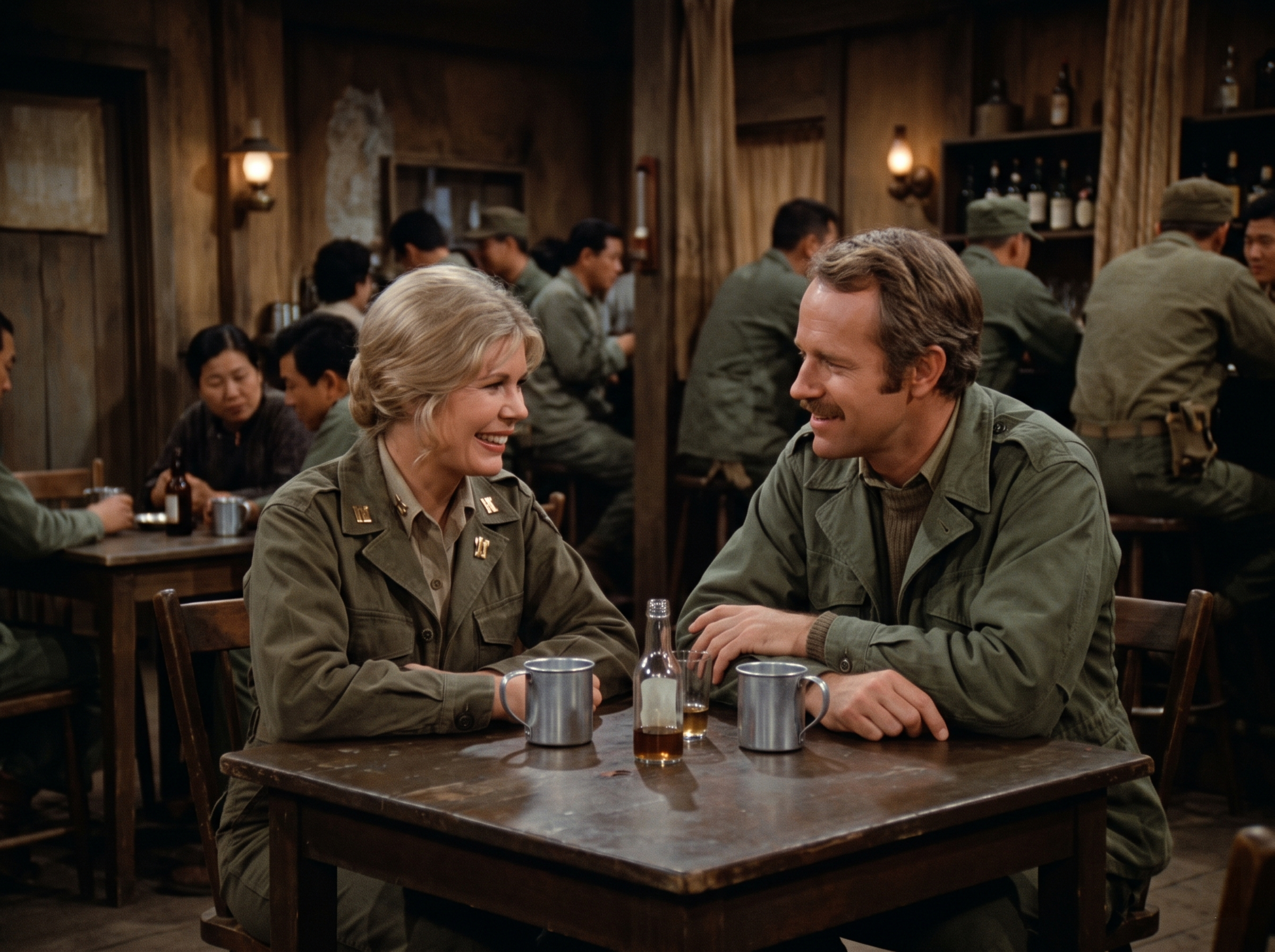
Rosie’s Bar smelled of cheap pine polish, stale beer, and the unmistakable, lingering scent of damp wool uniforms. It wasn’t much of a sanctuary, just a rustic, drafty room with worn wooden tables and a few dim, amber-colored lamps, but to the doctors and nurses of the 4077th, it was the closest thing to heaven in South Korea.
The low hum of tired voices filled the air, a steady background noise that usually drowned out the war. But tonight, the noise couldn’t quite drown out the exhaustion.
They had just finished a brutal thirty-six-hour marathon in the operating room. The kind of session where the helicopters seemed to multiply in the sky, and the scent of ether and copper stained their hands no matter how much lye soap they used.
Captain B.J. Hunnicutt walked through the swinging doors, his shoulders heavy and his eyes rimmed with red. He was looking for a quiet corner to decompress, perhaps a stale beer to wash the taste of the OR from his mouth.
Instead, he found Major Margaret Houlihan.
She was sitting alone at a small, scarred wooden table near the back. Two dented metal canteen cups sat on the table, along with a half-empty bottle of local liquor.
Margaret wasn’t drinking. She was just staring at the battered metal of the cup, her posture rigid, her hands clasped tightly in her lap. The harsh, commanding presence of the Head Nurse was entirely absent.
In its place was a profound, deeply guarded weariness.
B.J. hesitated for a moment. Usually, invading Major Houlihan’s space when she looked this intense was a surefire way to get a lecture on military protocol or the proper ironing of a fatigue shirt.
But B.J. was a doctor, and he knew a casualty when he saw one, even if they weren’t bleeding. He walked over slowly, pulling out the simple wooden chair across from her.
“Is this seat taken, Major?” B.J. asked, his voice soft, keeping his tone carefully neutral.
Margaret blinked, startled, as if she had forgotten where she was. She quickly straightened her spine, pulling the invisible armor of her rank back around her shoulders.
“Captain Hunnicutt,” she said, her voice a little brittle. “No. The seat is free. Though I was just about to leave. I have a ward to inspect.”
“The wards are quiet, Margaret,” B.J. said gently, sitting down and resting his arms relaxed on the table. “I just checked on my way over. Kellye has everything under control.”
Margaret looked away, her jaw tight. “Nurses need supervision, Captain. Standards must be maintained.”
“Standards are fine,” B.J. replied, offering a mild, easygoing smile. “But right now, the Head Nurse looks like she’s about to shatter into a thousand regulation-sized pieces.”
Margaret’s eyes snapped back to him, flashing with a sudden, defensive anger. “I am perfectly fine, Hunnicutt. I don’t need your armchair psychiatry.”
“I’m a surgeon, Margaret, not a psychiatrist. Sidney is the one who charges by the hour,” B.J. said smoothly, unfazed by her sharp tone. “I’m just a guy offering to share a table.”
She stared at him, breathing heavily, fighting a battle entirely within herself. The anger in her eyes began to fracture, replaced by something much more fragile.
“It was the boy on table three,” Margaret whispered suddenly, the words escaping before she could stop them.
B.J. nodded slowly. He remembered the kid. Blonde, barely old enough to shave, holding onto Margaret’s hand as the anesthesia took him under, crying out for a mother he hadn’t seen in two years.
“He looked at me,” Margaret said, her voice shaking now. “He looked right at me, B.J., and he squeezed my hand, and I had to tell him he was going to be fine. I had to look him in the eye and lie.”
“You gave him comfort, Margaret,” B.J. said quietly. “You did your job.”
“My job is to fix them!” Margaret’s voice hitched, a sudden, desperate sound that cut through the low noise of the bar.
She slumped forward slightly, the rigid military posture finally collapsing. She pressed a hand to her mouth, her eyes bright with unshed tears, fighting a losing battle against the overwhelming, crushing weight of the war. She looked entirely broken, alone in a crowded room, terrified that if she let a single tear fall, she would never be able to stop.
B.J. didn’t move. He didn’t reach across the table to pat her hand, and he didn’t offer any hollow, comforting platitudes about the nature of war or the will of God. He knew Margaret Houlihan well enough to know that pity would only make her build her walls higher.
Instead, he sat quietly in the dim, olive-and-amber light, an anchor of steady, grounded calm.
The silence stretched between them, heavy and raw. The background chatter of Rosie’s Bar continued, a blurry haze of tired medics and corpsmen, leaving their small wooden table as an isolated island of shared grief.
Slowly, deliberately, B.J. reached out and took the small bottle of liquor. He uncorked it with a quiet pop and poured a modest splash into Margaret’s metal cup, then did the same for his own.
“You know, Margaret,” B.J. said, his voice dropping to a conversational, almost thoughtful murmur. “I had a similar problem with a patient today.”
Margaret sniffled softly, hastily wiping a stray tear from her cheek before it could fall. She looked at him suspiciously, still bracing herself for a joke at her expense. “What problem?”
“Table one. Corporal from Ohio,” B.J. continued, leaning in just a fraction, his eyes crinkling at the corners. “He woke up in post-op, looked right at my face, and started crying.”
Margaret frowned, the medical professional in her briefly overriding her emotional crisis. “Was he in pain? Did you check his chart?”
“Oh, I checked his chart,” B.J. said, his mustache twitching with a suppressed smile. “He wasn’t in physical pain. He was just profoundly disappointed.”
“Disappointed?” Margaret asked, confused.
“Yes,” B.J. sighed dramatically. “Apparently, the anesthesia had him convinced he was dying and going to heaven. But when he opened his eyes and saw this mustache hovering over him, he realized he was either still in Korea, or heaven had really lowered its grooming standards.”
Margaret stared at him for a second. The absolute absurdity of the statement hung in the air between them.
Then, quite suddenly, the strict, disciplined lines of Margaret Houlihan’s face melted away.
She let out a short, startled sound—half-sob, half-laugh. She leaned forward slightly, resting her forearms on the worn wood of the table, and looked at the man across from her.
Her face broke into a warm, deeply moved, and quietly vulnerable smile. It was a beautiful, unguarded expression, one that smoothed the harsh lines of fatigue from her forehead and brought a soft, human light back to her eyes.
“You are impossible, B.J. Hunnicutt,” she whispered, her voice thick with emotion, but no longer shaking.
“I prefer the term ‘medicinally irritating,'” B.J. replied, offering her a dryly funny, easygoing smile in return. He kept his arms relaxed on the table, holding her gaze with a supportive, steadfast warmth.
He had done exactly what he set out to do. He had thrown a lifeline wrapped in a terrible joke, giving her permission to feel the pain without making her feel weak for it.
Margaret picked up her metal cup, wrapping her hands around the cool, dented tin. She looked down into the amber liquid, then back up at B.J.
“He was just so young,” she said softly, the tragic reality still there, but no longer a crushing, solitary weight.
“They all are, Margaret,” B.J. said, his smile softening into something tender and terribly sad. “And we are just trying to patch the leaks in a sinking ship. But we couldn’t do it without you. If you fall apart, who is going to terrify the new recruits into washing their hands?”
Margaret chuckled, a genuine, quiet sound that belonged entirely to the woman underneath the Major’s oak leaves. “Someone has to maintain the standards around this lunatic asylum.”
“Amen to that,” B.J. said. He raised his metal cup a few inches off the table. “To standards.”
Margaret raised her cup, tapping it gently against his with a dull, hollow clink. “To surviving them.”
They drank in silence. The liquor was terrible, burning a path down their throats, but it grounded them in the present moment.
Margaret didn’t put her walls back up immediately. She sat there in the dim light of Rosie’s Bar, allowing herself to just be a tired woman sharing a drink with a good friend. She looked at B.J., really looked at him, seeing the dark circles under his eyes and the gray dust in his hair, and felt a profound, overwhelming surge of affection for this frustrating, ridiculous, beautiful makeshift family.
They were all broken, she realized. Every single one of them was cracked and bleeding in their own invisible ways. But as she watched B.J. swirl the dregs of his drink, offering her that quiet, steadying presence, she knew they would keep each other from falling apart entirely.
The war would be there tomorrow. The choppers would come, the mud would freeze, and the blood would flow.
But tonight, in this dusty, softly lit corner of a makeshift bar in the middle of nowhere, they had each other. And for a little while, the analog softness of the evening was enough to heal the deepest wounds.
In the end, it wasn’t the medicine that kept them alive, but the quiet moments of grace shared across a worn wooden table.