The Weight of the Quiet Hours
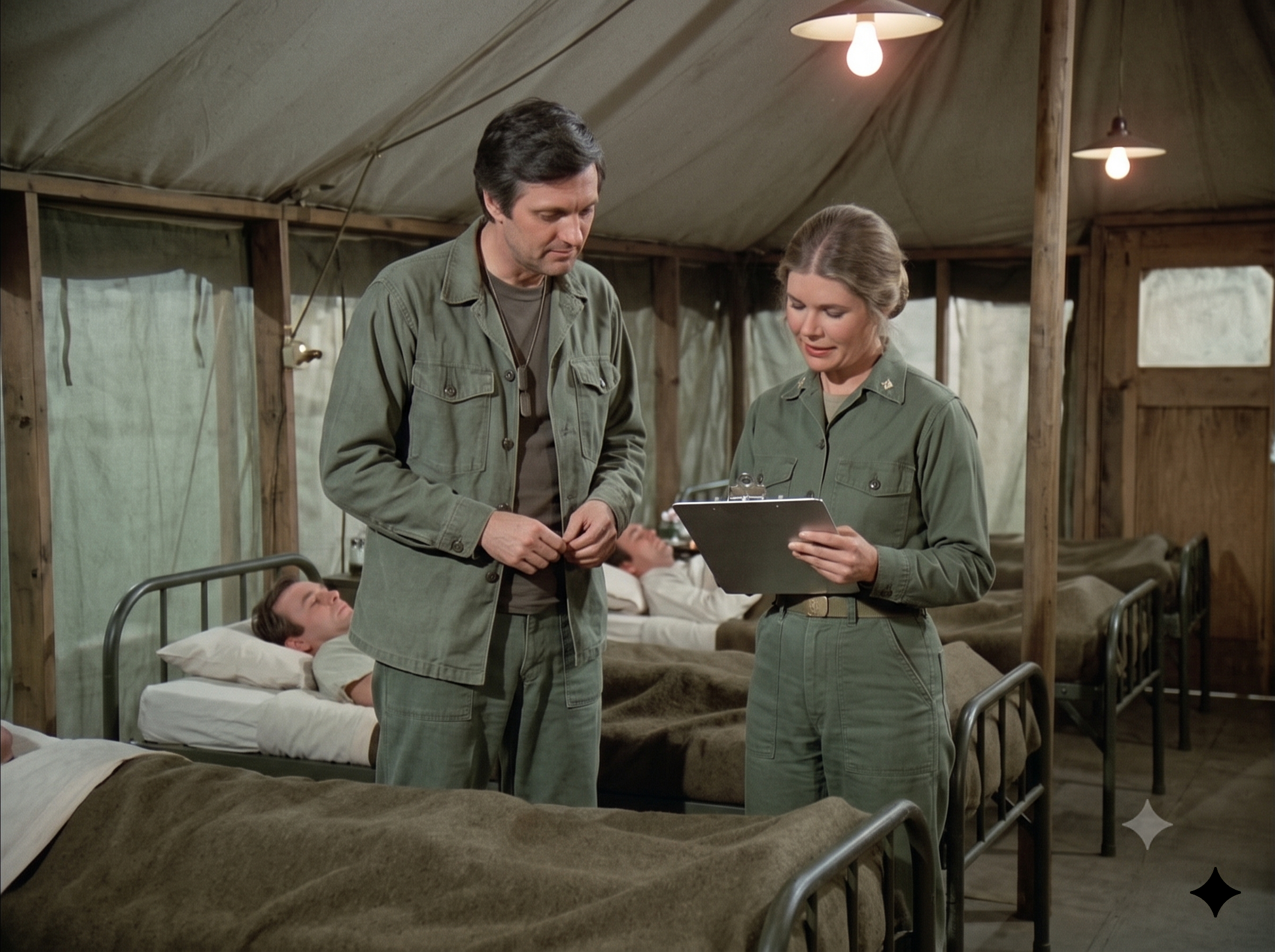
The silence inside the Post-Op ward was a rare and fragile thing.
It was the kind of heavy, echoing quiet that only arrived after a brutal, thirty-six-hour marathon in the operating room. The frantic shouting for clamps and sponges had finally faded, replaced by the steady, rhythmic breathing of two dozen sleeping soldiers.
The harsh, blinding overhead lights of the OR were a world away. Here, a few practical bedside lamps cast a soft, gentle glow across the room.
The light bathed the rows of simple cots and muted woolen blankets in a pale green and washed-out white color palette. It gave the entire ward an analog softness, a quiet warmth that felt almost out of place in the middle of a war zone.
Captain Hawkeye Pierce stood perfectly still at the foot of bed number four.
He wore his faded, oversized robe over a pair of worn, olive-drab trousers. Nothing about his appearance was polished. He looked practical, exhausted, and entirely lived-in, a natural fixture of the 4077th.
Hawkeye wasn’t on duty. He should have been in the Swamp, dead to the world, trying to sleep off the lingering smell of iodine and ether.
Instead, he was staring down at a young corporal who couldn’t have been more than nineteen years old.
Usually, Hawkeye’s face was alive with manic energy, armed with a defensive wit ready to deflect any serious emotion. But right now, standing in the dim shadows, his mask had completely fallen away.
He wore a thoughtful, quietly wounded expression. It was a look of profound, underlying compassion, heavy with the ghosts of the boys he couldn’t piece back together.
He was so lost in his own tired mind that he didn’t hear the soft, deliberate footsteps approaching from the nurse’s station.
“You’re not on the schedule, Pierce.”
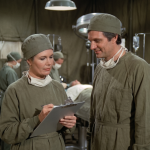
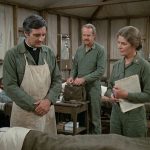
Hawkeye blinked, slowly turning his head. Major Margaret Houlihan stood a few feet away, clutching a metal clipboard to her chest like a shield.
She wore her standard, modest fatigues. There was no glamour here, just the worn, practical reality of a Korean War surgical hospital.
“Just doing a little late-night window shopping, Major,” Hawkeye whispered, his voice raspy and devoid of its usual sarcastic bite. “Seeing if the patchwork is holding up.”
Margaret didn’t snap at him. She didn’t bark an order about him being out of uniform or lurking in her ward after hours.
Instead, she stepped closer, leaning into the pale circle of lamplight beside the bed.
She lowered her clipboard and began to review the bedside chart, checking the neat columns of temperatures and pulse rates. She leaned into her professional task, her posture as crisp as ever.
But as she read the boy’s vitals, the strict, unyielding authority of the Head Nurse began to soften.
Beneath her strict composure, a quietly moved, caring expression surfaced. She had been at the table with Hawkeye. She knew exactly how close this boy had come to slipping away, and she knew exactly how hard Hawkeye had fought to keep him tethered to the earth.
“His pressure is steady,” Margaret said softly, her voice barely louder than the wind rattling the canvas walls.
“For now,” Hawkeye murmured, his eyes fixed on the boy’s pale face. “Until the army patches him up, slaps a helmet on his head, and tells him to go catch another piece of shrapnel.”
Hawkeye rubbed his tired eyes, the exhaustion finally pulling his shoulders down.
“Sometimes, Margaret,” he said, his voice cracking slightly in the quiet room. “Sometimes I look at these kids, and I feel like I’m just emptying the ocean with a teaspoon.”
The silence stretched between them, heavy and raw.
Hawkeye looked up, his gaze meeting Margaret’s in the dim light. The defensive walls were completely gone, leaving him exposed, overwhelmed, and looking as though he might just shatter.
Margaret stopped writing. The sharp snap of her pen echoed loudly in the quiet ward.
She looked back at him, and for the first time in a long time, she didn’t see an insubordinate, wisecracking surgeon. She saw a man buckling under the impossible weight of playing God in the mud.
Margaret stood perfectly still, the weight of Hawkeye’s unspoken pain hanging in the pale green air between them.
In the bright light of day, in the middle of the compound, she would have offered a brisk reprimand or a stiff, patriotic platitude. She would have told him to pull himself together and remember his rank.
But here, in the tender, analog shadows of the recovery ward, the rigid rules of the military felt a million miles away.
Here, they were just two exhausted human beings, doing their best to hold back the dark.
Margaret took a slow step forward, closing the physical distance between them. She lowered her clipboard to her side, letting go of the armor she wore so well.
“You saved his life today, Hawkeye,” she said, using his nickname with a rare, quiet softness that caught him off guard.
Hawkeye shook his head slightly, a bitter, tired smile touching the corners of his mouth.
“I sewed up a hole, Margaret. That’s all,” he whispered. “I didn’t stop the war. I didn’t send him home to his mother. I just hit the pause button.”
Margaret looked at him, her blue eyes warm and steady. She shed the strict authority of Major Houlihan entirely, revealing the deep, enduring empathy of a nurse who felt every single loss just as sharply as he did.
She reached out. It was a hesitant, careful movement at first.
Then, she placed her hand gently on his forearm.
The touch was grounding. It was a simple, profound gesture of emotional aftercare, completely unburdened by rank, regulation, or their usual bickering.
Hawkeye looked down at her hand, surprised by the sudden warmth, and then slowly looked up into her eyes.
“We can’t stop the war, Pierce,” Margaret said quietly, her voice serving as a gentle anchor in his storm. “But we stopped the war from taking him today.”
She gave his arm a firm, reassuring squeeze.
“That has to be enough,” she continued, her voice thick with her own hidden fatigue. “It has to be. Because if it isn’t, none of us are going to make it out of this place with our minds intact.”
Hawkeye let out a long, ragged breath.
The immense tension in his shoulders, wound tight as a coiled spring since the first chopper landed hours ago, finally began to release. He leaned into the small comfort she offered, a quiet surrender to the overwhelming fatigue they both shared.
It was a deeply intimate, bittersweet moment of ensemble survival. They were a found family, forged in blood and exhaustion, holding each other up when the rest of the world made no sense.
“When did you get so smart, Major?” Hawkeye asked, a faint, genuine smile finally breaking through his quiet woundedness.
“I’ve always been smart, Captain,” Margaret replied smoothly, a gentle, understated warmth in her tone. “You’ve just been too busy making terrible jokes to notice.”
Hawkeye chuckled, a low, dusty sound that felt incredibly human. It didn’t wake the sleeping soldiers, but it instantly lightened the heavy air in the room.
“I’ll have you know my jokes are considered top-tier entertainment from here to Seoul,” he whispered defensively, though there was no real fight left in him.
“By who?” Margaret countered, a playful spark returning to her eyes. “Klinger? The man wears a fruit basket to morning roll call.”
Hawkeye smiled, really smiled this time. The haunted look in his eyes receded just enough to let a little bit of light back in.
“Touche, Major,” he conceded softly.
Margaret offered one last, comforting pat to his arm before stepping back. The familiar, professional armor slid back into place, but this time, it didn’t feel like a wall between them.
She raised her clipboard once more, though the caring expression never left her face.
“Go to bed, Hawkeye,” she ordered gently. “I’ve got the ward tonight. And Colonel Potter will have my hide if his best surgeon falls asleep standing up during morning rounds.”
Hawkeye offered a lazy, sloppy salute that was more of a tired wave of gratitude.
“Yes, Mom,” he teased quietly.
Margaret rolled her eyes, but she couldn’t hide the soft, affectionate smile that broke through her composed exterior.
“Goodnight, Pierce.”
“Night, Margaret.”
Hawkeye turned and began the slow, heavy walk toward the double canvas doors of the ward.
Before he pushed his way out into the cold, he stopped at the threshold and looked back.
Margaret was already moving to the next bed. She was leaning over another sleeping soldier, adjusting a muted blanket with profound care, her pen scratching softly against the medical chart.
She looked perfectly in her element—strong, capable, and deeply tender.
Hawkeye realized then that for all their loud arguments and fundamental differences, they were tethered together by the exact same fragile thread. They were the battered, exhausted caretakers of this muddy little corner of hell, finding small, quiet pockets of grace in the spaces between the dying.
He pushed through the canvas doors and stepped out into the cool Korean night, the heavy burden in his chest feeling just a little bit lighter.
In a place built on breaking people apart, the greatest medicine they had was simply holding each other together.