A Quiet Chord in the Swamp
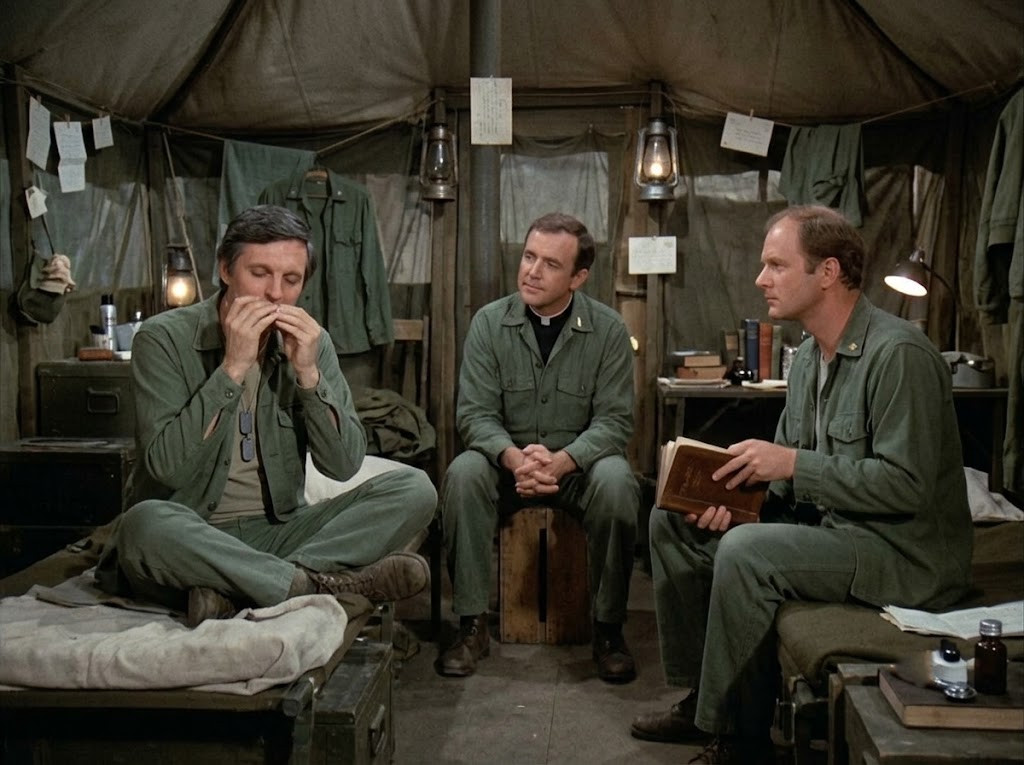
The mud outside the 4077th had finally stopped its steady, miserable drumming against the tent canvas, leaving behind a silence so profound it felt heavy. Inside the Swamp, the air was thick with the scent of damp wool, stale coffee, and that peculiar, persistent exhaustion that only a shift in Surgery could leave behind.
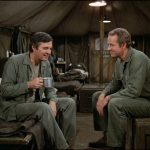
Hawkeye Pierce sat cross-legged on his cot, his shoulders slumped in a way that spoke of a very long, very difficult day. He held a harmonica to his lips, his eyes closed, coaxing a melody out of the thin brass reeds that was less of a song and more of a long, shuddering sigh. It was a tune that didn’t quite belong in Korea; it was something slow, something from a parlor back in Crabapple Cove, meant for a quiet evening by a fireplace, not a drafty tent in the middle of a conflict that refused to end.
Across from him, Father Mulcahy sat perched on a wooden crate, his hands clasped tightly in his lap. He wasn’t praying, at least not in the conventional sense. He was simply watching, his head tilted slightly, his face a landscape of quiet, gentle empathy. He knew that look on Hawkeye’s face—the one that said the surgeon was trying to scrub the day’s memories off his hands, but they were stuck fast to his heart.
Charles Emerson Winchester III sat on his own cot, a heavy, leather-bound book open in his hands, though he hadn’t turned a page in ten minutes. His posture was rigid, his refined features pulled into an expression of studied indifference, yet his gaze kept drifting toward the harmonica.
The tension in the room was a delicate, fragile thing. It was the sound of a man trying to find a rhythm to keep from breaking, and two friends waiting, terrified to speak lest they shatter the fragile peace he had built. Hawkeye’s eyes suddenly flew open, the music cutting off with a sharp, dissonant wheeze that left a ringing silence in the tent. He looked up, his jaw tight, his eyes searching the faces of his bunkmates as if asking if he’d finally pushed the world a little too far.
“It’s flat,” Charles remarked, his voice cutting through the silence with the precision of a scalpel. He cleared his throat, the sarcasm momentarily misplaced, replaced by a sudden, uncharacteristic softness. “The A-flat, Pierce. You are missing the A-flat. It is ruining the entire structural integrity of the piece.”
Hawkeye stared at him, the harmonica still gripped tightly in his hand. For a second, it looked like he might snap a retort back, something sharp and biting about Winchester’s high-culture sensibilities. But then he saw it—the way Charles wasn’t looking at him with judgment, but with a strange, weary patience.
“Well, Professor,” Hawkeye said, his voice raspy, “I’m fresh out of sheet music and my tuning fork is buried somewhere under a pile of laundry. You want to show me how it’s done, or are you just here to critique the acoustics of my misery?”
Charles sighed, a long, weary sound, and set his book down on the crate beside the Father. He reached out, his long, aristocratic fingers taking the instrument from Hawkeye with surprising care. He didn’t play a melody, not right away. He simply tested the reeds, his eyes distant, perhaps thinking of the symphony halls of Boston, thousands of miles and a lifetime away.
Father Mulcahy leaned forward, a small, encouraging smile breaking across his face. “Music has a way of finding the soul, Charles,” he whispered, his voice barely audible over the distant rumble of a generator. “Even when the soul is tired.”
Charles took a breath and began to play. It was a simple, haunting rendition of an old hymn, the kind that reminded everyone in that tent of a Sunday morning, of polished wooden pews and sunlight streaming through stained glass. It wasn’t the boisterous, frantic energy they usually brought to the Swamp. It was slow, deliberate, and undeniably kind.
As the notes filled the cramped space, Hawkeye’s posture began to shift. The tension seemed to seep out of him, his shoulders dropping, his gaze softening as he leaned his head back against the tent pole. B.J., who had been quietly cleaning his glasses in the corner, stopped his movements and sat perfectly still, letting the melody wash over him.
In that moment, the war didn’t exist. The casualties, the mud, the constant, low-grade fear—it all retreated to the periphery. There were just three men, bound together by the absurd, beautiful necessity of surviving one more night together.
When the last note finally faded into the canvas walls, no one moved. The air in the tent felt lighter, scrubbed clean of the day’s grime. Charles handed the harmonica back, his expression guarded once more, though he couldn’t quite hide the faint flush of satisfaction in his cheeks.
“Better,” Hawkeye murmured, tucking the harmonica into his pocket. He didn’t thank him. He didn’t have to. A nod, a small, tired smile, and the shared knowledge that they had made it through one more day was enough. They were a family, forged in the most unlikely of crucibles, finding grace in the spaces between the notes.
Sometimes, the only way to heal the heart is to share the weight of the silence.