The Weight of a Smile
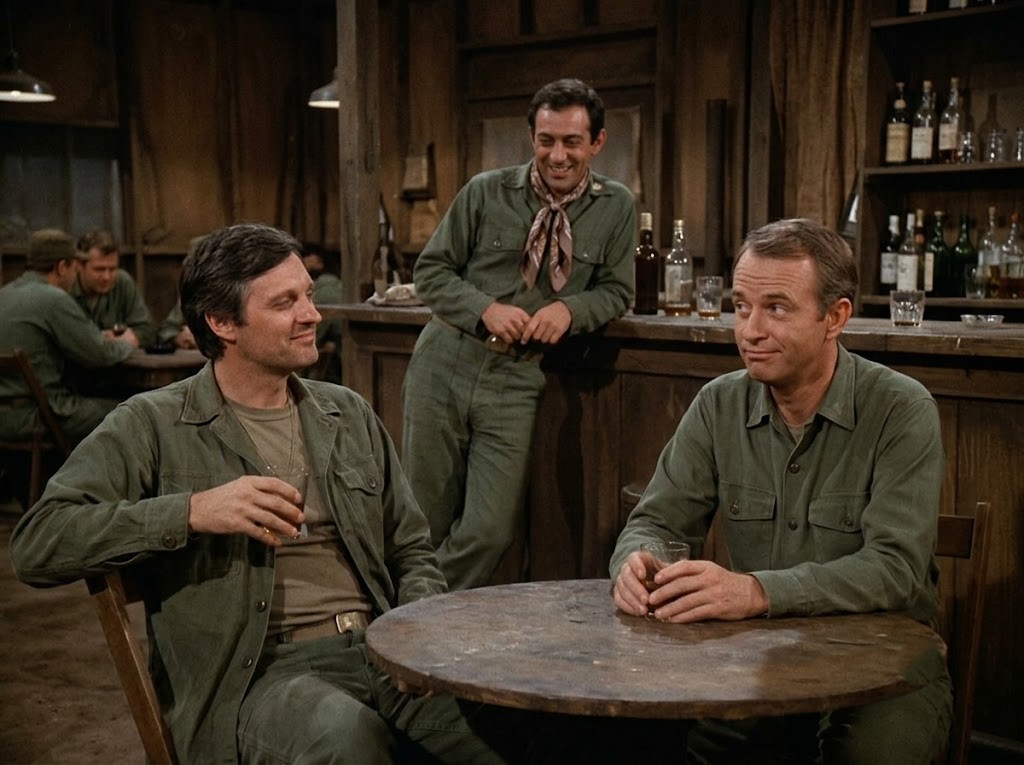
The mud outside the Officer’s Club was ankle-deep, but inside, the air smelled of stale beer, damp wood, and the fragile, hard-won peace that only came after a thirty-six-hour shift in the operating room.
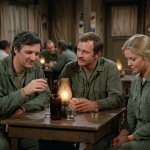
If you looked closely at the corners of Hawkeye Pierce’s eyes, you could see the faint, dark lines of exhaustion that no amount of cheap local whiskey could wash away. Yet, there he sat, slumped back in a creaking wooden chair, a glass held loosely in his right hand and a familiar, crooked smirk playing on his lips.
Across the small, round table, B.J. Hunnicutt stared into his own drink, his expression a mix of quiet amusement and deep, bone-weary fatigue. He had his hands wrapped around his glass as if the warmth of the amber liquid could somehow reach all the way back to San Francisco, back to Peg and Erin.
Leaning casually against the wooden bar behind them was Klinger, traded out of his usual chiffon and lace for a standard issue green uniform, though he’d managed to accent it with a rakishly tied, patterned silk scarf. Klinger was smiling, a genuine, wide grin that momentarily erased the grime and frustration of another endless week in America’s favorite forgotten corner of Korea.
“I’m telling you, Beej,” Hawkeye said, his voice carrying that familiar, rhythmic cadence that usually signaled a long, rambling monologue designed to keep the reality of the war at bay. “The secret to surviving this place isn’t the gin, and it certainly isn’t the gourmet cuisine. It’s all about the facial muscles.”
B.J. didn’t look up right away, but his eyebrows twitched upward. “The facial muscles, Hawk?”
“Absolutely,” Hawkeye insisted, gesturing with his glass, the amber liquid swirling precariously close to the brim. “It takes forty-three muscles to frown, but only seventeen to smile. By my calculations, Klinger back there is saving at least twenty-six calories a minute just by looking at us. At this rate, he’ll be nimble enough to fly back to Toledo on his own wings by Tuesday.”
Klinger chuckled, shifting his weight against the bar. “Hey, Captain, if it gets me a ticket out of here, I’ll smile until my jaw cracks. Beside, I just got a letter from my Uncle Alberto. He says the bakery is doing so well he might buy a second delivery truck.”
“See?” Hawkeye beamed, turning his gaze back to B.J., his smile softening into something deeply affectionate, the kind of look reserved only for the brother he’d found in the middle of a nightmare. “Good news from Toledo. A fresh glass of something that vaguely resembles scotch. And yet, look at you. You’re wearing your face upside down.”
B.J. finally raised his head, a wry, slow smile spreading across his face, though it didn’t quite reach his eyes. “I’m smiling, Hawk. I’m just doing it internally. It saves even more calories.”
“Don’t give me that,” Hawkeye said, his voice dropping an octave, losing a bit of its theatrical edge. “I know that look. That’s the look you give the chart when a patient’s temperature won’t drop. Come on, Beej. Out with it. What’s weighing down the pride of California?”
The casual, easy atmosphere in the room seemed to shift, the silence between them suddenly feeling a little heavier, a little more fragile. Klinger’s smile faded slightly, his eyes tracking the sudden change in tone between the two doctors.
B.J. set his glass down on the scarred wooden tabletop with a small, hollow click. He reached into his breast pocket and pulled out a small, crumpled piece of paper, folded so many times the edges were turning white.
“It’s from Peg,” B.J. said quietly, his voice thick with a sudden, raw emotion that caught Hawkeye completely off guard. “It came in the mail pouch right before the chopper push yesterday. I haven’t had a chance to really look at it until now.”
Hawkeye’s smirk vanished, replaced instantly by the intense, protective seriousness of a man who loved his friend fiercely. He leaned forward, the humor gone from his eyes. “Is everything alright, Beej? Is Peg okay? The baby?”
B.J. looked at the paper, then up at Hawkeye, his eyes shining with a sudden, heartbreaking vulnerability that made the walls of the Officer’s Club feel very thin against the cold Korean night.
—
“They’re fine,” B.J. said, his voice barely above a whisper, though it cut through the quiet room like a scalpel. “They’re perfectly fine. In fact, Peg says Erin took her first real steps three weeks ago. Right across the living room rug, straight into her mother’s arms.”
Hawkeye let out a breath he didn’t realize he’d been holding, his shoulders dropping. “Well, that’s fantastic, Beej! That’s incredible news. Why the long face? You should be dancing on the tables. Klinger, get this man another drink, we’re celebrating a marathon runner!”
But B.J. didn’t move, his hand still resting heavily on the folded letter. “She took her first steps, Hawk. And I wasn’t there. I was in a tent three thousand miles away, covered in someone else’s blood, trying to patch up a kid from Iowa who will never walk right again.”
The silence returned, but this time it wasn’t the comfortable quiet of tired friends. It was the crushing, ache-in-the-chest silence of the 4077th, the collective weight of everything every man and woman in that camp had left behind.
Klinger straightened up from the bar, his theatrical bravado entirely gone. He looked down at his boots, the patterned scarf around his neck suddenly looking less like a joke and more like a desperate, colorful anchor to a normal world that felt further away every day.
Hawkeye looked at B.J., the witty comebacks dying in his throat. For all his talk, for all his jokes and his endless barrage of words, there were times when even Hawkeye Pierce ran out of things to say. He looked down at his own glass, then back at B.J.’s tired, honest face.
“Beej,” Hawkeye said softly, reaching across the table to place a hand near his friend’s sleeve. “You’re here. You’re here saving the fathers of future kids who are going to take their first steps because of you. I know it doesn’t make up for missing it. Nothing can. But Erin’s going to walk a lot of miles in her life, and when you get home, you’re going to be right there to catch her.”
B.J. looked at Hawkeye, searching his roommate’s face. He saw the genuine, deep-seated pain Hawkeye carried for him, the shared burden of a brotherhood forged in a place where youth went to die. Slowly, the tight lines around B.J.’s mouth began to relax.
Behind the bar, Klinger cleared his throat, a small, tentative smile returning to his face. “You know, Captain Hunnicutt… my family, we have an old saying back in Toledo. Well, it’s an old Lebanese saying, really. It means, ‘The miles between us are just the space where the love grows bigger.'”
Hawkeye looked up, a faint glimmer of his old spark returning. “Klinger, that’s surprisingly poetic. Are you sure your Uncle Alberto didn’t steal that from a greeting card?”
“Maybe,” Klinger said, a small grin breaking through his serious expression. “But it works, doesn’t it? Besides, Captain, when you get home, that kid is going to be running so fast you’ll be wishing she was back to just crawling.”
B.J. let out a short, sudden laugh—a genuine, warm sound that broke the tension entirely. He picked up his glass, looking between Klinger and Hawkeye, the deep, aching loneliness in his eyes replaced by the steady, resilient warmth that kept them all going day after day.
“To Erin,” B.J. said, raising his glass slightly. “May she always walk forward.”
“To Erin,” Hawkeye echoed, clinking his glass against B.J.’s with a soft, musical ring. “And to her father, who makes sure a lot of other people get to walk home, too.”
Klinger raised a clean glass from behind the bar in a silent toast, his wide smile back in place, bright and comforting under the dim lights of the club.
They sat together in the quiet sanctuary of the wooden shack, three men trapped in a war they didn’t want, finding a way to laugh, a way to remember home, and a way to survive until the next chopper call.
—
In a place where time stood still, it was the small reminders of tomorrow that kept the 4077th moving forward.