A Quiet Morning at the Edge of the World
The war always looked a little different in the soft, hazy light of dawn.
The harsh, unforgiving glare of the Korean sun hadn’t yet baked the dirt paths of the 4077th. Instead, the compound was painted in a quiet, fragile gray. It was the one time of day when the endless rows of canvas didn’t look like a temporary prison, but rather a strange, exhausted little neighborhood.
The camp was silent, save for the hum of the mess hall generator and the distant barking of a village dog. The Swamp’s wooden door swung open with a familiar, creaky groan.
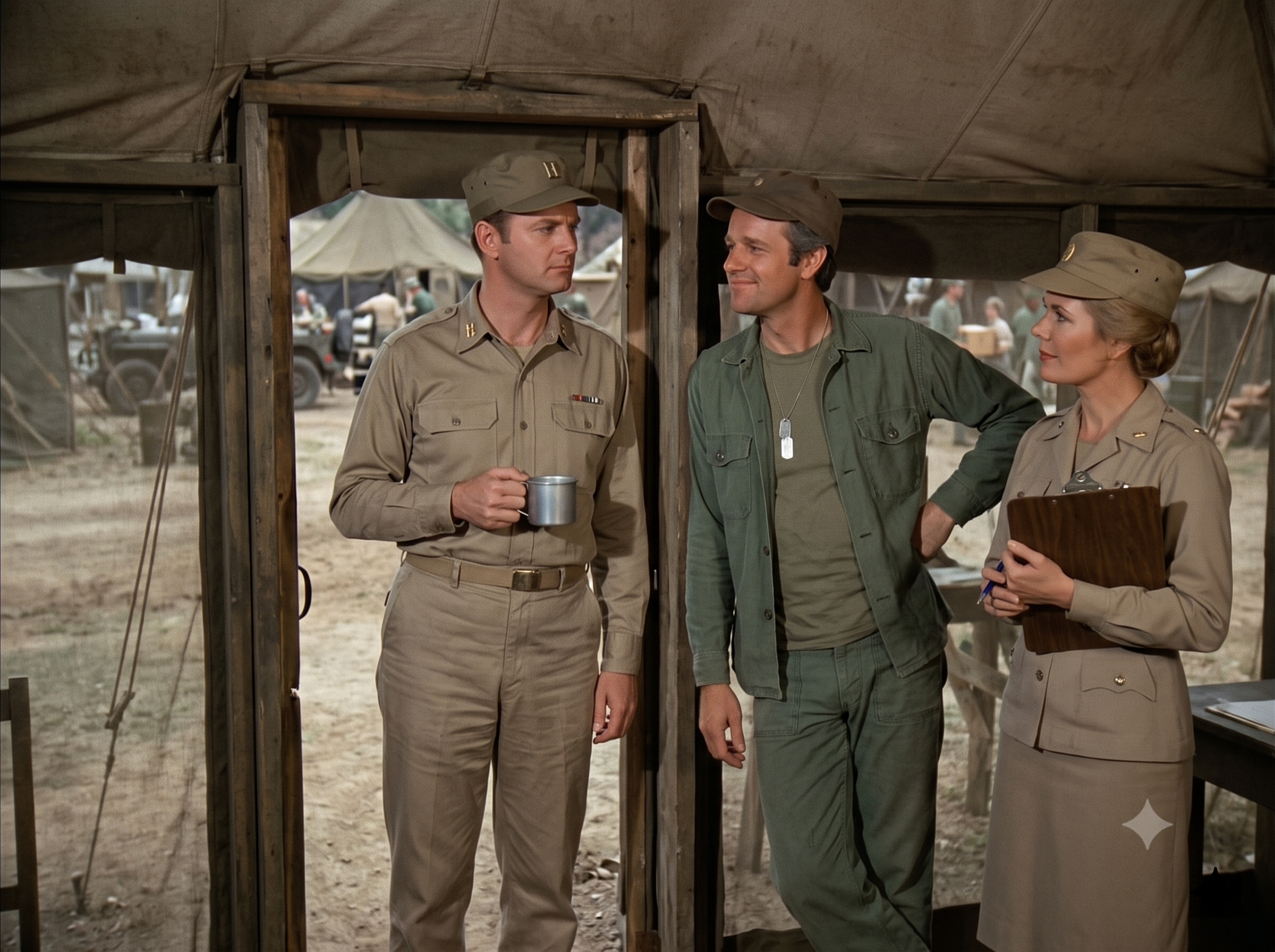
Major Charles Emerson Winchester III stepped into the doorway, stopping just at the threshold where the wooden floorboards met the dusty transitional space of the camp path. He was exhausted. They all were.
They had just walked away from a brutal thirty-six-hour marathon in the operating room. The heavy scent of ether and iodine still clung to their wrinkled, sweat-stained khakis.
Yet, true to form, Charles refused to let the squalor completely break his spirit.
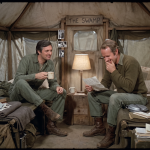
He stood in the doorway with a posture of dignified pride, his back perfectly straight. In his hand, he held a dented aluminum cup as delicately as if it were a piece of fine Boston porcelain. It wasn’t Darjeeling—it was lukewarm mess hall coffee—but the way he sipped it was an act of pure, stubborn civilization.
Just behind him, leaning casually against the rough wooden frame of the tent, was Captain B.J. Hunnicutt.
B.J. looked like a man who could sleep standing up. His hands were tucked into his pockets, and his shoulders were slumped with the bone-deep weariness that only a frontline surgeon truly understood.
But as B.J. looked at Charles, his warm eyes crinkled at the corners. A look of dry, quiet amusement washed over his face. He didn’t say a word, but his expression spoke volumes. He was just taking it in—watching this brilliant, pompous aristocrat stubbornly defend his dignity against a canvas wall and a dirt path.
Despite their endless bickering, there was a reluctant, unspoken camaraderie hanging in the morning air between them.
Then, the crunch of boots on gravel broke the morning silence.
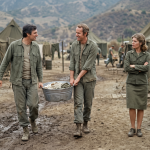
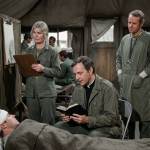
Major Margaret Houlihan appeared just outside the doorway. She was dressed in her standard, practical fatigues, her hair tied back loosely. She held a battered wooden clipboard pressed against her chest, a shield she carried even when the fighting stopped.
She stood with composed strength, her posture as military as ever. But the lines around her eyes betrayed the same heavy fatigue the men were feeling.
Margaret had spent the last day and a half working side-by-side with Charles. They had fought a desperate, bloody battle over the shattered leg of a nineteen-year-old corporal from Ohio.
It was a leg any textbook would have said to amputate. But Charles, driven by some fierce, stubborn brilliance, had refused. He had spent four agonizing hours painstakingly repairing vessels that were smaller than a piece of thread, while Margaret anticipated his every instrument.
Now, Margaret stopped in the dirt path, looking at Charles. The sharp, commanding presence she usually carried softened. She looked down at the patient manifest on her clipboard, her finger tracing a line.
She stopped reading. A heavy silence fell over the tent doorway.
Margaret looked up from the paper, her eyes locking onto Charles. The subtle, warm reaction that had been playing on her face suddenly tightened. She took a slow, deep breath, holding the clipboard a little tighter against her chest.
“Charles,” she said, her voice unusually quiet, entirely stripped of its usual commanding bark.
Charles stopped with his tin cup halfway to his lips. His aristocratic mask remained perfectly in place, but his eyes darted to the clipboard.
B.J. stopped leaning against the frame, instantly sensing the shift in the air. He stood up straight, his protective instincts kicking in.
“Major,” Margaret continued, her voice wavering just a fraction of an inch. “About the vascular graft in bed four…”
Charles stiffened. He slowly lowered the tin cup to his side.
For a fleeting second, the proud, imposing surgeon from Boston disappeared, replaced by a profoundly tired man who couldn’t bear to lose another boy to this miserable war. He braced himself for the blow. He knew the odds of that graft holding in a dusty, non-sterile field hospital were microscopic.
“Don’t tell me, Major,” Charles said, his voice dripping with a sudden, defensive bravado. He lifted his chin, staring over Margaret’s shoulder at the distant hills. “The graft failed during the night. I warned Colonel Potter. I explicitly stated that the post-operative conditions in this godforsaken dust bowl were entirely inadequate for a procedure of that delicacy. It is a tragedy, but hardly a surprise given the—”
“Charles,” Margaret interrupted softly.
He stopped mid-sentence, finally forcing himself to look her in the eye.
Margaret’s composed strength finally gave way to a brilliant, exhausted, and incredibly tender smile. Her eyes shone with an unshed layer of emotional relief.
“The graft is holding perfectly,” she said, her voice rich with admiration. “The pulse in his foot is stronger than yours or mine. He’s awake.”
The morning air seemed to rush back into the Swamp’s doorway all at once.
Charles let out a breath he didn’t realize he had been holding. He blinked rapidly, staring at Margaret. The stiff, defensive posture melted away, leaving only a profound, silent gratitude.
He quickly cleared his throat, desperately trying to pull his aristocratic armor back into place. “Well,” he muttered, adjusting his collar with his free hand. “Naturally. The technique was flawless. It would take more than the incompetence of the United States Army to undo a Winchester repair.”
B.J., who had been holding his breath right alongside them, let out a low, warm chuckle. He leaned back against the wooden tent frame, the dry amusement returning to his eyes in full force.
“Naturally, Charles,” B.J. said, a gentle, teasing drawl in his voice. “We never doubted you for a second. Even when you were sweating through your surgical gown and swearing at a clamp in three different languages.”
Charles shot B.J. a withering look, though there was no real heat behind it. “I was not swearing, Captain. I was merely reciting classical Latin to maintain my focus. Something you would know nothing about.”
Margaret let out a short, surprised laugh. It was a beautiful sound—a real, genuine laugh that she too often hid behind her rank and regulations.
She stepped a little closer to the doorway, leaning in slightly. Her sharp eyes were full of a deep, subtle warmth as she looked between the two men.
“Well,” Margaret added, a playful glint in her eye. “The corporal also asked if the loud doctor with the funny accent who saved his leg was going to come check on him. I told him I’d look for you.”
B.J. pushed off the doorframe again, grinning openly now. He patted Charles squarely on the shoulder. “A funny accent, Charles. Sounds like the kid is looking for you.”
“I do not have an accent,” Charles huffed, indignantly clutching his tin cup. “I possess a perfectly standard, highly educated Bostonian dialect. It is the rest of the world that speaks in uncultured grunts. And I will certainly not be rushing over there simply because some infantryman requested my presence.”
He took a slow, deliberate sip from his terrible coffee. Then, he casually checked his wristwatch.
“However,” Charles continued, his tone suddenly very casual. “Since I am already awake, and since I cannot trust any of the enlisted personnel to properly monitor a surgical site of that caliber… I suppose I could briefly look in on him.”
B.J. and Margaret shared a knowing, silent look. They saw right through him. Beneath the pompous exterior and the tailored khakis, Charles Emerson Winchester III cared more deeply than he would ever, ever admit.
“Right behind you, Charles,” B.J. said softly, his voice full of quiet respect.
Margaret stepped aside to clear the dirt path for him. She didn’t offer a salute, and she didn’t bark an order. Instead, she just offered him a gentle, tired nod of genuine partnership.
Charles stepped out of the doorway and onto the dusty path. He paused for a moment, looking at the two of them. The reluctant camaraderie he always fought against washed over him, and for once, he didn’t try to push it away.
They were three people, thousands of miles from home, standing in the mud, covered in the grime of a senseless war. But in this quiet, fleeting morning moment, they had won. They had pushed back the darkness, and they had done it together.
Charles gave a tiny, almost imperceptible nod of thanks to B.J. and Margaret. He straightened his back, gripped his tin cup, and marched off toward the post-op ward with all the dignified pride of a king walking among his people.
B.J. watched him go, a fond smile resting on his face. Margaret stood beside the tent, clutching her clipboard, feeling a rare sense of peace settle over the camp.
The war would be waiting for them when the sun came up, but for right now, the morning belonged to them.
Some families are born, but the best ones are forged in canvas tents, quiet mornings, and the shared miracles of holding the world together just one more day.