The Aristocrat and the Chaplain in the Amber Light
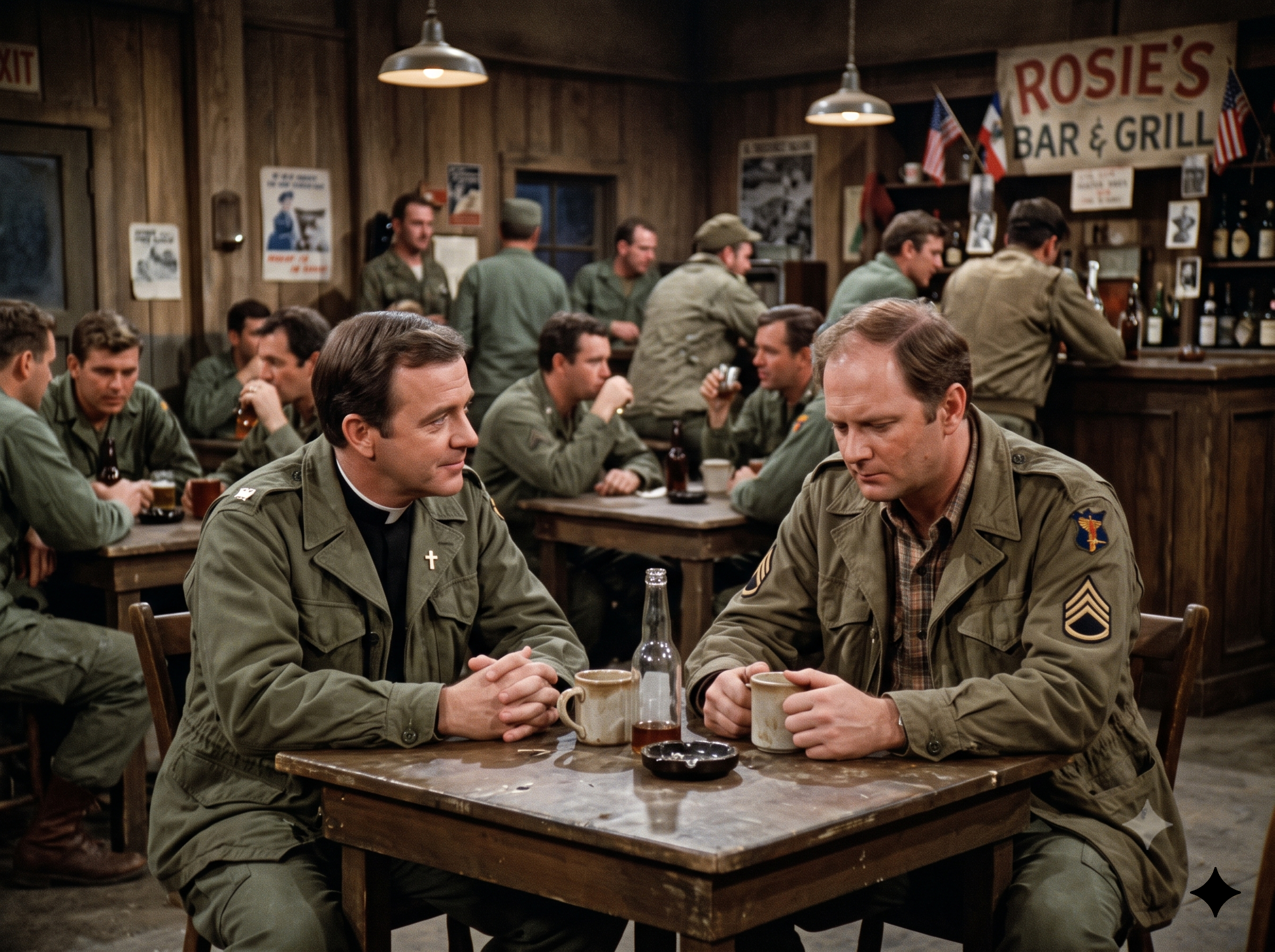
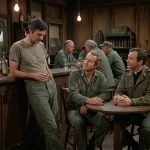
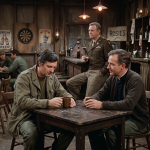
Rosie’s Bar was the closest thing the 4077th had to a sanctuary, provided you didn’t look too closely at the floorboards or ask what was actually floating in the beer.
It was a small, rustic wooden shack filled with worn tables, mismatched chairs, and the kind of dim, amber lighting that made everyone look a little softer, a little less haunted.
The air was thick with the smell of cheap cigars, fried food, and the desperate, loud laughter of exhausted people trying to forget the war for just one hour.
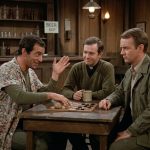
In the corner, away from the rowdy crowd of off-duty corpsmen and nurses, a heavy, quiet bubble enveloped one small wooden table.
Major Charles Emerson Winchester III sat staring blankly at the thick ceramic mug in his hands.
His normally pristine posture was gone, his shoulders slumped forward under the weight of his rumpled olive-drab jacket.
For once, there was no arrogant smirk, no condescending remark about the lack of proper stemware, and no sweeping declaration about the cultural wasteland of Korea.
Instead, the aristocratic surgeon simply looked utterly, profoundly defeated.
Sitting across from him was Father Francis Mulcahy, his hands folded modestly on the scratched tabletop.
The small silver cross on the Chaplain’s collar caught the warm, soft light filtering down from the bare bulb overhead.
Mulcahy didn’t speak right away; he had learned long ago that his most important job in this miserable place was often just to sit in the silence and bear witness to the pain.
They had just finished a grueling twenty-six-hour marathon in the operating room, a relentless wave of broken young men that had pushed the entire camp to its physical and mental limits.
On the table between them sat a half-empty clear glass bottle and a small metal ashtray, silent witnesses to a conversation that was struggling to begin.
Mulcahy watched as Charles traced the rim of his mug with a trembling finger, the surgeon’s emotionally guarded exterior showing deep, fractured cracks.
“It is the sheer, unadulterated pointlessness of it all that I cannot abide,” Charles finally whispered, his voice raspy and devoid of its usual Boston bravado.
Mulcahy leaned forward slightly, his eyes filled with gentle concern. “You did extraordinary work today, Charles. You saved that young corporal’s life.”
“I saved his life,” Charles replied, looking up slowly, his eyes bright with unshed tears and a fierce, helpless anger. “But I could not save his hands, Father. Did you read his chart? He was a pianist. A concert pianist.”
Charles gripped the mug tightly, his knuckles turning white as the noise of Rosie’s Bar faded into the background.
“I gave him a pulse, Francis,” Charles said, his voice finally cracking, “but I fear I have amputated his soul.”
The heavy silence returned to their small corner of Rosie’s, contrasting sharply with a burst of boisterous laughter from a group of GIs at the bar.
Mulcahy didn’t offer a quick platitude or a neatly packaged theological answer; to do so would be an insult to the deep, refined grief Charles was experiencing.
Instead, the priest slowly reached out and gently nudged the clear glass bottle toward the Major.
“I knew a boy in my parish back in Philadelphia,” Mulcahy began softly, his voice a steady, grounding murmur beneath the din of the bar.
“He was a runner. The fastest thing on two legs in the whole neighborhood, bound for a college scholarship.”
Charles stared at the bottle, his chest rising and falling in heavy, exhausted breaths, but he was listening.
“He caught polio when he was sixteen,” Mulcahy continued, looking down at his folded hands. “Lost the use of both his legs. I remember sitting with him in the hospital, thinking that the light in his eyes had been extinguished forever.”
Charles finally looked up, his jaw tight. “And I suppose you are going to tell me he found a new purpose, and everything was perfectly fine?”
“No,” Mulcahy said honestly, meeting Charles’s gaze with a quiet, moral warmth. “He was furious. He was bitter for a very long time. It was a terrible, unfair loss, just like this one.”
Mulcahy paused, offering a small, sad smile. “But a few years later, he started coaching the younger children. He couldn’t run, but he knew how to teach them the rhythm, the breathing, the joy of it. He found a way to let the music out, Charles, even if he couldn’t play the instrument the same way anymore.”
Charles closed his eyes, a profound weariness washing over his face as the priest’s gentle words found their mark.
The rigid, emotionally guarded walls of the Boston Brahmin didn’t entirely collapse, but they softened, allowing the bitter truth of the war to mingle with a small drop of grace.
“A pianist without hands,” Charles muttered, shaking his head, though the angry edge had left his voice.
“A boy who is going home,” Mulcahy gently corrected. “Going home to his family. Thanks to you.”
Charles let out a long, shuddering breath, the kind that carries the weight of a hundred lost hours of sleep.
He reached out and poured a small measure of the amber liquid into his mug, the clinking of the glass grounding him back in the present moment.
He didn’t offer a dramatic speech of gratitude, nor did he suddenly transform into an optimist.
Instead, he picked up the mug, holding it slightly awkwardly, and looked across the worn wooden table at the humble priest in his faded fatigue jacket.
“Your capacity for finding silver linings in this… this abattoir, Father, is as exhausting as it is mildly comforting,” Charles said, a faint, ghost of his usual dry wit returning to his tone.
Mulcahy’s eyes crinkled in a warm smile. “It’s a heavy cross, Major, but someone has to carry it.”
Charles took a slow sip of his drink, grimacing slightly at the taste of Rosie’s questionable liquor, but he didn’t put the cup down.
The dim, amber light of the bar seemed to settle around them like a protective blanket, shielding them temporarily from the mud, the blood, and the choppers waiting in the dark.
For a few more minutes, the aristocrat and the chaplain simply sat together in the warm, noisy gloom of Rosie’s Bar.
They didn’t fix the war, and they didn’t heal the heartbreak of a ruined musician, but in the quiet space between them, the terrible burden of the 4077th had been shared, and made just a little bit lighter.
Charles adjusted his collar, sitting up just a fraction straighter, his dignity slowly reassembling itself, anchored by the quiet friendship of the man sitting across from him.
In a place defined by what was lost, the quiet comfort found across a scratched wooden table was the only medicine that truly worked.