A Michelin Star in the Mud
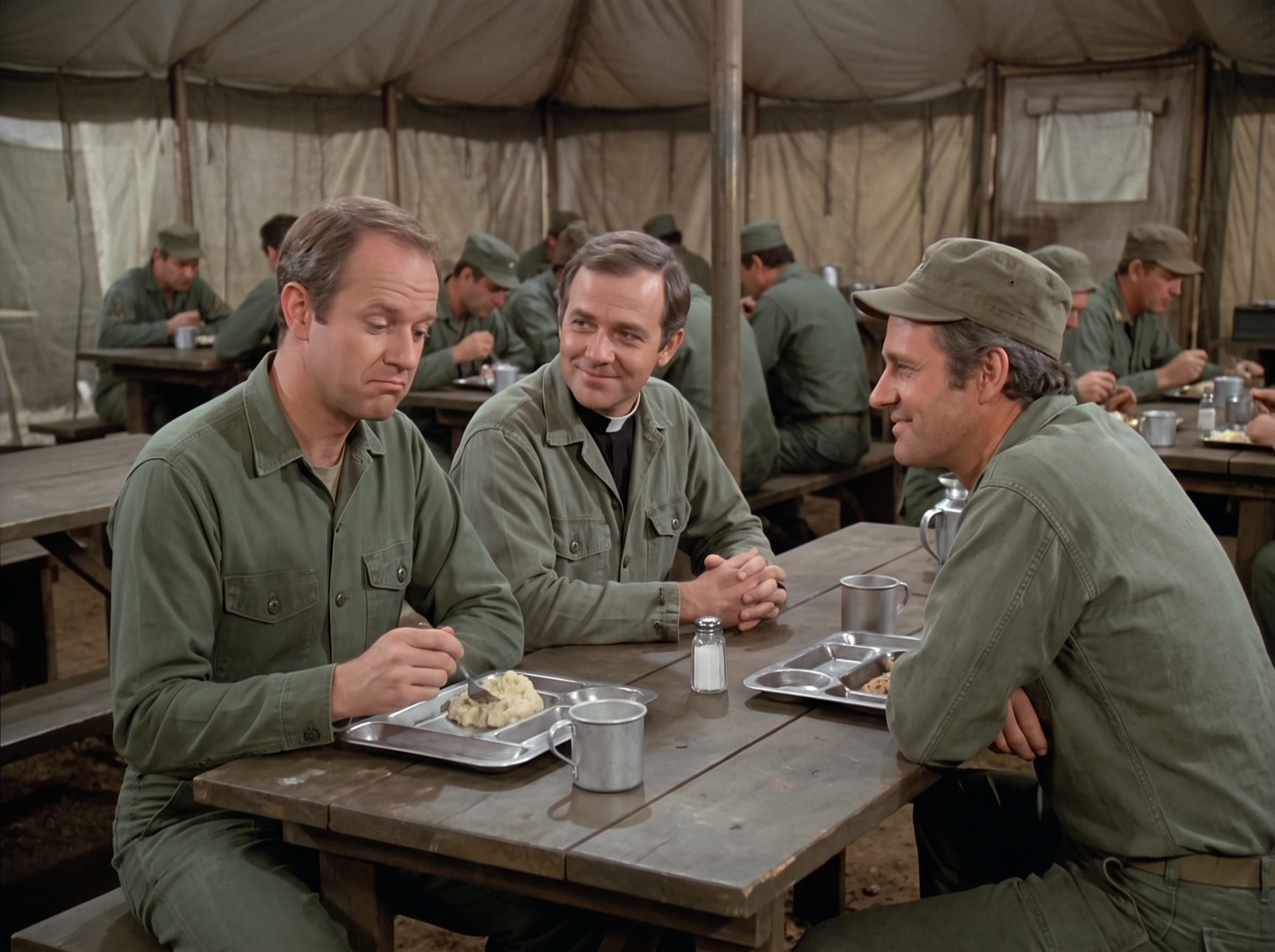
You could always tell exactly how long it had been since the last wave of choppers by the ambient volume of the 4077th mess tent.
On days when the war was quiet, the room buzzed with chaotic energy, practical jokes, and loud arguments over baseball. But today, after a grueling thirty-two-hour shift in the operating room, the mess tent was filled with nothing but a low, exhausted hum.
It was the sound of tired people chewing terrible food because their bodies required fuel, not because they had any appetite left.
The canvas walls flapped gently in the dry Korean wind, letting in thin streaks of grayish light that illuminated the dull, scratched metal of the mess trays.
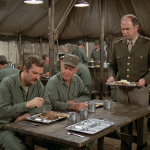
Sitting rigidly at one of the long wooden tables, Major Charles Emerson Winchester III looked as though he had just been handed a personal insult on a platter. Or, in this case, on a dented aluminum tray.
He sat perfectly upright, a stark contrast to the slumping postures of every other doctor and nurse in the room. Even drowning in a sea of standard-issue olive drab, Charles wore his fatigue shirt as if it were a tailored tweed jacket at the Harvard Club.
His eyes, however, were entirely focused on the single scoop of pale, yellowish mush resting in the center of his tray.
He held his standard-issue spoon suspended in the air, gripping it with the precise, delicate tension of a surgeon holding a scalpel. His eyebrows were raised in an expression of profound, restrained disgust. His lips were pursed, pressing together tightly as if to prevent his refined palate from crying out in sheer terror.
Beside him, Father Francis Mulcahy sat with his hands neatly folded on the table.
The chaplain wasn’t looking at his own food. Instead, he was watching Charles with a soft, gentle smile. Father Mulcahy had seen men face artillery fire with less trepidation than Charles was currently directing at Igor’s cooking. There was a quiet, moral warmth in the priest’s eyes, finding a spark of sincere, gentle humor in the sheer absurdity of the moment.
Across the table, B.J. Hunnicutt leaned his weight casually onto his forearms.
B.J. hadn’t shaved in two days. The dark shadow on his jaw made him look even more tired than usual, but his eyes were bright with dry amusement. He watched Charles’s internal struggle with an easygoing, friendly grin, fully prepared for the impending explosion.
Charles poked the yellow mound with the tip of his spoon. It did not yield. It simply moved across the metal tray as a single, unified entity.
“Igor,” Charles muttered, his voice trembling with a mixture of fatigue and aristocratic rage. “What, pray tell, is this?”
The mess tent grew just a fraction quieter.
Everyone at the surrounding tables knew that tone. It was the calm before the Winchester storm. When Charles got quiet and overly articulate, a masterclass in theatrical complaining was about to begin.
Charles took a deep, steadying breath, his chest expanding under his rumpled green shirt. He raised the spoon higher, his eyes narrowing, preparing to unleash a devastating monologue that would surely tear the very concept of Army cooking down to its foundations.
Before Charles could detonate, B.J. leaned a little closer across the table.
“I’d be careful, Charles,” B.J. said, his voice a warm, lazy drawl. “If you stare at it too long, it might decide to establish residency. And I hear it has a terrible personality.”
The tension in Charles’s shoulders hitched. He blinked, the grand, sweeping insult dying on his lips.
He looked at B.J., his aristocratic glare faltering for just a fraction of a second against the sheer, grounded warmth of Hunnicutt’s smile. Charles wanted to be furious. He wanted to rage against the mud, the blood, the canvas, and the terrible indignity of this culinary crime.
But he was just too tired. And, secretly, he was too comforted by the familiar rhythm of the banter.
“It is an affront to humanity, Hunnicutt,” Charles said, though the venom had noticeably drained from his voice. “It possesses the color of a bruised lemon and the structural integrity of industrial concrete. I believe it is meant to be mashed potatoes, yet it defies all botanical logic.”
Father Mulcahy chuckled softly, his folded hands remaining perfectly still.
“I believe the kitchen staff referred to it as a ‘sunshine surprise,’ Major,” Mulcahy offered gently. “Though I suspect one must have a very strong faith to find the sunshine within it.”
Charles slowly turned his head to look at the priest.
“Father,” Charles sighed, the weariness finally showing through his haughty facade. “Even the Almighty must look upon this tray and weep.”
“He tests us in many ways, Charles,” B.J. smiled, picking up his own metal mug of lukewarm coffee. “Today, your test is yellow and comes with a side of mystery meat. Eat up. You’ve got four more hours of post-op rounds, and your body needs the paste.”
Charles looked back down at the tray.
In Boston, he would have sent back a meal if the parsley was placed at the wrong angle. Here, three miles from the front lines of a forgotten war, he was debating whether a solid block of dehydrated potato substitute was worth the effort of chewing.
He closed his eyes for a brief moment, remembering the smell of roasting lamb, the clinking of crystal glasses, and the soft murmur of classical music in his family’s dining room.
When he opened his eyes, the dining room was gone.
He was back in the drafty tent. He smelled iodine, sweat, and boiling canvas. He saw the scuffed metal tables and the tired, slumped shoulders of the people who had just spent the last day and a half saving lives alongside him.
He looked at B.J., who was now forcing down a bite of his own food without complaint, his eyes staring blankly at the wall as he thought of his wife, Peg, halfway across the world.
He looked at Father Mulcahy, who was quietly blessing his own meager portion, grateful for whatever sustenance was provided, entirely focused on the spiritual well-being of his flock.
Charles realized, with a quiet pang of something he would never openly admit, that he wouldn’t trade these specific two dining companions for the finest table at the Ritz.
They were annoying, they were unrefined, and they possessed an entirely baffling sense of humor. But they were also the only thread keeping him tethered to his own sanity.
With a heavy, dramatic sigh that was entirely for show, Charles dug his spoon firmly into the yellow mound. It made a tragic scraping sound against the aluminum.
“Very well,” Charles declared, raising a modest portion to his mouth. “But let the record show that I am consuming this out of biological necessity, not out of any surrender to military standards.”
He placed the food in his mouth. His face instantly contorted into a mask of polite, agonizing regret.
B.J. let out a soft, genuine laugh, shaking his head. “Attaboy, Charles. Think of Boston.”
“I am trying, Hunnicutt,” Charles mumbled through the terrible food, picking up his tin mug. “But Boston feels very far away at the moment.”
“It’s not so far,” Father Mulcahy said softly, offering that same enduring, gentle smile. “As long as we have good company, Major, home is never entirely out of reach.”
Charles paused, the mug halfway to his lips. He glanced at the priest, then at B.J., feeling the familiar, quiet weight of their shared endurance.
He lowered the mug, giving a tiny, almost imperceptible nod of agreement.
They sat together in the damp, noisy tent, three very different men bound by circumstance, chewing terrible food in comfortable silence. The war raged on just over the mountains, but right here, at this scuffed metal table, there was a small, stubborn pocket of peace.
They came for the war, but they survived it because of each other.