The Mess Tent Mystery and the Boy from Iowa
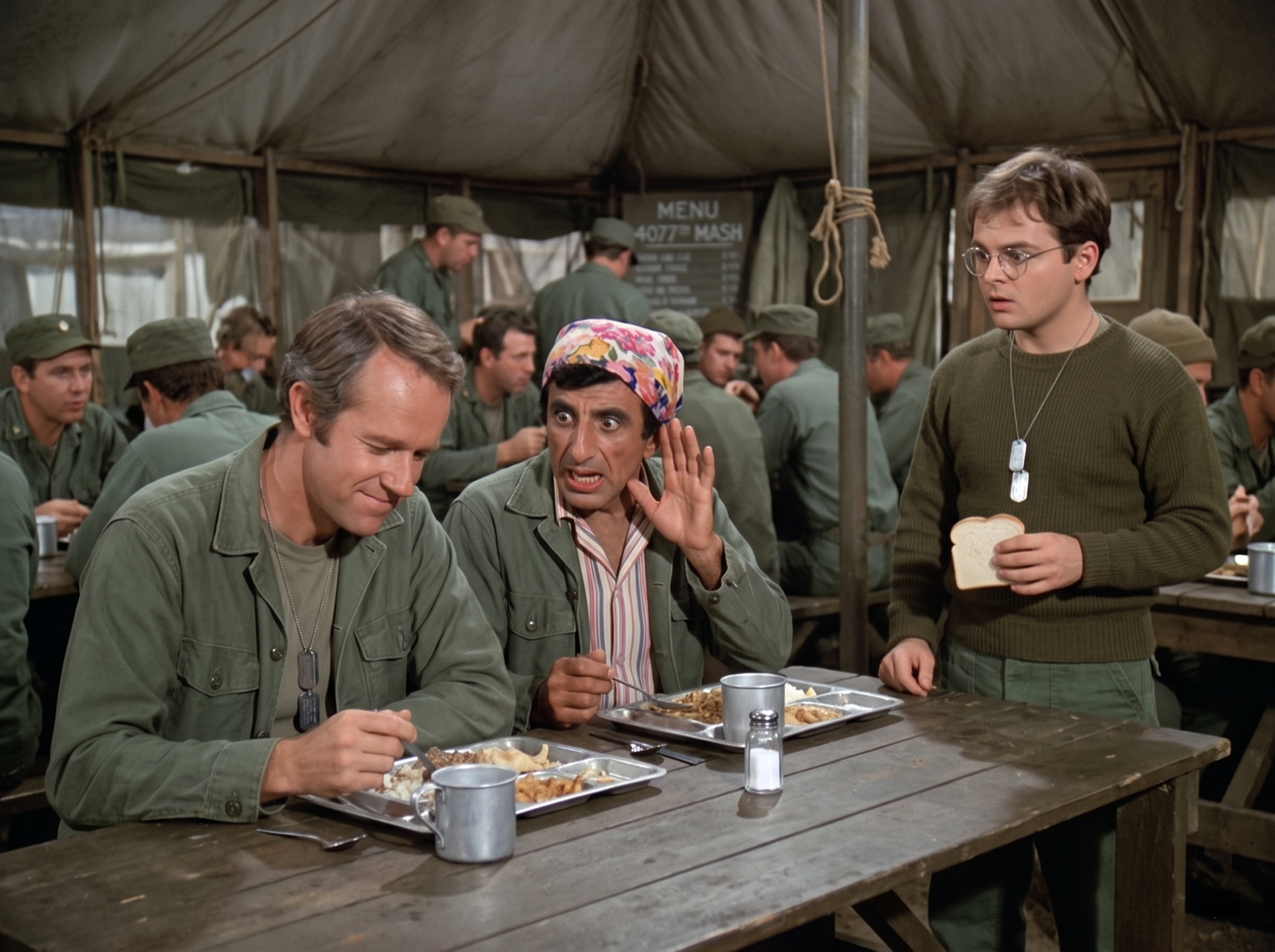
The 4077th Mess Tent at 1400 hours was a place where culinary hope usually went to die, or at least, to be covered in a thick layer of unidentifiable gray gravy.
You didn’t go to the mess tent for comfort. You went because the human body unfortunately required fuel to survive a war.
It was a quiet, lazy Tuesday afternoon. The midday sun filtered gently through the roof, casting a soft, even light over the endless sea of olive drab and faded beige canvas.
The room was nearly empty, smelling faintly of old coffee grounds, damp earth, and whatever mystery meat Igor had boiled into submission that morning.
At one of the long, simple wooden tables, Captain B.J. Hunnicutt slumped over his dull metal food tray.
His practical, worn olive uniform was rumpled, his shoulders carrying the heavy, invisible weight of a brutal twelve-hour shift in the operating room.
Yet, despite the deep fatigue etched into the lines around his eyes, B.J. wore a gentle, familiar smile.
He leaned lazily over his meal, projecting an aura of absolute, calm emotional stability in the face of truly terrible food. He used his fork not to eat, but to perform a slow, mocking autopsy on a gelatinous cube sitting on his tray.
“I think,” B.J. muttered with dry amusement, his voice smooth and steady, “this particular piece of meatloaf might still have a pulse. Should I call Margaret for a consult, or just hit it with a shovel and bury it?”
Sitting directly next to him was Corporal Maxwell Klinger.
Klinger was staring at his own metal tray as if it had just personally insulted his entire family lineage back in Toledo.
Suddenly, Klinger gasped.
It wasn’t a small gasp. It was a theatrical, sharp intake of air that practically sucked all the remaining oxygen out of the communal space.
His hands flew up into the air, his fingers splayed wide in a pose of absolute, sudden comic panic. He pushed himself back from the table, his eyes wide with profound horror.
“Captain!” Klinger shrieked, his voice cracking dramatically. “Captain Hunnicutt, don’t move! It moved! The lump on my tray… it just shifted on its own!”
Standing near the very end of the long table was Corporal Walter ‘Radar’ O’Reilly.
Radar had been quietly minding his own business, clutching a perfectly safe, dry piece of white bread in his hands.
At Klinger’s sudden shriek, Radar froze completely.
His wide, innocent eyes locked instantly onto Klinger’s tray. He held his piece of bread tight against his chest, as if using it as a small, beige shield to protect his heart.
“Did it squeak, Klinger?” Radar asked earnestly, his young voice trembling just a little bit. “Because back home in Iowa, if the meat squeaks, my Uncle Ed says you gotta get out of the kitchen before it bites you back.”
Klinger pointed a wildly trembling finger at the center of his food tray.
“I didn’t hear a squeak, Radar! I saw a twitch!” Klinger yelled, his dramatic hand placement making him look like a tragic actor on a stage. “A deliberate, hostile twitch! This isn’t lunch, Captain. This is biological warfare!”
B.J. didn’t flinch. He didn’t even drop his fork.
He just kept that calm, steady smile, leaning slightly closer to Klinger’s tray, while Klinger looked entirely ready to dive under the dull metal table to escape for his life.
“Take a breath, Klinger,” B.J. said smoothly, his warm voice acting as a soothing balm against the corporal’s rapidly rising hysteria.
“Take a breath?” Klinger echoed loudly, his hands now flying up to clutch his own face in deep despair. “I’m a young man, Captain! I have a whole beautiful life ahead of me in the glorious city of Toledo!”
Klinger gestured wildly toward the kitchen area. “I have hot dogs at Packo’s waiting for me! I refuse to be taken out by an angry piece of military-grade surplus beef!”
B.J. chuckled softly, the sound low and comforting.
He reached out with his fork and gave the offending lump on Klinger’s tray a gentle, clinical prod. The brown lump slid slightly across the slick, dull metal of the tray.
“See?!” Klinger yelled, scooting his wooden chair back another frantic inch. “Evasive maneuvers! It knows we’re watching it!”
“It’s just gravity, Klinger,” B.J. said, shaking his head with quiet, dry amusement. “The gravy has congealed. The structural integrity of whatever Igor calls this meat has compromised the surface tension. Thus, the slide.”
Radar took a slow, cautious step forward.
His round face was a picture of intense, pure focus. He peered over Klinger’s shoulder from a safe distance, his grip on his piece of bread never loosening.
“Are you absolutely sure, Captain?” Radar asked softly, his sweet innocence filling the room. “Because it kinda looks like the snout of a badger. Not that a badger would end up in here. They’re mostly nocturnal, and they don’t like loud noises.”
B.J. looked up at Radar, his eyes softening immediately.
There was something about the kid’s absolute, earnest nature that could instantly defuse any lingering tension in the camp. Radar looked at the world with a wide-eyed trust that the war had miraculously failed to destroy.
“I’m sure, Radar,” B.J. said gently, setting his fork down on the table. “It’s not a badger. It’s not a secret weapon from the enemy. It’s just… well, honestly, I think it’s supposed to be a mushroom.”
“A mushroom?” Klinger asked, dropping his hands to his sides. The sheer panic drained away, replaced by a look of profound, exhausted disappointment.
“A heavily mutated one,” B.J. agreed softly. He reached out and wrapped his hands around his chipped ceramic coffee mug. “But entirely harmless. Unless, of course, you actually try to digest it.”
Klinger let out a long sigh. It was a deep, theatrical sigh that spoke of the endless, daily indignities of being drafted into the United States Army.
He slumped forward, resting his chin on his hands, staring sadly at the dull tray and the beige walls.
“I was almost hoping it was dangerous,” Klinger muttered, the comedy fading into a quiet, relatable fatigue. “At least then I could apply for a Section 8 for being traumatized by my own lunch.”
B.J. laughed, a genuine, warm sound that filled the small, communal canvas space.
It was the laugh of a man who desperately missed his wife, missed his daughter, and was profoundly tired in his very bones. Yet, it was the laugh of a man who still found vital comfort in the absurd, beautiful people sitting right next to him.
Radar, seeing that the immediate crisis had fully passed, relaxed his stiff shoulders.
He looked closely at Klinger’s sad, deflated face. Then, the young corporal looked down at his own hand.
Slowly, with the quiet, unspoken tenderness that defined him, Radar stepped forward. He reached out and gently placed his pristine piece of dry white bread onto the clean edge of Klinger’s metal tray.
“Here you go, Klinger,” Radar said earnestly, his voice full of pure kindness. “You can have my bread. It’s safe. It hasn’t twitched once since I picked it up.”
Klinger looked down at the bread, and then up at Radar.
For a long second, all the theatricality and the dramatic comedy dropped away from the older man’s face. What was left was just a tired soldier, deeply touched by the gesture of a friend.
A soft, genuine smile finally touched Klinger’s lips. “Thanks, kid,” he said quietly, his voice lacking any of its usual volume.
“Don’t mention it,” Radar smiled brightly, reaching up to adjust his glasses. “I’ve got a backup piece wrapped in a napkin in my pocket anyway. Just in case.”
B.J. sat quietly, watching the gentle exchange. He leaned back slightly on the wooden bench, letting the worn, lived-in feeling of the mess tent wash over him.
He brought the ceramic mug to his lips and took another slow sip of his terrible, bitter coffee.
In that quiet moment, the bone-deep exhaustion of the operating room didn’t feel quite so incredibly heavy. The dull ache in his back seemed to fade just a little bit.
The mess tent was still drafty. The food on their dull metal trays was still terrible. The horrific reality of the war was still waiting for them just outside the olive drab canvas flaps.
But as B.J. looked at Klinger carefully breaking Radar’s safe piece of bread in half to share it, and Radar happily explaining the different types of wheat grown back home, B.J. felt a deep, profound sense of peace.
They were thousands of miles away from everything they loved, forced into a place they never wanted to be.
But somehow, in the middle of all the madness, the blood, and the bad food, they had managed to build a family out of canvas, coffee, and dry bread.
In a place where everything was broken, the quiet moments of shared survival were the only medicine that truly healed.