The Sanctuary of Red Tape
Silence at the 4077th wasn’t actually silent. It was just a different kind of noise. It was the sound of the canvas tents snapping in the dry Korean wind, the distant hum of a jeep engine in the motor pool, and the crunch of boots on the dusty camp path.
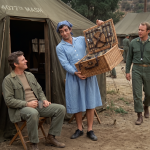
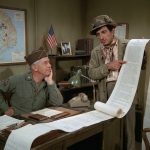
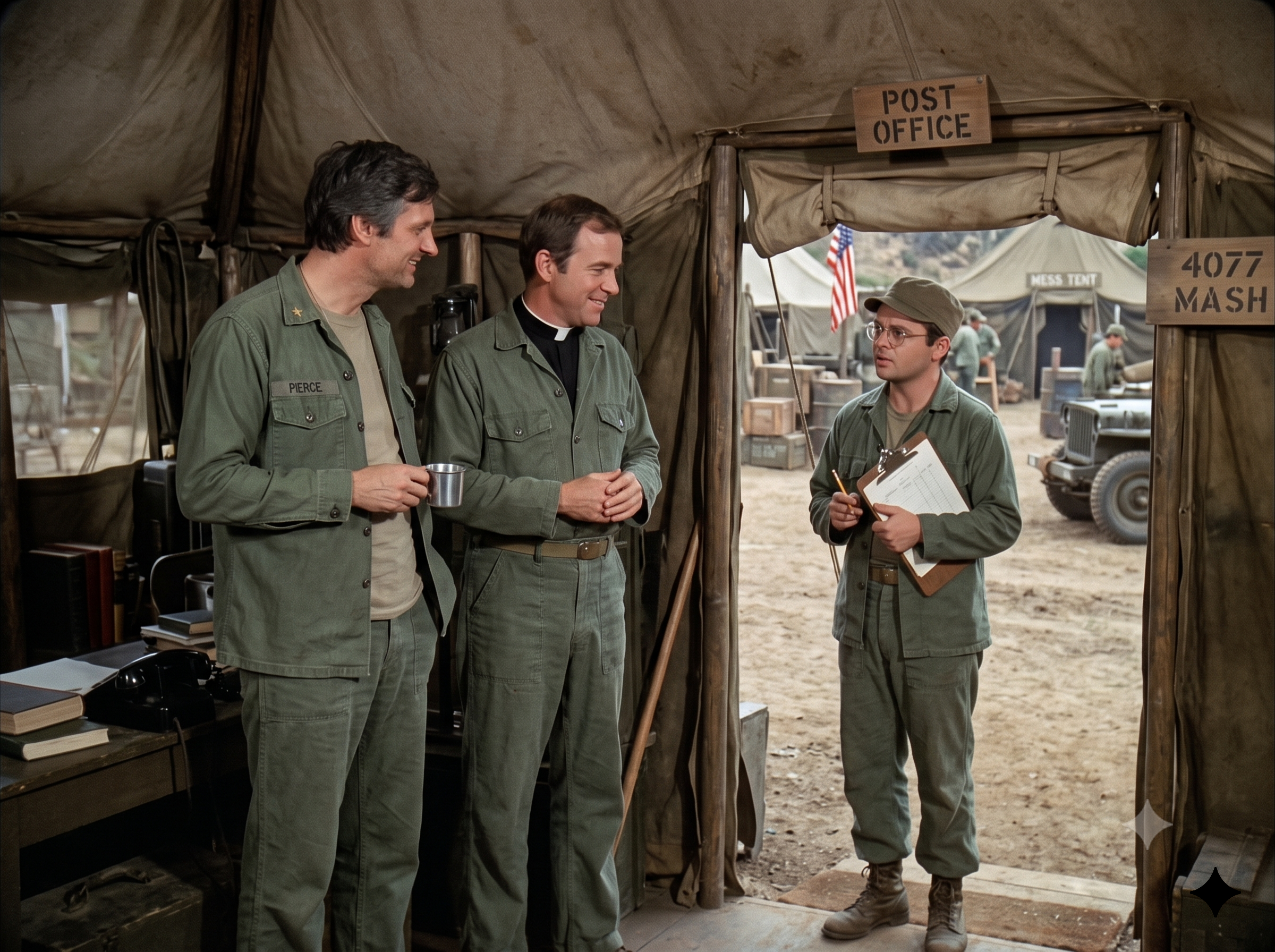
But inside the makeshift mail room, directly under the slightly askew wooden sign that read “POST OFFICE,” there was a rare, fleeting moment of genuine peace.
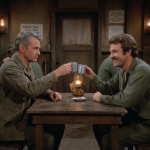
Hawkeye Pierce stood near the clerk’s desk, wearing his usual uniform of wrinkled green fatigues and a profound, bone-deep exhaustion. Yet, for the first time in what felt like a month, he wasn’t pacing. He wasn’t firing off sarcastic remarks at the walls. He was just standing there, leaning slightly, holding a battered metal canteen cup of something that barely passed for coffee, and smiling.
It was a real smile. Not the sharp, cynical smirk he used as a shield in the operating room, but a tired, human smile.
Beside him stood Father Francis Mulcahy. The chaplain’s presence always seemed to lower the temperature of a room by a few degrees. His white clerical collar peeked out from beneath his worn army greens, a quiet reminder of grace in a place that desperately needed it. They had been talking about nothing in particular—a memory of a Maine autumn, the proper way to roast a hot dog, anything that lived thousands of miles away from the war.
For five minutes, the war had stopped.
Then, the canvas flap moved.
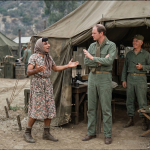
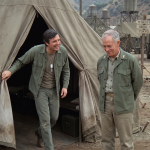
Corporal Radar O’Reilly appeared in the doorway, framed by the bright, dusty beige of the camp outside. In the distance, the olive-drab peak of the mess tent sat quietly under the afternoon sun, but Radar’s attention was entirely inside the tent.
He stood half-in and half-out of the doorway, clutching his trusty wooden clipboard to his chest like a piece of armor. His cap was pulled down over his brow, his round glasses reflecting the soft light of the tent.
Radar possessed a sixth sense for many things, but his most tragic gift was knowing exactly when to hesitate. He could see the relaxed set of Hawkeye’s shoulders. He could see the gentle, easy way Father Mulcahy was leaning against the table. Radar knew what peace looked like, and it broke his heart to be the one to ruin it.
He cleared his throat. It was a small, nervous sound.
Hawkeye turned toward the door. His posture remained relaxed, the metal cup resting easily in his hand. He looked at the young corporal with a witty, affectionate patience. “Enter, O’Reilly,” Hawkeye said warmly. “We were just discussing the theological implications of the mess tent’s meatloaf. Father Mulcahy believes it requires an exorcism.”
Father Mulcahy offered Radar a mild, comforting smile of sincere kindness, pausing his own thoughts to welcome the boy in.
But Radar didn’t smile back. He gripped the edges of the clipboard tighter, his knuckles turning slightly white. He stepped just over the threshold, his boots resting on the wooden floorboards, his back still to the dusty camp.
“Sirs,” Radar stammered, his voice tight with apology. “I, um… I have a message from I Corps. About the requisition forms we sent up last Tuesday.”
Hawkeye’s smile didn’t vanish, but it froze. The canteen cup in his hand suddenly looked a little heavier. “The requisition for the St. Jude Orphanage?” Hawkeye asked, his voice dropping an octave. “The extra wool blankets and the powdered milk?”
Radar swallowed hard, looking down at the ground. “Yes, sir.”
Hawkeye took a slow breath. “And?”
“And…” Radar winced, hating the words before they even left his mouth. “They denied it, Captain. The Quartermaster in Seoul stamped it ‘Non-Essential Civilian Aid.’ They said the army isn’t running a charity.”
The silence that followed wasn’t peaceful anymore. It was the heavy, suffocating silence that always came just before Hawkeye Pierce broke a rule, a chair, or an officer’s nose.
Hawkeye lowered the metal cup. The relaxed slump of his shoulders tightened into a rigid line. The gentle humor vanished from his eyes, instantly replaced by the familiar, righteous anger that kept him functioning in a madhouse.
“Non-essential,” Hawkeye whispered, the word tasting like ash. He took a step toward the center of the tent. “Non-essential. There are thirty kids freezing their toes off in a bombed-out church five miles from here, and some clerk with clean fingernails in Seoul says it’s non-essential.”
He started to pace, the brief sanctuary of the afternoon entirely shattered. “I’ll get him on the phone. Get me the spark-gap, Radar. I want to talk to the general. I want to talk to the president. I’ll walk to Seoul and wrap that requisition form around the Quartermaster’s neck—”
“Hawkeye,” Father Mulcahy said.
It was just one word, spoken softly, but it had the weight of an anchor. Mulcahy stepped forward, his expression losing its easy warmth but retaining its deep, steady compassion. He didn’t reach out, but his presence was enough to make Hawkeye pause.
“Anger won’t keep those children warm, Hawkeye,” the priest said gently. “And yelling at a desk clerk will only get you court-martialed. We must find another way.”
Hawkeye ran a hand through his greying hair, letting out a long, ragged sigh. The fight drained out of him, leaving only the crushing fatigue of a man trying to empty the ocean with a slotted spoon. “There is no other way, Father. The army has spoken. In triplicate.”
By the doorway, Radar shifted his weight. He was still standing half-outside, his shadow stretching across the dusty floorboards. He pushed his glasses up the bridge of his nose.
“Um. Excuse me, Captain?”
Hawkeye looked up, his eyes tired. “It’s not your fault, Radar. I know you’re just the messenger. Put the denial in my file. I’ll use it to line my birdcage.”
“Well, that’s the thing, sir,” Radar said, his voice squeaking slightly before he forced it steady. He pulled a pen from behind his ear and looked down at his clipboard. “They denied Form 412-B for civilian aid. That’s absolutely true.”
Hawkeye frowned, confused by the boy’s tone. “Right. So we get nothing.”
“Well,” Radar continued, looking nervously between Hawkeye and the priest. “I was on the radio with Corporal Jenkins at Supply. Jenkins owes me a favor from when I covered for him during the poker game with the Marines last month. So, I was talking to him about how cold it’s getting.”
Hawkeye stopped moving. Father Mulcahy tilted his head, a quiet curiosity blooming on his face.
Radar flipped a page on his clipboard. “It turns out, sir, that while I Corps is very strict about civilian aid, they are currently running a surplus of ‘Thermal Engine Protectors’ for heavy motor pool equipment. And they have a massive backlog of ‘High-Caloric Nutritional Rations’ for search-and-rescue dogs.”
The tent was perfectly quiet again. Outside, a jeep rumbled past, kicking up a cloud of beige dust that drifted past the canvas flaps, but inside, the air was entirely still.
Hawkeye stared at the young clerk. The anger that had been boiling in his chest suddenly evaporated, replaced by a profound, overwhelming affection.
The image of the three of them—frozen in time in that dusty doorway—was perfectly complete. Hawkeye turned his body back toward Radar, his posture relaxing into a slouch. The witty, affectionate patience returned to his face, softening the hard lines around his eyes. He looked at Radar not as a subordinate, but as a brilliant, criminal little brother.
Beside him, Father Mulcahy gently paused mid-sentence. The priest folded his hands together, offering Radar a mild, comforting smile of sincere kindness. It was a look of pure, holy pride.
“Radar,” Hawkeye said, his voice barely above a whisper, laced with awe. “Are you telling me you ordered army dog food for a Catholic orphanage?”
Radar blushed, looking down at his boots. “It’s powdered milk, sir. They just put a different label on the tin so the brass doesn’t ask questions. And the engine protectors are just wool blankets dyed brown instead of green. They’re arriving on the supply truck tomorrow at 0600.”
Hawkeye slowly raised his metal cup, offering a silent, reverent toast to the boy in the doorway.
“You are a delinquent, O’Reilly,” Hawkeye smiled, the warmth radiating from his tired face. “You are a master of fraud, a corrupter of the United States military, and an absolute criminal.”
Radar looked up, a hesitant, goofy smile spreading across his face. “Thank you, sir.”
“The Lord works in mysterious ways, Corporal,” Father Mulcahy added softly, his eyes crinkling at the corners. “And it seems He frequently relies on your filing system.”
Radar held out the clipboard, stepping fully into the tent for the first time. “I just need you to sign this, Captain Pierce. It’s an authorization form. Since you’re technically the acting Motor Pool Morale Officer this week.”
“I’ve never been prouder to hold the title,” Hawkeye said. He traded his canteen cup for the clipboard, balancing it on his arm as he signed the requisition with a grand, sweeping flourish. He handed it back, tapping the wood twice. “Make sure those ‘engine protectors’ get a police escort to St. Jude’s the minute they arrive.”
“Already arranged it with the MPs, sir. I traded them a tin of the dog food.” Radar winked, tucked the clipboard under his arm, and gave a sharp, happy nod. “I’ll go file this.”
He turned and stepped back out into the bright, dusty camp path, vanishing behind the canvas flaps, leaving the two older men alone once more.
Hawkeye picked up his cup of awful coffee. He took a sip, grimaced, and looked over at Father Mulcahy. The war was still raging just over the hills. The wounded would still come. The exhaustion would never really leave.
But for today, the kids would be warm.
Hawkeye smiled, leaning back against the wooden desk. The sanctuary had returned to the 4077th.
In a place surrounded by endless madness, the greatest medicine they ever prescribed was simply looking out for each other.