The Typo That Stopped the 4077th
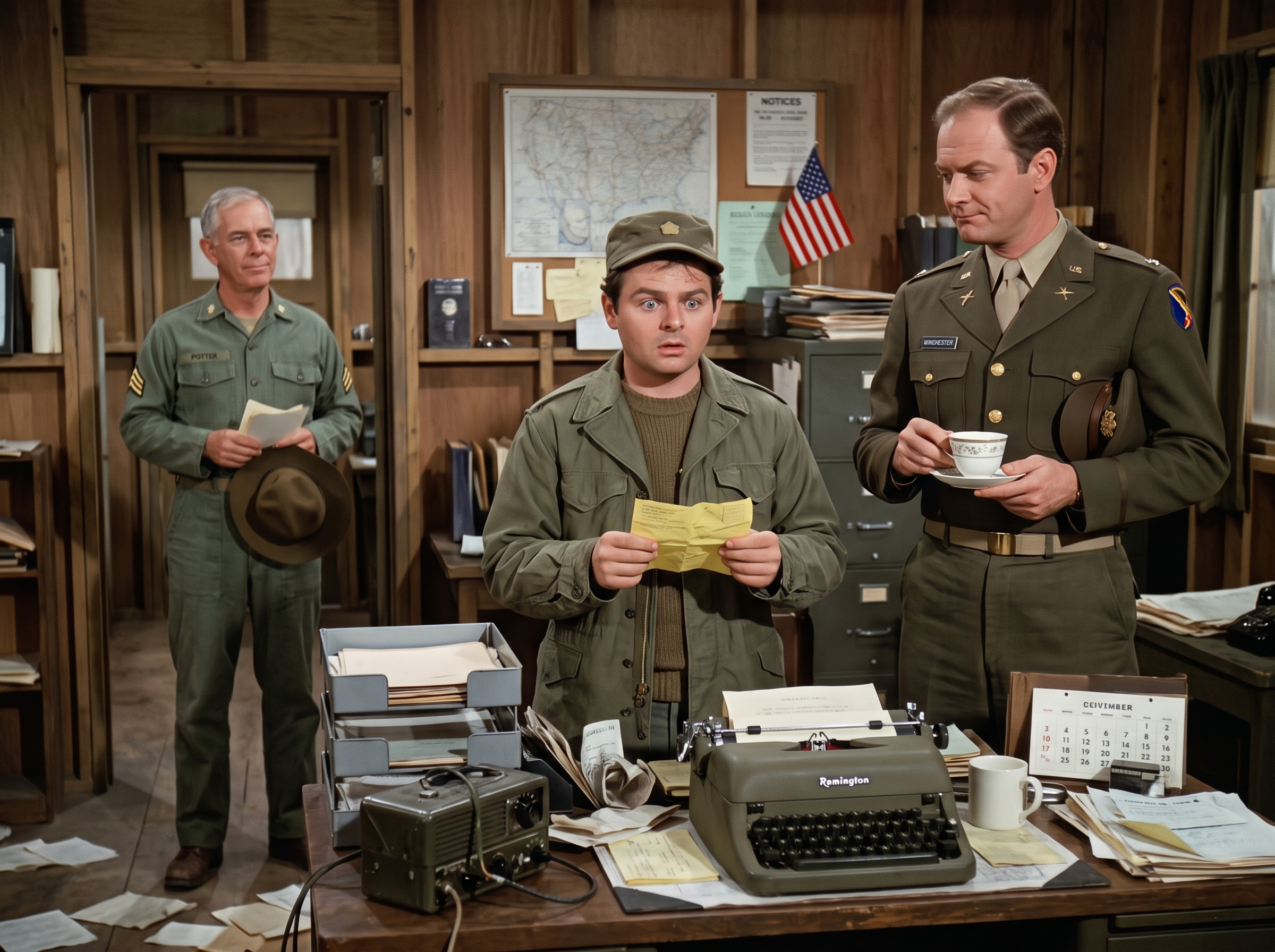
It was just past dawn at the 4077th, and the clerk’s office was already losing its daily battle against the United States Army’s relentless supply of paperwork.
The air in the small room felt heavy, smelling faintly of stale coffee and damp canvas. Pages of discarded forms and carbon paper littered the wooden floorboards, scattered like fallen leaves in a bureaucratic autumn.
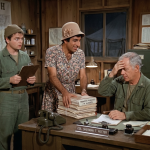
Behind the clutter of his desk, Corporal Walter “Radar” O’Reilly stood completely frozen.
He was dressed in his familiar olive drab jacket, green sweater, and jeep cap, but his youthful face was utterly drained of all color.
In his hands, he clutched a crumpled yellow telegram. His eyes were as wide as saucers, projecting a mixture of absolute innocence and sheer, unadulterated panic.
“I… I can’t do it,” Radar stammered, his voice cracking into a high pitch that hadn’t been heard since he was a boy in Iowa. “They can’t make me. I have flat feet. And I’m allergic to loud noises.”
Standing just a few feet away, Major Charles Emerson Winchester III seemed to occupy an entirely different universe.
Immaculately dressed in his pristine Class A dress uniform, Charles held a delicate, floral china teacup resting perfectly on its saucer.
He gazed down at the trembling corporal, one eyebrow arched in an expression of spectacular, dry superiority.
“Do try to breathe, Corporal,” Charles drawled, taking a slow, refined sip of his morning tea. “It is highly unseemly for an enlisted man to hyperventilate over a piece of official stationery. What, pray tell, has the great machine demanded of you now?”
“It’s a direct order from I Corps, Major,” Radar gasped, holding the yellow paper out as if it were a live grenade. “They’re… they’re transferring me.”
Charles sighed, clearly inconvenienced by the drama, yet undeniably curious. “Transferring you? To where? A finishing school, one can only hope?”
“To the infantry,” Radar whispered, his chin trembling visibly. “Front line. Foxhole duty.”
The silence in the office suddenly felt heavier than the distant rumble of artillery.
Behind them, standing quietly in the doorway, was Colonel Sherman T. Potter.
He had just stepped into the room, wearing his faded green fatigues. In one hand he casually held his campaign hat, and in the other, a small piece of paper.
Potter didn’t interrupt the scene unfolding before him. He simply stood there, observing his clerk’s total meltdown and his surgeon’s haughty composure with a grounded, patient, fatherly smirk.
“Infantry?” Charles repeated, setting his teacup down with a sudden clatter. The sarcastic arch of his eyebrow faltered just a fraction.
“Yes, sir,” Radar squeaked, clutching the telegram tightly to his chest. “Effective immediately. They’re sending a jeep.”
Charles looked at the frightened boy, then glanced around at the chaotic piles of forms, requisitions, and medical files that miraculously kept their fragile hospital running.
The harsh reality of a 4077th without Radar O’Reilly suddenly dawned on the proud Boston aristocrat.
“That,” Charles said, his voice entirely losing its mocking edge, “is absolutely, unequivocally, out of the question.”
Charles stepped forward, his imposing frame suddenly shifting from casual observer to active defender.
He reached out and decisively plucked the crumpled yellow paper from Radar’s shaking hands.
“Let me see that document,” Charles demanded.
He adjusted his posture, bringing the telegram closer to his face. For a fleeting moment, the refined surgeon looked like a four-star general preparing to counter-attack an entire enemy division.
“This is an outrage,” Charles muttered, his eyes scanning the poorly typed lines. “An absolute travesty of military intelligence. Which, I might add, is an oxymoron of the highest order.”
Radar swallowed hard, his hands nervously finding the edges of his jacket. “Are you gonna operate on me, Major? Take out my appendix so I fail the physical?”
“Don’t be absurd, Walter,” Charles snapped, surprisingly using the boy’s actual first name without a hint of irony. “I am going to do something much more effective. I am going to place a call to General Peterson at I Corps.”
Radar’s eyes somehow grew even wider. “You can’t call a General!”
“I most certainly can,” Charles retorted, straightening his shoulders proudly. “The man’s sister is married to my mother’s second cousin. He is a buffoon, but he is a buffoon who owes the Winchester family a considerable favor.”
Charles turned slightly toward the green field radio sitting securely on the busy desk.
“No one takes our clerk away,” Charles said, his voice firm and unusually protective. “This place is a madhouse on its best day. Without you, we would be living in caves and eating tree bark within a week.”
It was, perhaps, the most profound and genuine compliment Charles Emerson Winchester III had ever paid to anyone outside of Massachusetts.
Radar blinked, thoroughly stunned by the fierce defense from the camp’s resident snob. “Gosh, Major. Thanks.”
“Do not mention it. Ever,” Charles replied stiffly, his aristocratic armor sliding back into place. “Now, how does one operate this archaic radio contraption?”
“Hold your horses, Winchester,” a gruff, warm voice cut through the tense room.
Colonel Potter stepped fully into the office. The fatherly smirk on his face had softened into a genuine, weathered smile.
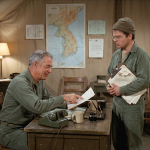
He walked past the large bulletin board covered in faded notices and the map of the United States pinned to the wooden wall.
“Colonel,” Charles said, immediately standing at attention. “I am simply attempting to rectify a catastrophic error by the brass.”
“I appreciate the enthusiasm, Major,” Potter said gently, coming to a stop near the desk. “But you can leave General Peterson’s sister out of this.”
Potter rested a hand near the heavy, green Remington typewriter sitting squarely in the middle of the clerk’s station.
“Son,” Potter said, looking directly at Radar’s pale face. “Read the serial number on that telegram.”
Charles, who was still holding the yellow paper, squinted at the top line. “US53… 90… 421.”
Radar blinked, his panic slowly beginning to recede as confusion took over. “But… my serial number is RA15021306.”
“Bingo,” Potter said, tapping the piece of paper he held in his own hand. “And read the name again, Major. Out loud. Carefully.”
Charles sighed softly, adjusting his gaze to the poorly inked type. “Corporal… Wallace O’Reilly. With an ‘E-I-L-L-Y’. Ah.”
Charles slowly lowered the paper, handing it back across the desk to the clerk.
“It appears, Corporal, that the United States Army has confused you with someone who is entirely not you,” Charles concluded.
Radar looked at the paper, then up at Charles, and finally over to Colonel Potter. The youthful color slowly began to return to his cheeks.
“You mean… I’m not going to the front?” Radar asked, his voice trembling with a completely different kind of emotion now.
“The only front you’re going to, son, is the front of the mess tent line,” Potter said warmly. “I got a call from I Corps ten minutes ago apologizing for the mix-up. Wallace O’Reilly is a motor pool mechanic down in Seoul. You’re staying right here at the 4077th where you belong.”
Radar let out a long, shaky breath that seemed to deflate his entire body. He sank back slightly, the heavy, terrifying weight of the war lifting off his small shoulders for just a brief moment.
“Oh, wow,” Radar whispered, clutching the paper. “Thank you, Colonel.”
“Don’t thank me, thank the Army’s legendary inability to spell,” Potter chuckled softly.
He looked over at Charles, his eyes crinkling with deep amusement. “Mighty fine of you to offer to call in a family favor, Winchester. Mighty fine.”
Charles cleared his throat, his face flushing just a fraction of an inch. He quickly picked up his floral teacup from its saucer.
“I assure you, Colonel, my motives were entirely selfish,” Charles said, desperately trying to re-establish his aloof reputation. “If Corporal O’Reilly leaves, who on earth would manage the procurement of my imported bath salts?”
Potter just smiled, knowing perfectly well that the Major was lying through his teeth to hide a tender heart.
“Right. Bath salts,” Potter said dryly. “Carry on, gentlemen.”
The Colonel turned and headed back out the door, pausing just long enough to put his worn campaign hat back on his head.
In the office, the familiar, comfortable quiet settled back in.
Radar sat down in his chair, carefully folding the yellow telegram and placing it safely in a desk drawer.
Charles took a slow sip of his tea, looking around the cluttered, chaotic room that smelled of dust, ink, and exhaustion.
“Corporal?” Charles asked softly into the quiet room.
“Yes, sir?”
“If you ever hyperventilate near my morning tea again, I shall transfer you to the infantry myself.”
Radar smiled, a small, genuine, knowing smile. He pulled a fresh sheet of carbon paper from a stack on his desk.
“Yes, sir, Major,” Radar said.
It was just another morning at the 4077th. They were bone-tired, they were thousands of miles from home, and the paperwork was still a catastrophic mess.
But as Radar loaded the fresh paper into his typewriter, the loud clack of the keys didn’t sound like a war machine anymore.
In a place surrounded by madness, the greatest comfort was simply knowing you had a family fighting to keep you exactly where you belonged.