The Point on the Mountain
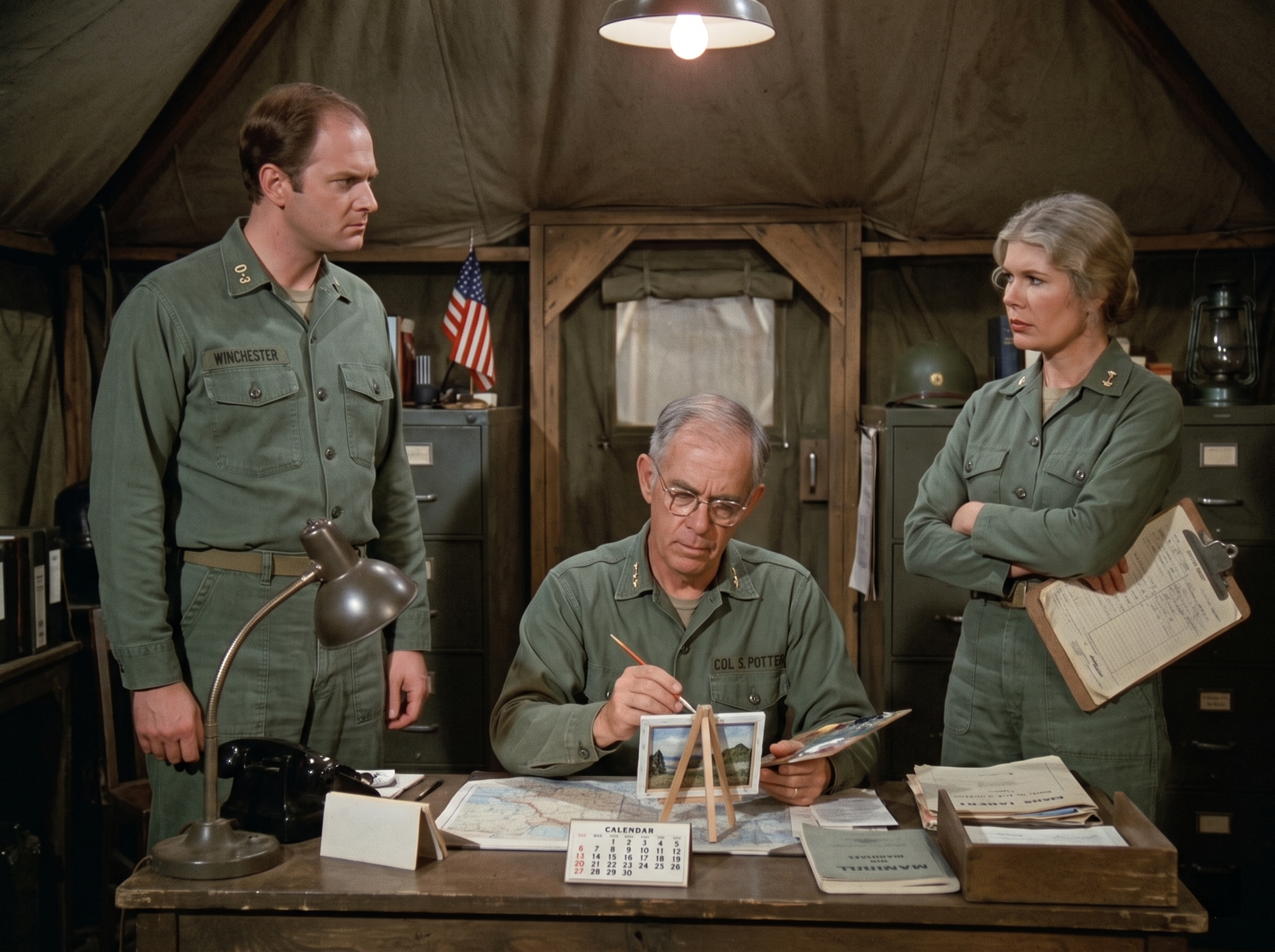
The O.R. lights were harsh, stripping away pretense and privacy, leaving only blood, sweat, and survival. But inside Colonel Sherman Potter’s canvas sanctuary, the light was different. It was soft, warm, and smelled of Old Spice, filterless cigarettes, and, today, turpentine. It was a modest, functional space, a cluster of filing cabinets, a worn desk, and the quiet dignity of command, held together by olive-drab canvas and sheer will. A low-hanging light bulb struggled to banish the shadows of a gray afternoon in Korea. On the calendar on the desk, the date was April 1953. Spring was technically here, though the chill and the dampness suggested otherwise.
Major Margaret Houlihan was the first to speak, her tone efficient, sharp, and tightly controlled. “Colonel, the surgical suite is not a buffet. We use what is available, what is safe, not whatever boutique supply Captain Winchester decides is aesthetically pleasing for a basic closure.” Her arms were folded tightly across her chest, a physical manifestation of her resolve. In her left hand, she gripped a medical chart, a clipboard full of logical arguments and professional grievances. She stood rigid, her professional demeanor masking her weariness, her eyes locked onto the back of the Colonel’s head.
Captain Charles Emerson Winchester III, standing to her left, didn’t immediately speak, which was usually a sign he was crafting a devastating rhetorical flourish. He was a pillar of starched indignation, his stance upright and precise, mirroring her intensity. His name tag, ‘WINCHESTER’, was perfectly level. His face, however, held a raised eyebrow of refined irritation, directed solely at Margaret. “My dear Major,” he began, his voice dripping with condescending patience. “There is a difference between utilitarian stitching and surgical artistry. A patient who survives should not carry the visual scar of your pedestrian needlework.“
Potter didn’t move. He sat leaning slightly forward in his chair, his glasses perched on his nose. His expression was a portrait of serene focus, radiating the weary, patient wisdom of a man who had seen too many wars and heard too many arguments. His face was weathered, his skin a roadmap of decades of service and concern. Between his fingers, he delicately held a tiny paintbrush. His other hand held a small, humble palette smeared with dots of blue, brown, and green. A miniature easel, barely larger than a notepad, supported a minuscule canvas. He was completely ignoring them. He was focused on placing a microscopic point of white color onto the tiny peak of a distant, painted mountain.
The silence that followed Winchester’s comment stretched dangerously thin. Normally, a Colonel would bark, a desk would be slapped, or a judgment would be made. Today, only the faint skritch of the tiny brush against the canvas disturbed the quiet. Margaret shifted her weight, a subtle sigh escaping her. “Colonel?” she asked, her voice cracking slightly under the pressure of the stillness. They were waiting for his judgment. Waiting for fatherly authority to settle the matter. They were trapped in a state of controlled frustration, balanced precariously on an emotional precipice, waiting for him to simply look up.
Potter held his breath, his eyes narrowed, the brush hovering. He placed the speck of paint, withdrew the hand, and then finally exhaled slowly. He didn’t turn around. He didn’t drop his hands. He merely rotated slightly, the miniature palette and brush remaining fragile extensions of his focus. He looked at Margaret, then at Winchester, through the top of his spectacles, his eyes containing the quiet weight of things far more important than surgical aesthetics. The emotional focus shifted instantly, the comedic tension evaporating under the gravity of his simple, tired presence.
“A point on the mountain,” Potter said quietly, his voice a low, comforting gravel. “Just one tiny, specific point of light.” He gestured with the brush toward the minute painting, which featured a landscape they all knew too well, but stripped of its ugliness. It was a memory of home, maybe, or a vision of a world not covered in dust. “You can get lost in the details out here, you know?” he continued. “Details like silk sutures or supply protocols. It’s easy to focus so hard on the small things because the big things—the constant noise, the unending flow of broken boys—are too damn big to handle.” He paused, letting the truth of it settle in the warm, enclosed air.
He finally lowered the palette and brush to the messy surface of his desk, near the calendar noting the passage of time. The antique telephone sat silent, a rare blessing. “You’re both right, of course. Major, we use what we have, and we use it efficiently. The logistics are critical. And Captain,” he turned his head slightly toward Winchester, “your commitment to excellence is commendable. We all strive for artistry.” He looked from one to the other, his expression softening into profound tenderness. “But if we spend our limited energy fighting each other over how to save a life, we lose sight of the fact that we are saving lives. Together.“
Margaret’s crossed arms relaxed slightly, her grip on the clipboard softening. She recognized the weariness in his voice. It was the same weariness she felt, the exhaustion of carrying the responsibility of an entire nursing staff on her shoulders. Her jaw unclenched, and for the first time in hours, she looked like a tired nurse rather than a Major. “Yes, Colonel. We will find a solution. Captain.” She gave Winchester a stiff, but genuine nod.
Winchester, too, felt his irritation dissipate. His rigid posture yielded to a slight slouch, the starched perfection of his uniform seeming less armored. Deep down, he was a dedicated surgeon. And he was a part of this found family. He recognized the gentle wisdom of Potter’s distraction. It wasn’t apathy; it was a necessary escape, a quiet protest against the chaos. “I… yes, quite. Perhaps we can re-evaluate supply allocation in the morning, Major.” He offered the closest thing he could manage to an apology.
Potter reached for a worn rag to wipe the blue paint from his thumb. He looked up, the corner of his mouth turning up in a small, tired smile. “There’s always enough work to go around, folks. We don’t need to go inventing new problems.” He picked up the small painting and held it closer to the light. “If only this tiny world could heal the real one,” he murmured, more to himself than them.
For a moment, they just stood there. The soft light, the quiet, and the gentle scratch of paint on canvas felt like a gift. They were tired, frustrated, and stuck in a war zone. But in that small, functional tent office, surrounded by filing cabinets and a desk full of papers, they were also together. It was a quiet moment of humanity, a temporary truce in the constant noise. Margaret quietly set the clipboard down. Winchester offered a simple, stiff nod. They were simply three people sharing a fragile moment of peace, held together by the quiet authority and profound wisdom of a man who just wanted to paint a mountain.
In the end, it was always the small acts of creation that held them together when the world felt like it was breaking.