The Quiet Watch of the 4077th
The hardest part of a twenty-four-hour session in the OR wasn’t the noise. It wasn’t the shouting, the clatter of dropped instruments, or the relentless, thumping rhythm of the incoming helicopters.
The hardest part was the heavy, fragile silence that settled over the Post-Op ward long after the fighting had stopped.
It was three in the morning at the 4077th Mobile Army Surgical Hospital. The camp was dead to the world, wrapped in the damp, freezing chill of a quiet Korean night.
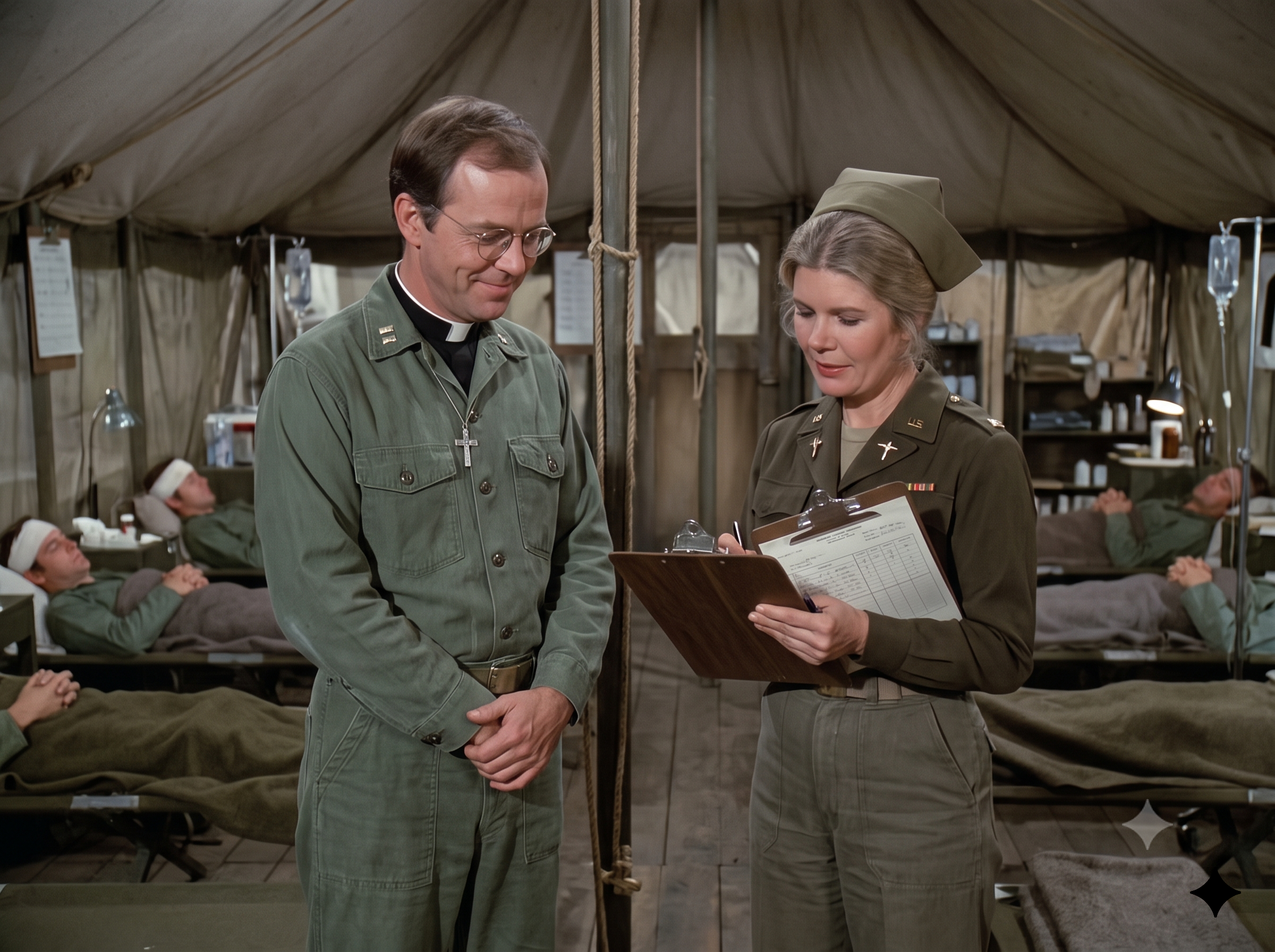
Inside the long, canvas recovery tent, the air was thick. It smelled of damp wool blankets, iodine, and the lingering, stale residue of nervous sweat. Rows of simple canvas cots lined the rough wooden floorboards. They held the sleeping, broken bodies of young men who were a million miles from home, wrapped in pale green pajamas and muted gray blankets.
Major Margaret Houlihan was not sleeping. She rarely did when there was a critical case in her ward.
She moved quietly down the center aisle, her posture impeccably straight despite the bone-deep fatigue pulling at her shoulders. Her green fatigues were crisp, her hair tucked neatly beneath her nurse’s cap. She was the absolute picture of military discipline. To the camp, she was the iron-willed head nurse who demanded perfection from everyone, but mostly from herself.
But in the quietest hours of the night, when the brass and the wisecracking doctors were finally asleep, her armor always softened just a fraction.
She stopped at the foot of cot number four, her boots making a soft creak against the floorboards.
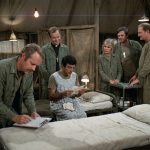
Standing on the other side of the cot, bathed in the soft, even light of a solitary bulb, was Father Francis Mulcahy. He wore his standard green fatigues, the silver crosses on his collar catching the dim light. His hands were gently folded in front of him, resting quietly against his waist.
He had been standing there for hours. Father Mulcahy was the camp’s spiritual sentry. He didn’t wield a scalpel, but he offered something equally vital to the dark corners of the tent: a quiet, unshakeable presence.
The young soldier in cot four, a private with heavy white bandages wrapped around his head, had been fighting a losing battle against a soaring fever since the afternoon. Hawkeye Pierce had worked a frantic miracle to piece the boy back together. But before Hawkeye collapsed onto his own bunk, smelling of cheap gin and exhaustion, he had whispered to Margaret, “It’s up to him now, Meg. If he doesn’t cool down by morning, we lose him.”
Margaret picked up the wooden clipboard attached to the iron foot of the bed. Her usually composed, commanding face was tight with anticipation.
Father Mulcahy stepped slightly closer. He didn’t speak. He just kept his hands gently folded, his eyes fixed on the young man’s pale face, silently continuing a prayer he had started somewhere around midnight.
Margaret’s eyes scanned the handwritten numbers on the medical chart. She reached out with her free hand, her fingers pressing gently against the boy’s wrist. She stared intently at her wristwatch, counting the faint beats in the overwhelming quiet of the tent.
The silence stretched out, thick and heavy. The only sounds were the distant, steady hum of the camp generator and the shallow breathing of the sleeping men in the background.
Mulcahy watched Margaret’s face, waiting for the verdict. He knew she would know in an instant.
Margaret’s eyes stopped moving across the chart. Her fingers went perfectly still against the boy’s wrist. She stopped counting, and a sudden, sharp breath hitched in her chest.
Margaret slowly lowered her hand, letting the boy’s wrist rest back onto the muted wool blanket.
She looked from her watch, down to the sleeping private, and then back to the clipboard in her hand. The rigid, professional mask she wore so flawlessly during the daylight hours finally, completely slipped.
A subtle, deeply tender expression washed over her face. The tight, drawn lines of worry around her mouth dissolved. A soft, quiet, and profoundly relieved smile touched her lips, changing her entire demeanor. She looked entirely unguarded, completely human, and deeply moved.
“Well?” Father Mulcahy whispered, his voice barely rising above the gentle hiss of the canvas walls breathing in the wind.
Margaret didn’t look up right away. She just stared at the clipboard, her thumb lightly tracing the edge of the rough paper as if the numbers written there were a precious, fragile gift.
“It broke,” she whispered back. Her voice was thick with an emotion she would never allow herself to show in the bright, sarcastic light of the mess tent. “His temperature is down to a hundred. His pulse is steadying out. He’s sleeping normally.”
Father Mulcahy let out a long, slow breath that he felt like he had been holding in his chest for three hours.
He looked down at the boy, a soft smile of quiet sadness and hopeful warmth blooming on his own face. He didn’t raise his hands in a grand, theatrical gesture of religious triumph. He just kept them gently folded, offering a silent, profound thank you to whatever grace hovered beneath the canvas roof of the 4077th.
“The Lord works in mysterious ways, Major,” he said softly, his eyes crinkling warmly behind his wire-rimmed glasses.
Margaret finally looked up at him. Normally, in the light of day, she might have offered a sharp salute to the superiority of military medicine. She might have praised the sterile technique of her nursing staff or demanded credit for the army’s supply lines.
But tonight, looking at the gentle, tired priest who had stood vigil on aching feet just to keep a scared kid company, she let the regulations go.
“He had some pretty good help on the ground, too, Father,” she replied quietly, her voice full of genuine affection.
She made a neat, precise notation on the chart, the scratch of her pen sounding loud in the quiet room.
Mulcahy watched her work. He knew exactly what the rest of the camp thought of “Hot Lips” Houlihan. They saw the shouting, the flying clipboards, the endless demands for regulation, and the fierce devotion to Army protocol.
But Mulcahy saw this. He saw the woman who stayed awake long past her assigned shift. He saw the head nurse who knew every single patient’s name, who checked IV drips until her eyes burned, and who fought death with a fierce, maternal stubbornness that left her heartbroken and exhausted, time and time again.
He saw the profound, aching humanity beneath the polished brass.
“You know, Margaret,” Mulcahy said gently, using her first name—a rare and quiet privilege reserved only for the late hour and the shared exhaustion. “Captain Pierce may have sewn him up in there… but I truly believe it was your sheer refusal to let him go that pulled him through the night.”
Margaret blushed, a pale pink dusting her cheeks. She quickly adjusted her grip on the wooden clipboard, instinctively trying to rebuild a small piece of her professional armor.
“Nonsense, Father. It’s just… standard post-operative care. We followed the book to the letter.”
But her voice completely lacked its usual steel. She looked back down at the sleeping private. With her free hand, she gently adjusted the rough blanket around the boy’s shoulders. Her touch was as delicate and lingering as a mother tucking in her child on a cold night.
Mulcahy didn’t push it. He just nodded, accepting her defensive lie with the easy grace of a man who dealt exclusively in the business of human souls.
“Of course, Major,” he smiled softly. “Standard care.”
They stood there together for a long moment in the dim, even light of the ward.
Around them, the sleeping soldiers rested peacefully against their pillows. The clear liquid in the IV bottles continued its slow, rhythmic countdown. The war felt very far away, locked entirely outside the canvas flaps of the tent.
Tomorrow morning, the madness would return. There would be more choppers, more mud, more noise, and more impossible, terrible choices. The exhaustion would settle right back into their bones, Hawkeye would make a terrible joke to hide his pain, and the endless, spinning carousel of the 4077th would start all over again.
But in this singular, frozen moment, there was only peace.
Two very different people—a rigid military nurse and a gentle parish priest—stood side by side in the middle of a nightmare, finding quiet comfort in the beautiful, simple fact that one young boy was going to wake up to see the sunrise.
Margaret gave the medical chart one last, satisfied look, hooking it securely back onto the iron foot of the bed. She took a deep breath, her spine straightening just a little as she prepared for the rest of her shift.
“Come on, Father,” she said softly, turning her body toward the next long aisle of cots. “Let’s go check on the rest of our boys.”
Mulcahy smiled his gentle, sad smile, unclasped his hands, and fell right into step beside her.
“Lead the way, Major.”
In a place built on the tragedy of war, the greatest victories were always found in the quietest moments of humanity.