The Broken Notes of the 4077th
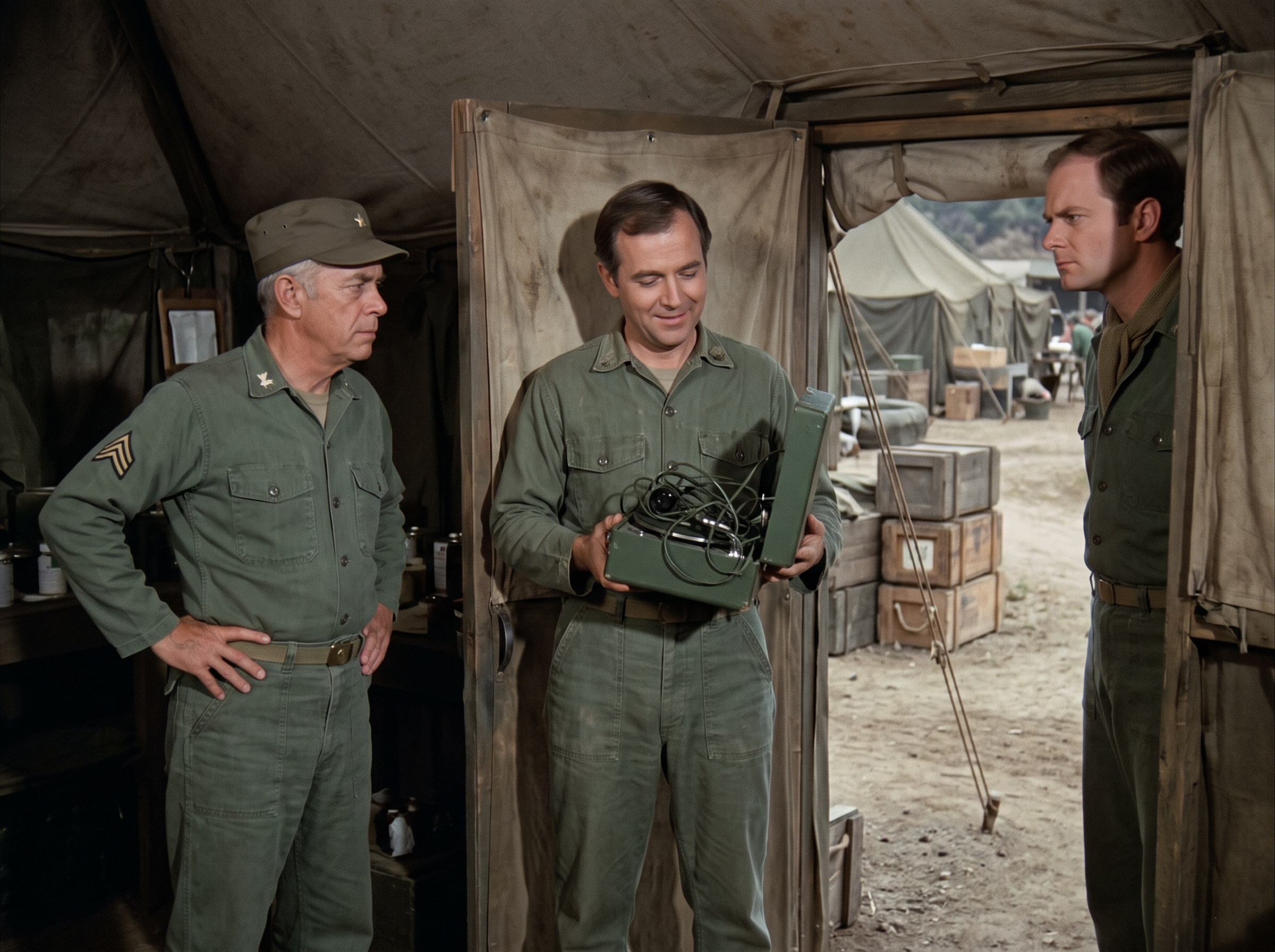
It was a quiet Tuesday afternoon at the 4077th, the kind of rare, dusty silence that always felt like it was holding its breath.
There were no choppers in the sky, no sirens wailing in the compound, and for once, no immediate crisis demanding blood and sweat. Inside the commanding officer’s tent, Colonel Sherman T. Potter was taking advantage of the lull. He was halfway through a stack of requisition forms, savoring the rare taste of a lukewarm coffee and the even rarer taste of peace.
Then, the canvas flap of the tent was pushed aside.
The harsh, muted daylight of the South Korean afternoon spilled into the shadows of the office. Standing in the doorway, blocking the sun, was Father John Mulcahy.
The camp’s modest, endlessly kind chaplain didn’t look like a man bringing spiritual comfort. He looked like a man who had just lost a wrestling match with a box of spare parts.
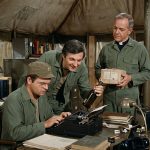
Cradled in the Padre’s arms was the camp’s beloved, battered phonograph. Or rather, what was left of it. The wooden casing was unhinged, the needle arm was dangling by a single frayed wire, and a long, grease-stained spring was tangled wildly around the turntable like a metallic vine.
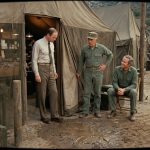
Mulcahy stood right on the threshold, framed by the wooden crates and the dusty path behind him. He offered a smile that was equal parts hopeful warmth and total, helpless confusion.
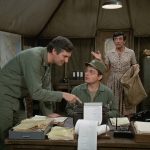
Colonel Potter paused, his pen hovering over a form for surgical gauze. He pushed his spectacles down his nose, stood up, and placed his hands firmly on his hips.
Potter’s face settled into an expression of weary wisdom. It was a stern look, but entirely loving. It was the look of a grandfather who had just watched a child accidentally dismantle a perfectly good toaster.
“Padre,” Potter said softly, his gravelly voice breaking the silence. “Please tell me you didn’t try to perform an exorcism on the camp record player.”
“Well, Colonel,” Mulcahy began, his voice carrying that familiar, gentle tremor. “It’s a bit of a tragic story, I’m afraid. I was only trying to dust the internal mechanisms.”
Just outside the tent, leaning slightly into the frame of the doorway, stood Major Charles Emerson Winchester III.
Charles had clearly been walking past, dressed in his perfectly pressed, albeit dusty, fatigues. Now, he was paused in his tracks. He looked at the mechanical disaster in Mulcahy’s hands with an expression of dry, absolute superiority. One aristocratic eyebrow was arched so high it threatened to disappear into his receding hairline.
“Dust it, Father?” Winchester drawled, his Boston accent cutting through the warm air. “It appears you have attempted to strangle it. Though, given the pedestrian garbage this camp usually forces through its speakers, I suppose one could call it a mercy killing.”
Mulcahy looked down at the mess in his hands, his shoulders dropping just a fraction. The hopeful smile wavered.
“There’s a young corporal in Post-Op,” Mulcahy explained quietly, looking back up at Potter. “He’s a farm boy from Iowa. He hasn’t said a word since he woke up from surgery yesterday. He just stares at the canvas.”
The humor instantly drained from the doorway. The reality of the war, which they had kept at bay for a few precious hours, crept right back in.
“His chart said he used to play the trumpet,” Mulcahy continued, holding the broken machine a little tighter. “I found a Benny Goodman record in the mess tent. I just… I thought if I could play it for him, it might remind him that there is still a world outside of this terrible place.”
As if on cue, the phonograph offered a pitiful, metallic groan. The tangled spring slipped from Mulcahy’s fingers, bounced off the wooden casing, and hit the dirt floor with a hollow, mocking thud.
The machine was entirely dead. And the heavy, crushing silence of the 4077th rushed back in to take its place.
The small metal spring rolled to a stop at the toe of Colonel Potter’s boot.
For a long moment, nobody moved. The three men were frozen in the doorway—the weary commander, the heartbroken priest, and the cynical surgeon.
Potter looked from the spring on the floor to the defeated look in Father Mulcahy’s eyes. The sternness melted completely from the old cavalryman’s face. He let out a long, slow sigh and took his hands off his hips.
“Well, Father,” Potter said gently. “The Lord works in mysterious ways, but He generally leaves the mechanical repairs to the rest of us.”
Potter stepped forward, closing the distance to the doorway. He reached out with his weathered, steady hands and took the heavy wooden box from Mulcahy’s arms. He carried it over to his desk, pushing the vital requisition forms aside to make room for the wounded machine.
“Let’s see what kind of trauma we’re dealing with,” Potter muttered, leaning over the phonograph.
Winchester, still standing outside in the dirt, crossed his arms. “Colonel, surely you don’t intend to waste your afternoon performing CPR on a rusty box of gears. It is a lost cause. The acoustics were barbaric to begin with.”
“Winchester,” Potter barked without looking up. “Unless you’ve got a symphony orchestra hiding in your footlocker, I suggest you grab a pair of tweezers from the dispensary and get in here. We need delicate hands.”
Charles stiffened. He opened his mouth to protest, to offer a biting remark about officers doing the work of mechanics. But he looked at Mulcahy.
The chaplain was still standing by the tent flap, his hands empty, watching the desk with a quiet, desperate hope.
Charles closed his mouth. He let out a breath through his nose, uncrossed his arms, and stepped into the tent.
“I will have it known,” Charles muttered, pulling a handkerchief from his pocket to wipe his fingers, “that I am a thoracic surgeon of the highest caliber. I do not tinker.”
“Just hold the wire, Charles,” Potter said smoothly, handing him a frayed copper coil.
For the next twenty minutes, Potter’s office transformed into a different kind of operating room. The air was thick with concentration.
Potter worked the main gears with the blade of his pocket knife, grunting with effort. Charles used his incredibly steady, gifted hands to re-thread the delicate needle wires, his face a mask of intense, reluctant focus. Mulcahy stood by, offering a flashlight, a piece of surgical tape, and quiet words of encouragement.
“Careful with that tonearm, Major,” Potter warned. “It’s more fragile than a glass jaw.”
“Please, Colonel,” Winchester scoffed softly, his eyes narrowed as he twisted a tiny screw into place. “I have reconnected the delicate vessels of the human heart in near total darkness. I believe I can manage the primitive innards of a Victorola.”
Despite his complaints, Charles was working with a surprising gentleness. He treated the broken wires with the same reverence he reserved for a patient.
Finally, with a loud, satisfying click, Potter locked the rogue spring back into its housing.
“That oughta do it,” Potter said, wiping sweat from his forehead. “She ain’t pretty, but she’s breathing.”
Mulcahy’s face lit up like a sunrise. “Oh, gentlemen. I… I truly don’t know how to thank you.”
“Don’t thank us yet, Padre,” Potter smiled softly. “Let’s see if she sings.”
Together, the three men walked out of the office. They carried the resurrected phonograph across the dusty compound, moving as a strange, quiet parade toward the Post-Op ward.
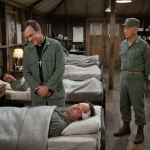
Inside the long, dimly lit tent, the air smelled of antiseptic and tired bodies. In the far corner, the young corporal from Iowa lay staring at the slanted canvas roof, his eyes hollow and miles away.
Mulcahy set the phonograph on an empty supply crate next to the boy’s cot. He carefully placed the Benny Goodman record on the turntable.
Potter and Winchester stood a few feet back, waiting in the shadows.
Mulcahy cranked the handle. He gently lifted the taped-together tonearm and lowered the needle onto the spinning black vinyl.
For a second, there was only the loud, rhythmic hiss of static. Charles winced slightly at the terrible audio quality.
Then, the warm, golden notes of a clarinet floated into the air.
The music was scratchy. It popped and skipped, filtered through terrible wiring and a dusty cone. But it was music. It was a melody from a world where people danced, and laughed, and lived without the sound of artillery in the distance.
The young corporal blinked. His head slowly turned on the pillow. He looked at the wooden box, then up at Father Mulcahy.
For the first time in two days, a tear slipped down the boy’s cheek, and his lips parted in a small, fragile smile.
Mulcahy reached out and gently patted the soldier’s shoulder.
In the shadows, Colonel Potter offered a slow, satisfied nod. He turned to leave, gently clapping a hand on Winchester’s shoulder as he passed.
Charles didn’t brush the hand away. He stood in the dim light of the ward for a moment longer, listening to the scratchy jazz, his arrogant posture softening into something profoundly human and deeply tired.
They couldn’t fix the war. They couldn’t fix the world. But for one afternoon, they had fixed a broken machine, and managed to mend a broken spirit along with it.
In a place built on mending the shattered pieces of humanity, sometimes the greatest healing comes from a dusty record and the quiet loyalty of friends.