The Quiet Between the Storms
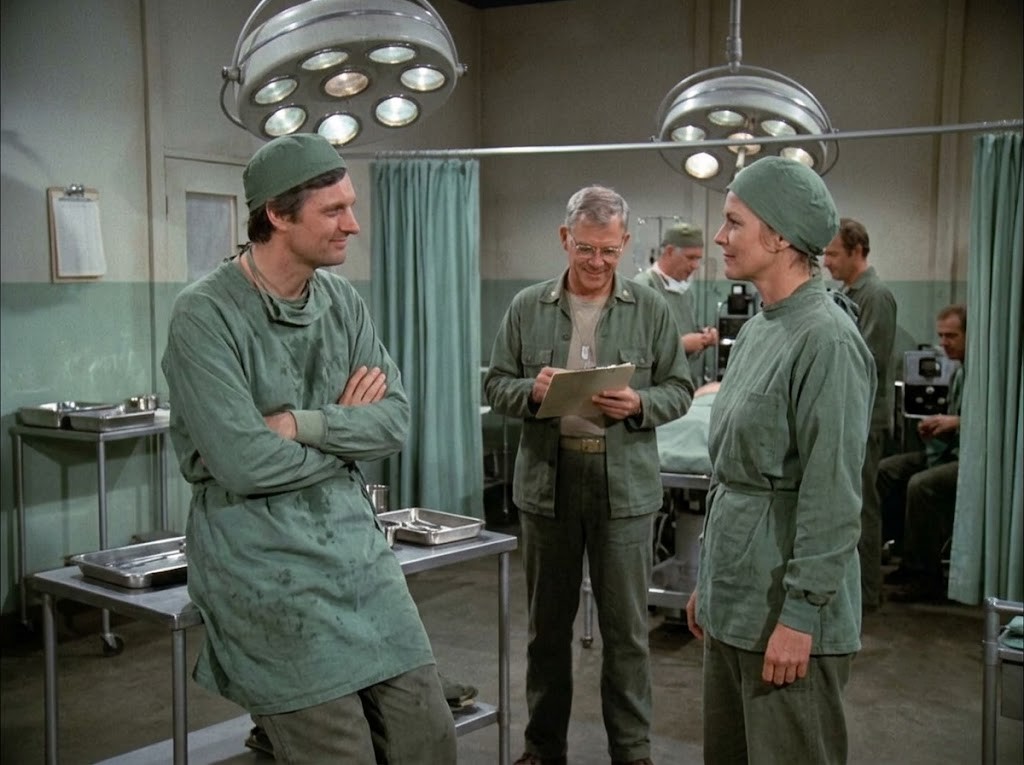
 The OR smelled of antiseptic, sweat, and the damp, heavy heat of a Korean summer afternoon. For sixteen straight hours, the tables had been full, the metal trays clattering with instruments, the air thick with the rhythmic, exhausting dance of surgery. But now, the last patient of the shift had just been wheeled out to post-op, leaving behind a sudden, ringing silence.
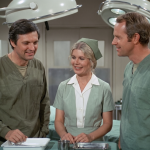
Hawkeye Pierce leaned against a stainless steel prep table, his arms crossed over a scrub gown stained with the day’s grim work. His cap was pushed back slightly, and a faint, tired smile tugged at the corner of his mouth as he looked across at Margaret.
A few feet away, Colonel Potter stood with his reading glasses perched on his nose, focused intently on a clipboard. The old horse soldier was already tabulating the supply needs for the next influx, his brow furrowed, the steady anchor of the 4077th even when his own bones ached with fatigue.
In the background, B.J. Hunnicutt stood by the secondary table, his hands on his hips as he shared a quiet word with one of the corpsmen. The tension that usually gripped the room during a heavy triage was slowly evaporating, replaced by the unique, fragile peace that only came when the chopper blades finally stopped spinning.
Hawkeye let out a soft, dry chuckle, breaking the silence. “You know, Margaret, if we stay in these gowns any longer, they’re going to permanently bond to our skin. We won’t need uniforms anymore; we’ll just be walking blocks of olive drab sterile gauze.”
Margaret didn’t snap back with her usual military rigidity. Instead, she stood tall, her hands loosely at her sides, looking at him with an expression that was remarkably soft, almost tender. The fierce, demanding Major Houlihan had receded, leaving behind a woman who had fought just as hard as any surgeon in that room to keep twenty young boys alive today.
“Drink your coffee, Pierce,” she said, her voice dropping its usual command tone, carrying a rare, quiet warmth. “Before you start hallucinating that the surgical tape is talking to you.”
“It already did,” Hawkeye shot back, his eyes twinkling despite the dark circles beneath them. “It told me it’s leaving me for a roll of ace bandages in Seoul. A tragic love story, really.”
Potter looked up from his clipboard, peering over the rims of his glasses with a mixture of fatherly affection and mild exasperation. “If you two comedians are finished doing a soft-shoe routine, we have a minor situation on our hands. Radar just brought in a message from Tokyo supply.”
Hawkeye’s smile faltered slightly, his posture shifting as he sensed the sudden gravity in the Colonel’s voice. The OR grew perfectly still, the hum of the overhead surgical lamps suddenly seeming incredibly loud as they all waited for the other shoe to drop.
“Don’t tell me,” Hawkeye sighed, his wit dropping away to reveal the raw exhaustion underneath. “They’re out of penicillin again. Or they’ve decided to replace our surgical gloves with winter mittens.”
Potter adjusted his clipboard, his voice steady but grave. “Worse. The generator parts we requested three weeks ago were diverted to a battalion near the line. The auxiliary generator we’re running right now is on its last legs. If it blows during the next push, we’re operating by flashlight.”
The warmth in the room vanished, replaced by the cold reality of their geography. Operating under the best conditions was a tightrope walk; operating in the dark was a nightmare none of them wanted to face.
Margaret stepped forward, her professional instinct taking over instantly. “Colonel, we still have the kerosene lanterns from the winter tents. I can have the nurses prep them and store them in the corridor just in case.”
“Good thinking, Major,” Potter nodded, looking at her with deep pride. “Get on it. Hunnicutt, I want you to look over the remaining battery-operated lamps. Let’s see how much life we can squeeze out of them.”
B.J. nodded from the back, already moving toward the storage cabinets. The seamless transition from exhausted survival to proactive planning was what kept the 4077th alive, a quiet choreography of dedication that never made the official reports.
Hawkeye looked down at the metal table he was leaning against, his fingers tracing a small scratch in the steel. The humor he used as armor felt heavy now, but as he looked up and caught Margaret’s gaze, he saw something else—an unyielding resilience.
She wasn’t looking at him as a subordinate or an adversary; she was looking at him as a brother-in-arms who had shared the same blood-slicked floor for hours. She offered a tiny, almost imperceptible nod of encouragement.
“Well,” Hawkeye said quietly, the dry humor returning but softened by a deep affection for the people around him. “If the lights go out, look on the bright side. You won’t have to look at my face while I’m asking for a scalpel. It’ll be a massive improvement for everyone’s morale.”
A collective, quiet laugh rippled through the room—a gentle, healing sound that broke the tension once more. Potter shook his head, a smile finally breaking through his stern demeanor as he tucked the clipboard under his arm.
“You’re a real comfort, Pierce,” Potter said, turning toward the double doors. “Get some rest, all of you. That’s an order. We don’t know when the next choppers will be coming over the hill.”
As the Colonel walked out, followed by B.J. and the corpsmen, Hawkeye and Margaret remained for one last lingering moment under the bright, circular lights of the OR. The room was empty, the crisis was managed, and the bond between them remained unspoken but unbreakable.
They had survived another day in the tents, holding together a broken world with nothing but thread, steel, and each other.
Amidst the mud and the madness of Korea, the finest doctors and nurses found their truest family in the quiet, exhausted spaces between the casualties.