The Quietest Tune In Korea
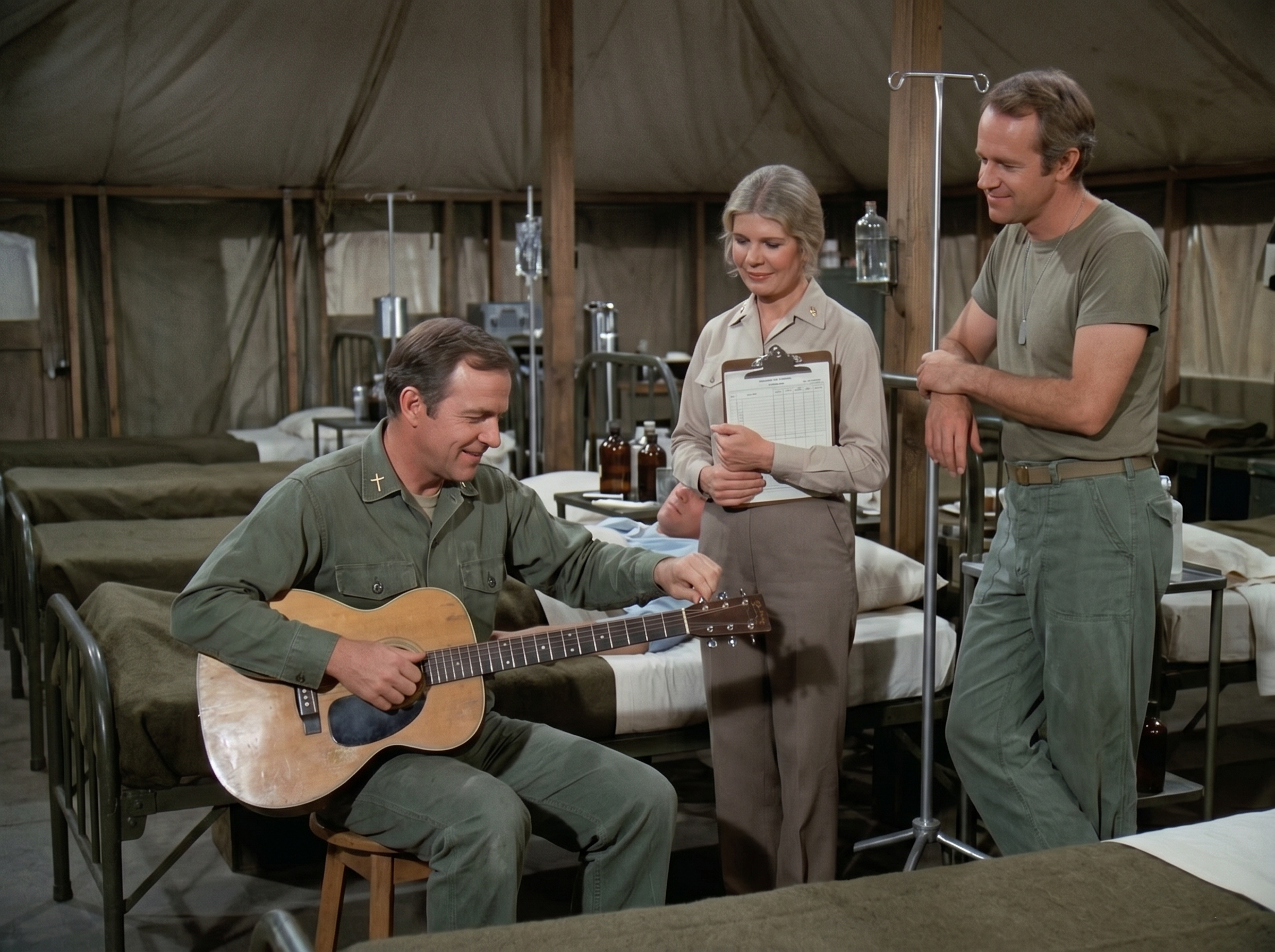
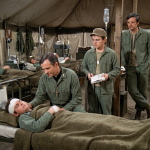
The Operating Room lamp had just gone dark. The last wounded soldier, PFC Tommy O’Connell, was sleeping fitfully on an olive drab cot. The rest of the ward was an exhausted canyon of green canvas and metal frames. Silence, here, always felt precarious.
Margaret Houlihan adjusted the chart on her clipboard, her eyes scanning the vitals. She was professional, as always, but her shoulders dropped an inch. It was the posture of the 4077th’s resilience: tired, but still standing.
B.J. Hunnicutt was leaning casually against an IV pole near the foot of O’Connell’s bed. He was wearing just his standard green t-shirt, arms crossed, watching. He glanced toward the front of the tent where the other surgeons had scattered, but O’Connell, he decided, needed one more check.
That’s when Father Mulcahy slipped into the tent. He wasn’t there for a blessing, not this time. He was cradling an old, scuffed acoustic guitar. It looked like it had survived three rainstorms and at least one artillery barrage.
“Everything looks stable, Major,” B.J. said softly, not looking up.
“It is, Captain,” Margaret replied, the barest softening in her voice.
They both noticed the guitar at the same time.
“Father,” Margaret said, a rare note of genuine surprise. “The CO doesn’t usually… approve of recreation in post-op.”
“This isn’t recreation, Major,” Mulcahy said gently, finding a sturdy wooden stool near the end of the cot. “It’s… morale therapy. We are trying something new.”
“I see,” B.J. said, a small grin forming. “And did you have this specific patient in mind for the therapy, or just the general vicinity?”
Mulcahy smiled and sat down. He carefully started to tune the E-string, the tiny pin-prick *ping* of the metal string cutting the silence. He adjusted a tuning peg, focusing. He didn’t play a song yet, just made those small, purposeful adjustments, as if he were preparing a medical instrument.
He looked over at O’Connell, then up at Margaret and B.J. For a moment, all three of them were trapped in a shared breath, waiting. This was the stillness after the storm.
“He likes ‘Danny Boy’,” Mulcahy murmured.
He began the first three notes. They were pure, resonant, and shockingly delicate in that space.
Margaret bit her lip, clutching her clipboard a little tighter. B.J.’s grin vanished, replaced by an intensity that was hard to read. Both of them looked at the sleeping soldier, then back at the Father, holding their collective breath.
Father Mulcahy continued the melody. He didn’t play it loud; it was an acoustic hum, a gentle vibration that seemed to match the low thrum of the 4077th’s generator. It wasn’t a performance. It was just a presence.
Margaret stood watching, her clipboard tucked against her side. Her posture was still rigid, but the hard lines around her mouth relaxed. This was the ‘tough’ Head Nurse who ran post-op like a tight ship. But right now, in the presence of that simple, mournful tune, the authority was just a shell. Beneath it was a human heart that remembered its own home. She had family back in the States who loved music, who sang at gatherings. O’Connell was just a boy, younger than her own nephews. *’Oh, Danny Boy, the pipes, the pipes are calling…’* She squeezed her eyes shut for a microsecond.
B.J. continued to lean against the IV pole, his eyes glued to the sleeping soldier. He felt the weight of every surgery he’d performed that night. It was the heavy, emotional dust of the operating room. He thought about his wife, Peg, and their daughter, Erin, back in San Francisco. He could picture Erin now, sleeping with her favorite blanket. When he looked at O’Connell, he didn’t just see a patient. He saw a father’s son, maybe a husband, another thread connected to a home that felt light-years away. He wanted that boy to wake up and hear that song. He wanted it to be the first thread of normal life after the chaos.
O’Connell’s breathing evened out. His eyes, still closed, seemed to settle. His hand, which had been clenched slightly, released its grip on the edge of the sheet. He didn’t wake, but the melody seemed to act like a soothing balm, easing the trauma of his mind and body. The small, peaceful change was everything.
Margaret finally shifted. She nodded, almost imperceptibly, toward Mulcahy, her eyes glistening. She made a quick, decisive mark on the chart, as if acknowledging the guitar strum was as effective as any medication.
B.J. stayed where he was, a small, grateful smile returning. He didn’t speak. He didn’t need to. The simple comfort of that guitar and the shared understanding between the three of them—that this wasn’t just a wound; it was a person—said everything.
Mulcahy finished the last notes of the first verse. He let the final chord ring out in the quiet tent. It vibrated, holding the silence. The scuffed guitar, the tired surgeons, the nurse holding a clipboard, and the sleeping soldier. They were a found family, an impossible collection of souls united by fatigue and unexpected tenderness in a war that couldn’t break them.
“I think your therapy worked, Father,” B.J. said quietly.
“Good,” Mulcahy said, standing up and carefully cradling the guitar. “He’s a good lad.”
Margaret, the Major, turned and placed the clipboard back on its hook. “Good work, Captain,” she said to B.J., “and you, Father. The night is far from over.”
They each took a breath. B.J. pushed off the IV pole, heading back toward the main artery of the camp. Mulcahy gently slipped out the side. Margaret resumed her post, eyes scanning the row of cots. But for that fleeting moment, in that green canvas tent, the music had stitched something together, making the long night a little softer. The memory of that scuffed guitar in post-op would linger, a quiet tune in their hearts that they’d all remember long after Korea was just a place on a map.
Some of the most effective medicine never came in a bottle.