The Quietest Prayer in Post-Op
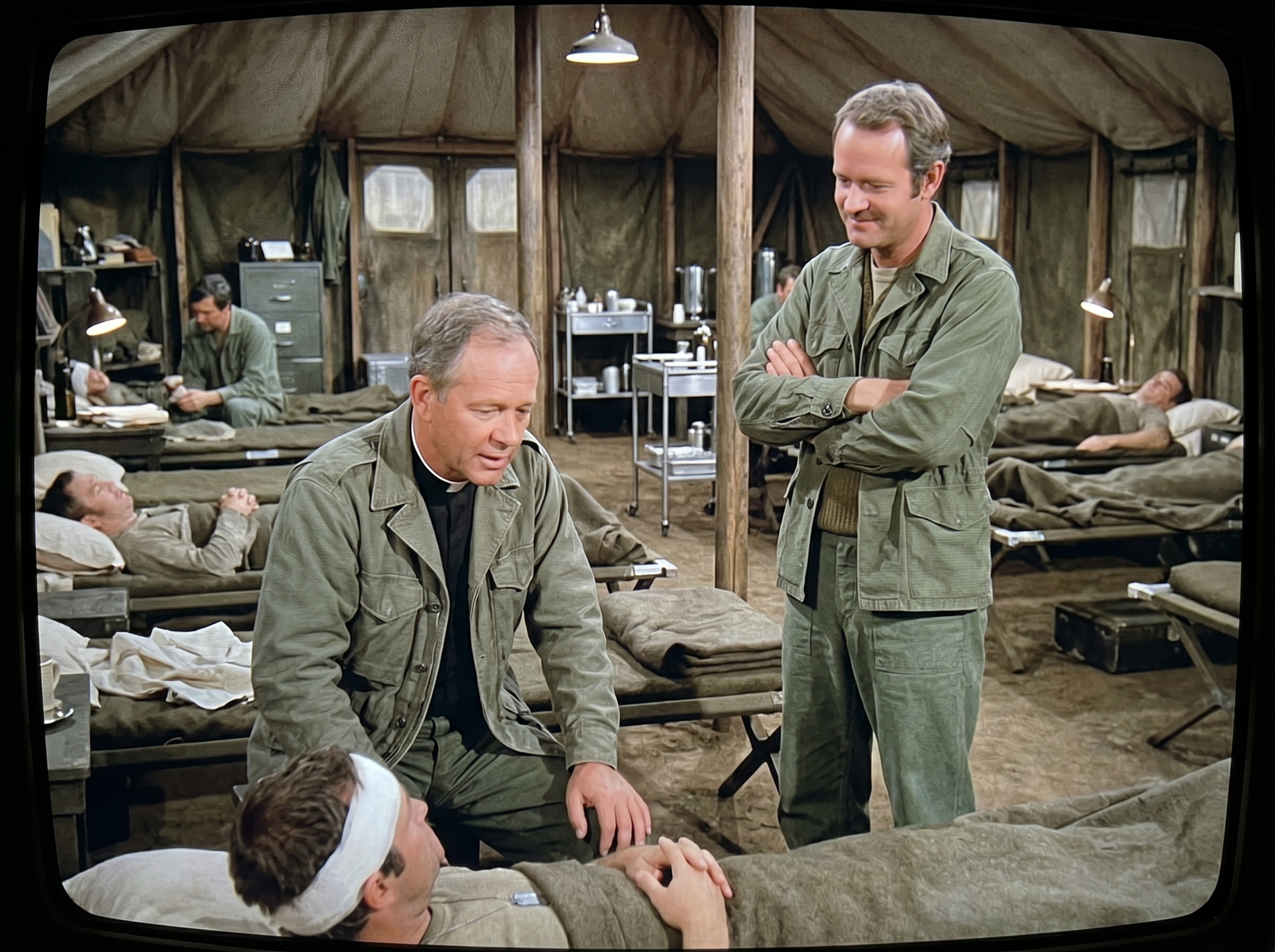
The mud of Korea has a way of clinging to your soul long after you’ve scrubbed it off your boots. Inside the recovery tent, the air was thick with the scent of rubbing alcohol, stale coffee, and the heavy, lingering exhaustion of a shift that had lasted far too long.
It was that strange, liminal hour when the sun hadn’t quite decided to set, and the generator’s hum was the only thing keeping the silence from becoming deafening.
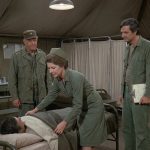
Father Mulcahy knelt by the cot, his posture radiating a quiet, unshakeable grace despite the grease-smudged fatigue etched into the lines around his eyes. He leaned in, his voice a soft, melodic murmur, offering comfort to a young corporal who was blinking up at the ceiling, trying to remember his own name.
Standing just a few feet away, leaning against the support pole with his arms crossed over his olive-drab jacket, was Hawkeye. He wasn’t cracking wise. He wasn’t launching into a manic monologue about the absurdity of war or the quality of the mess hall’s powdered eggs.
He was just watching.
There was a profound stillness in him—a rare, unguarded moment where the cynical armor slipped, leaving only the man who had seen too much and cared too deeply. He watched the Father’s hand rest gently on the cot, and he watched the soldier’s tense shoulders finally begin to drop, an inch at a time.
Suddenly, the soldier gripped the Father’s wrist, his knuckles white, his eyes darting toward the canvas ceiling as if he could see the ghosts of the day passing through. “Is it over, Father?” he whispered, his voice cracking like dry parchment. “Is it really over, or is the whistle about to blow again?”
The room seemed to shrink. Hawkeye took a half-step forward, his own breath hitching in his chest, his gaze locked on the soldier’s desperate, searching eyes.
Hawkeye didn’t speak. He didn’t need to. He simply moved closer, reaching out to rest a hand on the edge of the cot, grounding the space between the soldier’s terror and the quiet peace the Father was trying to hold together.
“It’s over for today, son,” Mulcahy said, his voice steady, anchored in a faith that somehow held up even under the weight of a M*A*S*H unit. “The only thing you have to do now is breathe. Just breathe.”
Hawkeye finally offered a small, crooked smile—the kind that didn’t reach his eyes but reached straight for the heart. “He’s right, kid,” Hawkeye added, his tone uncharacteristically gentle, stripped of all its usual sharp edges. “And if the whistle blows, I’ll be the first one to complain about the scheduling. I’m very good at complaining. It’s practically a medical specialty.”
The soldier let out a shaky, half-laugh, the tension finally bleeding out of his frame. He released the Father’s wrist and let his head fall back against the pillow, his breathing evening out into the deep, rhythmic sleep of the utterly exhausted.
The three of them stayed like that for a long moment—the healer, the shepherd, and the boy who had survived. It was a tableau of the 4077th that the history books wouldn’t record, but the ones who were there would never forget. It was the humanity found in the cracks of a broken world.
Eventually, Hawkeye straightened up, his joints popping with the protest of a long day’s labor. He gave the Father a solemn, respectful nod—a silent acknowledgment of the heavy lifting Mulcahy did every day, the kind that didn’t involve a scalpel but saved just as many lives.
Mulcahy stood slowly, his knees creaking, and wiped his brow with a handkerchief. He looked at Hawkeye, and for a fleeting second, the two of them shared the weary, unspoken understanding that defined their strange, beautiful, and fractured family.
They didn’t need to discuss the war or the politics or the politics of the war. They just needed to know that, for this one kid, in this one tent, they had managed to hold the darkness at bay for another night.
As they turned to head back out into the cool Korean twilight, the sounds of the camp began to drift back in—a distant laugh, the clatter of a mess kit, the rumble of a jeep. It was the soundtrack of survival. It wasn’t perfect, and it was certainly a far cry from home, but as the sun finally dipped below the ridge, it felt enough like grace to get them through to the morning.
In the heart of the storm, kindness is the only compass that never fails.