The Littlest Patient in the Post-Op
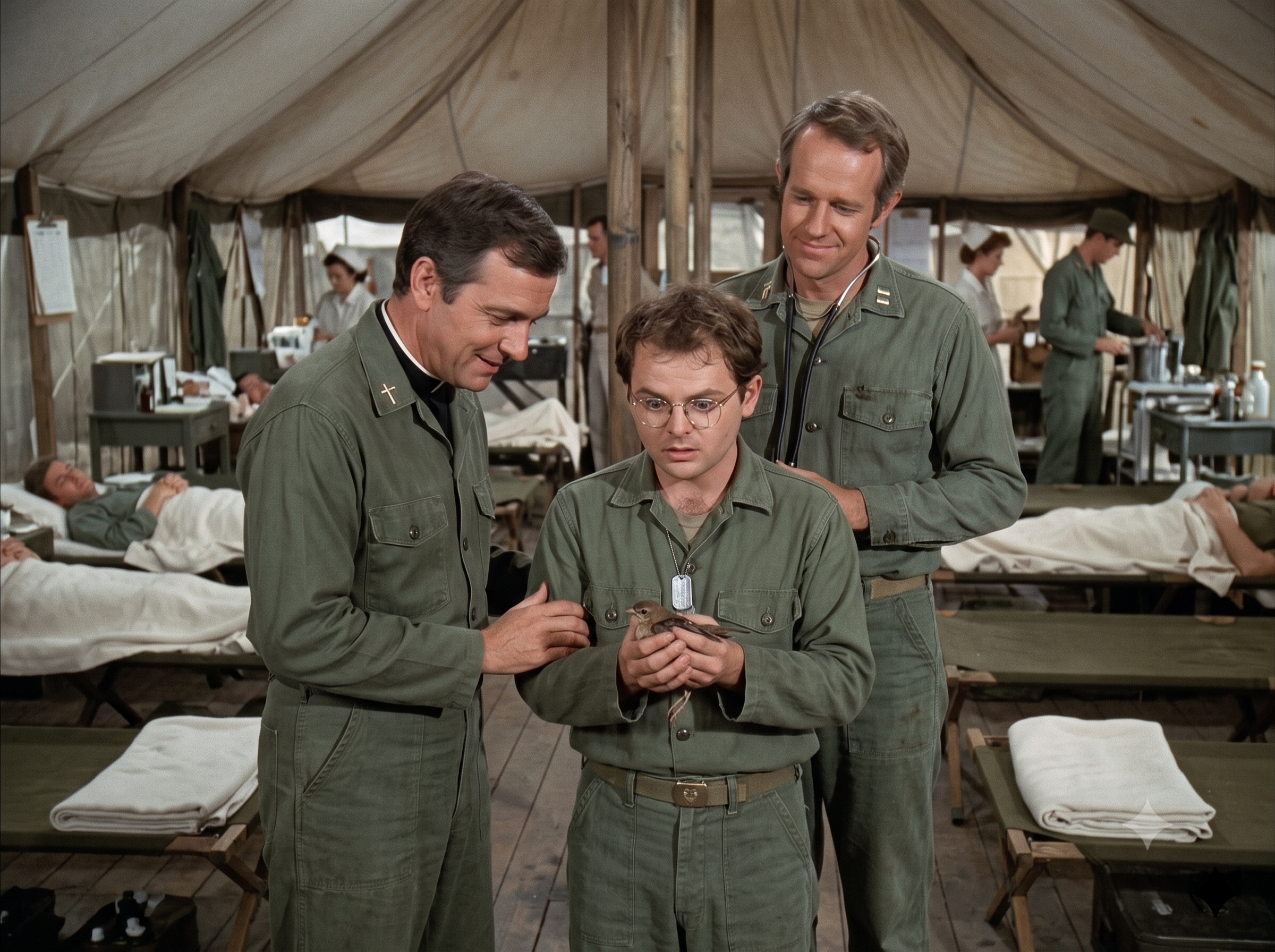
The sound of the choppers always lingered, a vibration in the canvas that wouldn’t let anyone truly rest.
After three days straight of triage and the OR, the Post-Op tent felt heavy, even when it was mostly empty.
The rows of green cots stood like reminders of the broken men who had recently filled them, waiting to be stabilized or moved.
The smell of antiseptic, stale coffee, and old canvas was etched into every fiber. It was the scent of a battle fought in the middle of nowhere.
B.J. Hunnicutt stood by a supply counter, leaning heavily on it, the stethoscope around his neck feeling like a ten-pound weight.
His face was a map of fatigue, and he’d just lost a patient he’d fought four hours for. The failure was sitting sour in his stomach.
In the background, a few nurses were moving silently between the rows, checking charts with slow, tired movements.
A corpsman was wiping down a table, a mindless routine in a world that often lacked order.
Then the tent flap moved, not with the aggressive rip of Colonel Potter or the weary push of a surgeon coming from the OR.
It was a slow, deliberate movement.
Corporal Radar O’Reilly stepped inside.
He was always small, but right now he looked even smaller, hunched over, his shoulders curved inward.
He didn’t look up at anyone. Instead, he stared down at his own hands, which were cupped together tightly, forming a protected, hidden nest.
B.J. straightened up. It was unusual to see Radar without a stack of paperwork or an urgent message.
“Radar?” B.J. asked, his voice soft, not wanting to disturb the rare quiet of the ward.
At the same time, Father Mulcahy, who had been sitting by an empty cot offering a silent prayer, looked up.
The priest walked over slowly, his gentle face already softening with immediate concern.
Radar finally looked up.
His eyes, magnified behind his glasses, were wide with an innocent, anxious terror that only he could project.
He didn’t speak. He just slowly, carefully, opened his hands a tiny fraction.
Inside was a small, brown sparrow.
It was trembling violently, its head lolling to one side. Its eyes were half-closed, and one wing was bent at a painful angle.
“Found him,” Radar whispered, his voice cracking with desperation.
“By the perimeter fence. After that brief mortar splash this morning.”
Father Mulcahy leaned in, his expression immediate compassion.
He looked at the bird, then at Radar, then at B.J. His right hand was reaching out, almost instinctively, as if to offer comfort.
B.J. moved to stand slightly behind Radar, looking down.
He was a skilled vascular surgeon, a man who could rebuild shattered arteries. But this?
This was a thing so fragile, a sudden breeze might crush it.
Radar looked from the sparrow to B.J., his face a silent, pleading map of hope.
“Captain Hunnicutt,” Radar said, his voice a strained whisper of desperation that echoed in the quiet tent.
“Can you fix him? I think he’s dying, and I don’t know who else to ask.”
B.J. stared at the tiny bird, and then at Radar’s wide, pleading eyes.
In that moment, he wasn’t a surgeon in a war zone; he was just a guy from California who missed his daughter, looking at a boy who treated the entire 4077th like his family.
The bird was smaller than any instrument B.J. owned.
It was a casualty of war in the purest sense, caught in a crossfire it didn’t understand.
B.J. felt the weight of his own exhaustion, the memory of the patient he’d just lost still fresh.
He looked over at Father Mulcahy.
The priest gave him a silent, supportive smile that was both understanding and an affectionate challenge.
B.J. let out a long, slow sigh. It was a sound that was half exhaustion and half resolve.
“Well, Corporal O’Reilly,” B.J. said, his voice gaining its usual warm, steady tone.
“He doesn’t have a discharge paper, but I suppose we can’t just let him expire on our watch.”
A look of pure, agonizing relief washed over Radar’s face. He didn’t smile, but the tension eased just enough for him to take a deep breath.
B.J. gently guided Radar to a clean surgical tray that a nurse, who had silently approached, had placed on a wheeled table.
The staff at the MASH units had seen everything; they knew when to stay back and when a simple tray could change the entire atmosphere.
“Okay, keep your hands very, very still,” B.J. instructed, his own hands moving with deliberate precision.
“Father, if you could be my assistant?”
“Certainly, Doctor,” Mulcahy said, stepping up, his moral presence grounding the small, unlikely procedure.
B.J. picked up a pair of tiny forceps, the kind used for the most delicate facial repairs. He didn’t have veterinary instruments. He’d have to improvise.
“Now, listen,” B.J. said, looking at Radar over the top of his spectacles. “This is classified.”
“If you tell anyone I’m doing sparrow surgery, I will deny it. I’ll say I was just training the new corpsmen on delicate anatomy.”
A small, genuine smile touched Radar’s lips. It was the first one B.J. had seen in weeks. “Yes, sir. My lips are sealed.”
For the next twenty minutes, the large canvas tent felt strangely focused.
Other staff slowed down to watch, a silent, affectionate audience. The nurses in the background stopped their routine to observe.
B.J. used the forceps to align the tiny bone in the wing. It required a level of concentration different from regular surgery. Here, even the slightest pressure could kill the patient.
Mulcahy held a light and offered a quiet word when B.J.’s hand shook for a split second.
“Steady on, Captain. Even small works of mercy are noticed.”
They patched the wing with a Q-tip for a tiny splint, and wrapped it in a single strip of cotton gauze, securing it with a touch of medical tape.
“Alright, Private Sparrow,” B.J. said, gently setting the bird into a small cardboard box filled with soft towels, which Radar had materialised.
“You are officially off duty. Light activity only for the next four weeks. And no loud noises.”
Radar looked into the box, his expression a mix of awe and fierce possessive care.
He looked up at B.J., his eyes glassy behind his glasses. “Thank you, Captain Hunnicutt. Thank you.”
“Don’t thank me,” B.J. replied, wiping his forehead with his sleeve. “Thank the Q-tip company.”
He put his hands on Radar’s shoulders. “Good eye finding him, Radar.”
Mulcahy gently pattered the box. “And Private Sparrow will have the finest care, I have no doubt.”
As Radar picked up the box, treating it like the most valuable shipment of plasma they’d ever received, B.J. watched him go.
He turned and met Mulcahy’s gaze. The priest’s gentle smile said it all.
“You know, B.J.,” Mulcahy said quietly, “The Good Book talks about how God sees even the sparrow that falls.”
B.J. let out a dry, tired laugh.
“Well, Father, if he was watching us today, I hope he didn’t mind me using the forceps intended for Private Kowalski’s nose.”
Mulcahy smiled and shook his head, already heading back to comfort another man.
B.J. checked his watch. Triage would be active again soon.
He picked up a cup of cold coffee, taking a sip that tasted only slightly better than the war itself.
But as he walked toward the exit of the Post-Op, a quiet feeling of small victory settled in his chest.
In a place where you could save fifty men and still feel the loss of one, saving a single, tiny sparrow felt, for a fleeting moment, like winning the entire damn thing.
The bittersweet truth of the 4077th was that tenderness was the hardest medicine to dispense, and the most necessary.
In a place built on the edge of loss, tenderness was always worth fighting for.