A Small Victory in the Swamp
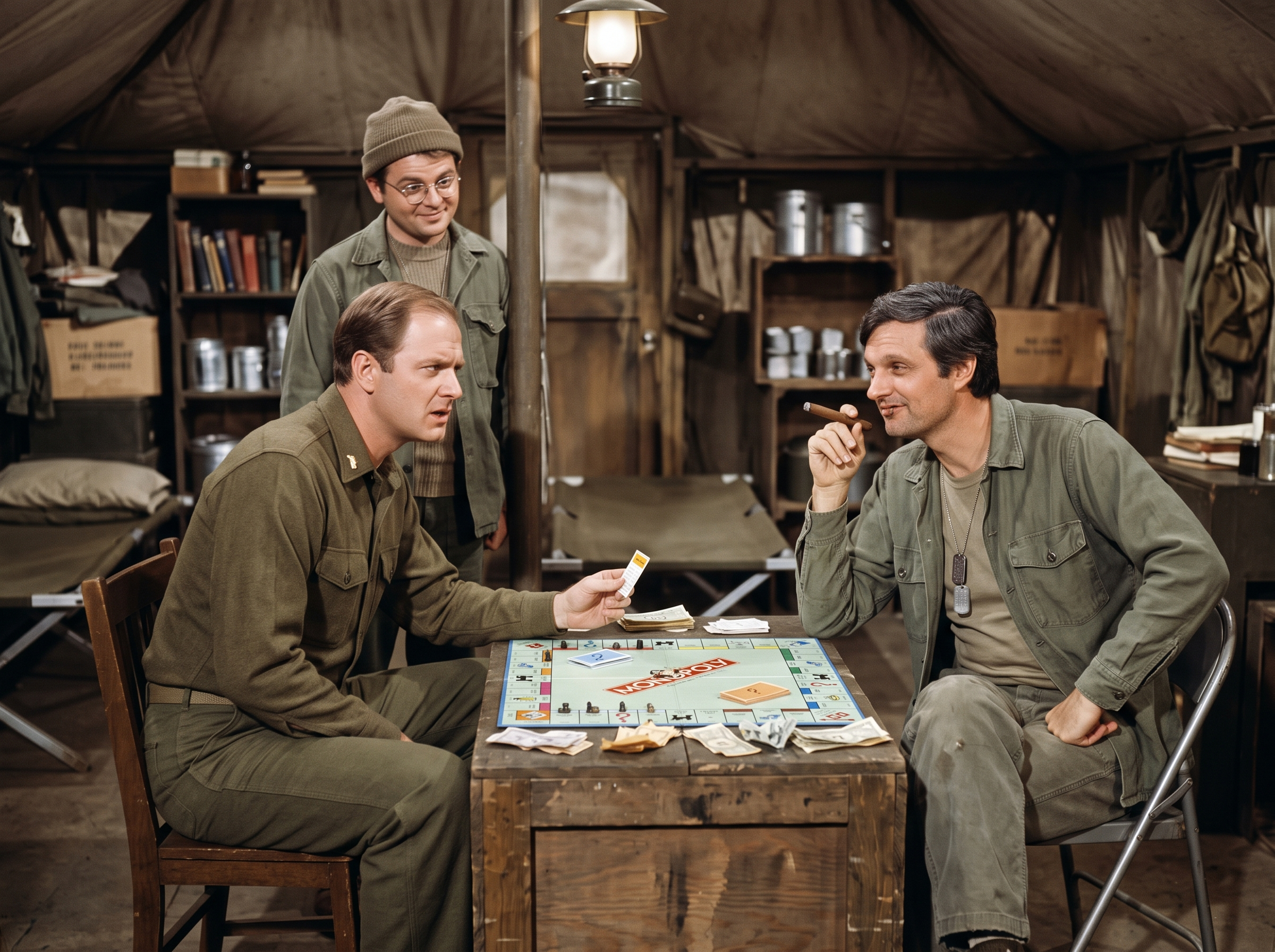
You didn’t need a calendar in Korea. The O.R. was the clock, and the number of cots filling up told you everything about the day.
Tonight, the operating room was finally quiet, but the *noise* didn’t stop. The echo of metal bowls clattering and the sharp smell of antiseptic always seemed to linger long after the surgeons unscrubbed.
In the Swamp, the noise was different. It was the sound of tired men clinging to the one thing they controlled: a distraction.
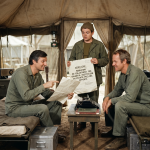
Three of them were gathered around an old wooden table. It was barely stable, propped up with grit and hope, but it was their kitchen table, their desk, and tonight, their high-stakes arena.
A full Monopoly set lay spread out across the rough surface. In an ocean of olive drab, the bright colors of Vermont Avenue and St. James Place were as jarring as a clown in a minefield.
But nobody was smiling. Not yet.
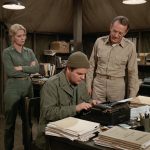
Captain B.J. Hunnicutt, looking tired enough to fall asleep standing up, was hunched over the board. His gaze was fixed intently on a small slip of paper—a yellow Chance card, plucked from the deck like a verdict.
He squinted, trying to read the faint text in the dim, yellow light hanging from the tent pole. Every line in his face seemed to tighten.
Directly across from him, Hawkeye Pierce, ever the picture of practiced indifference, slouched back in his folding chair.
He had an unlit cigar pinched delicately between his thumb and index finger, looking less like a weary surgeon and more like a riverboat gambler contemplating his next bluff.
The tension between them was palpable. Hawkeye’s expression, partially obscured by the cigar, held a hint of a cocky smirk, but his eyes were entirely serious, watching B.J. with laser-like focus.
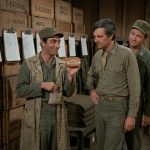
Radar O’Reilly stood slightly behind B.J., looking over his shoulder. The young corporal, his knitted cap pulled down tight, seemed completely engrossed. He watched B.J.’s reaction like a small bird waiting for rain, his face showing a mix of anticipation and concern.
What was on that small yellow card? A $15 tax? A free parking bonus?
The silence was heavy. For a split second, the Monopoly game felt like the only thing that mattered in the world.
If this card said “Advance to Boardwalk,” it was game over. The fate of their miniature empire, built on properties that weren’t even real, was now entirely in B.J.’s hands.
Radar’s eyes darted between the card and Hawkeye’s calm demeanor. It wasn’t just about a game of chance. This was a battle of nerves, a desperate search for control in a world that often made no sense.
Slowly, B.J. raised his eyes from the card. His face remained tense, unreadable. The wait was suffocating.
“Well?” Hawkeye asked softly, the cigar barely moving.
B.J.’s fingers twitched around the edge of the card. A flicker of something, maybe disbelief, passed through his eyes.
B.J. slowly looked up, his expression still masked, drawing out the suspense with painful deliberation. The single light bulb above them seemed to pulse with the shared anxiety in the tiny tent.
Radar leaned forward instinctively, his mouth slightly ajar, his heart beating a fast rhythm beneath his wool sweater. He knew this game was a delicate ecosystem, and a sudden influx of cash or debt could disrupt everything they had built over the last two hours.
Hawkeye remained still, a statue of calm with that maddening cigar perfectly balanced. Only the slightest narrowing of his eyes betrayed his own investment.
He didn’t need the money, real or fake, but he *needed* to win. It was about the principle, about keeping the absurdity of their existence balanced with a small, manageable win.
B.J.’s gaze shifted from Hawkeye to the board, then back to the card. He let out a long, slow exhale that sounded like a tire slowly losing air.
“I don’t believe it,” he whispered, his voice thick with a mix of awe and dread.
Radar jumped. “Is it bad? Sir? Do you owe the bank? I have some… I could maybe get you a loan?”
Hawkeye just lifted an eyebrow. The wait was exquisite torture.
“No,” B.J. said, and finally, a slow, wide smile broke across his face, crinkling his eyes. “It’s not bad.”
He slowly turned the card so both Radar and Hawkeye could see the text, printed in faded typewriter font: *”BANK PAYS YOU DIVIDEND OF $50.”*
The silence in the Swamp didn’t just break; it shattered.
Radar let out a yell of pure joy that would have been appropriate for an air raid siren. He slapped B.J. on the back, almost knocking him out of his chair. “I knew it! The luck! The pure, dumb luck!”
Hawkeye, however, didn’t move. He didn’t even drop the cigar. His smirk deepened, hardening into a grimace of pure mock tragedy. He looked at the card, then at B.J., and let out a dramatic, soul-deep groan that might have been heard all the way at the 8063rd.
“Dividend? *Dividend?*” Hawkeye muttered, the word tasting like sour milk. “I own half of the red properties, the four railroads, and I’m one turn away from a hotel on Park Place, and you… you get a dividend? For what? Being *nice*?”
B.J., now beaming like a schoolboy who just got an extra scoop of ice cream, scooped up fifty colorful play-money bills from the bank pile. “Well, Hawk, sometimes the system works. It’s all about sound financial planning.”
Radar, still bouncing on his heels, started counting the money B.J. had won. “Fifty dollars! That’s… well, in this economy, that’s not much, but still! A win is a win!”
“A win,” Hawkeye grumbled, finally lowering the cigar. He used it to gesture dramatically at B.J. “You, my friend, are the luckiest man this side of the 38th Parallel. And I say that with the profound professional jealousy of a man who just landed on Income Tax.”
“Technically,” B.J. corrected, shuffling his stack of cash, “that was three turns ago. I’m moving on to bigger and better things. Maybe I’ll pick up reading.”
The laughter that filled the tent was light, unexpected, and utterly fragile. It was a shared moment of silliness, a brief truce with the reality outside. In the context of a war, $50 in Monopoly money meant absolutely nothing. But in the Swamp, it meant everything. It meant a momentary escape.
They argued for another hour over who should pay for the lightbulb usage and if Radar should get a commission for “moral support.” The cigar remained unlit. The single bulb burned steadily.
Eventually, the game ended. Not with a decisive victory, but with the inevitable arrival of morning and the familiar, low-grade hum of the camp waking up. They left the properties scattered on the table, a tiny, colourful ghost town that would wait for them until the next quiet night.
Walking back to his cot, feeling the ache of a long shift returning to his bones, B.J. felt a unexpected warmth. It wasn’t about the $50 dividend. It was about the sound of Hawkeye’s laugh, the earnestness in Radar’s face, and the fleeting feeling that, for a few hours, they were just three guys playing a game, and nothing else mattered.
In a place where everything was real, sometimes a little fake victory was the only true thing we had.