The Distance Home in a Muddy Yard
The mud in Korea has a memory. It clings to your boots, tracks into the OR, and reminds you every single day that you are exactly ten thousand miles from where you want to be.
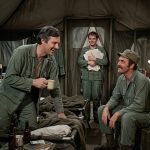
But on a rare, quiet afternoon at the 4077th, the sun managed to break through the gray canopy, casting a deceptive warmth over the olive-drab tents.
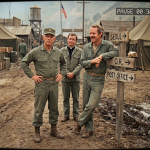
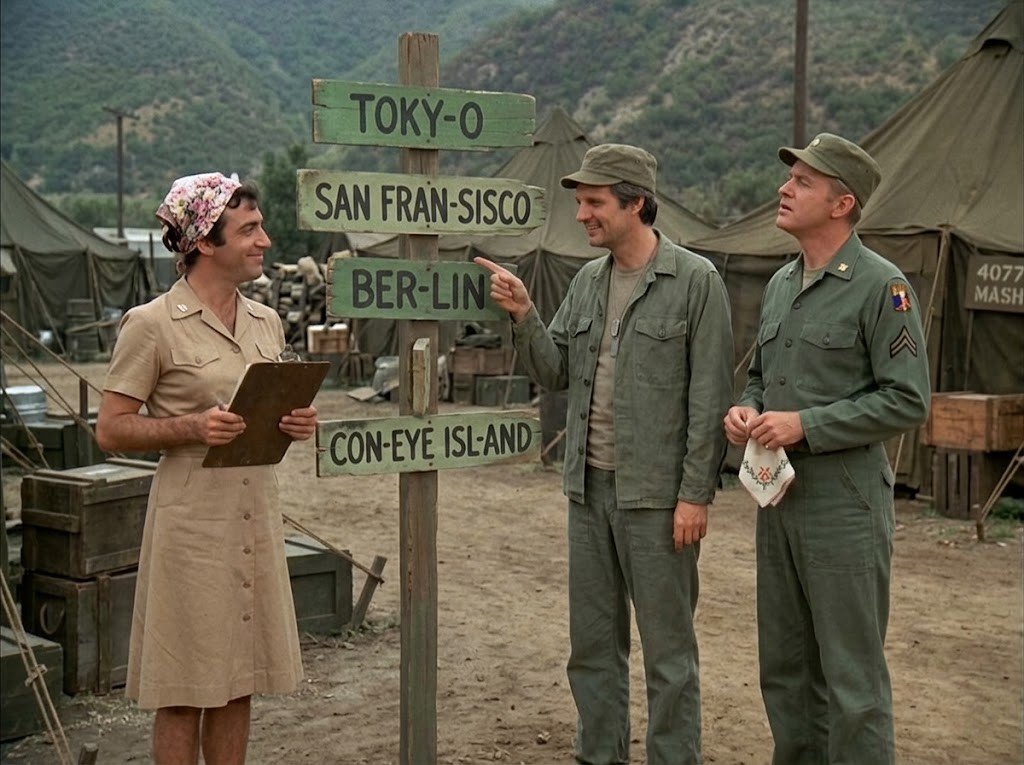
Standing by the iconic signpost, three men found themselves paused in a moment of shared, quiet contemplation, momentarily ignoring the distant, rhythmic thud of artillery.
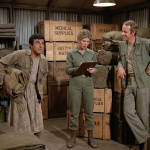
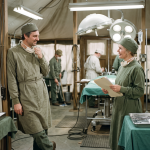
Klinger stood with his clipboard, wearing a floral headscarf and a crisp, tan nurse’s dress that he wore with an undeniable, defiant sort of dignity.
Beside him, Hawkeye pointed a casual finger at the freshly painted green slats of wood, his face wearing that familiar, lopsided smirk that usually hid a deeper ache.
Next to Hawkeye stood a young, tired lieutenant, a local hand holding a handkerchief, looking up at the signpost with a mixture of confusion and sudden, overwhelming longing.
“You see, Lieutenant,” Hawkeye said, his voice carrying that familiar, rapid-fire cadence, “the trick to surviving this place is all about geography. If you look at the map, we’re trapped in a permanent rerun of a bad movie. But if you look at this post, home is just a left turn away.”
“I don’t know, Pierce,” Klinger chimed in, adjusting his clipboard against his hip with a theatrical sigh. “I’ve been staring at that ‘Con-Eye Isl-and’ sign for three months, and I still haven’t smelled a single hot dog. Just burnt coffee and Winchester’s cheap cologne.”
The young lieutenant didn’t laugh. He stared at the word ‘BER-LIN’ painted on the wood, his knuckles turning white as he gripped his handkerchief.
He was a replacement officer, only three days in the camp, and the sterile smell of the pre-op tent was still fresh in his clothes.
“My mother was born in Berlin,” the young man whispered, his voice suddenly thick, breaking the light rhythm of Hawkeye’s banter. “She always told me about the linden trees in the spring. I used to think the world was small.”
Hawkeye dropped his hand, his smirk fading into something softer, his eyes narrowing with a quiet, protective concern.
The lieutenant’s eyes welled with sudden, heavy tears that he desperately tried to blink away, his chest heaving as the weight of the war finally crashed down on him right there in the middle of the compound.
Klinger stopped tapping his pen against the clipboard. The theatricality vanished from his posture, replaced instantly by the grounded, protective instinct of a man who knew exactly what it felt like to want to run away.
He took a step closer to the young officer, his voice dropping its usual sharp edge. “Hey, Lieutenant. Look at me. It’s okay. The first week is the hardest. The air smells different here, and it makes your chest tight. We’ve all had that Tuesday.”
Hawkeye reached out, placing a steady, grounding hand on the lieutenant’s shoulder, feeling the young man trembling underneath the heavy fatigue jacket.
“The signpost lies, kid,” Hawkeye said softly, his voice devoid of any jokes now, filled only with a raw, gentle honesty. “Radar and the boys built it out of old ammo crates because we needed to believe that those places still existed. Tokyo, San Francisco, Berlin… they aren’t gone. They’re just waiting for us to finish up this terrible business.”
The lieutenant swallowed hard, looking from Hawkeye’s tired, kind eyes to Klinger’s sympathetic expression. He wiped his face quickly with the handkerchief, embarrassed by his own vulnerability in front of the seasoned doctors.
“I’m sorry,” the lieutenant mumbled, looking down at the mud. “I’m supposed to be leading a supply detail tomorrow. I shouldn’t be cracking up over a piece of painted scrap wood.”
“Listen to me,” Hawkeye said, squeezing his shoulder firmly. “Cracking up is the only healthy reaction to this place. If you didn’t cry, I’d be worried about you. You weep for Berlin, Klinger here weeps for Toledo, and I spend half my nights dreaming about a clam bar in Maine. It keeps us human.”
Klinger lifted his clipboard, offering a small, encouraging smile. “And if you ever need to talk about those linden trees, Lieutenant, you find me. I might wear a dress, but I’m a hell of a listener. Besides, a little talk about spring is better than listening to Pierce complain about the meatloaf.”
A small, watery smile finally broke across the lieutenant’s face, the tight tension in his shoulders easing just a fraction. He nodded, taking a deep breath of the cool, mountain air, looking at the signpost not as a reminder of his exile, but as a promise.
Colonel Potter walked past the swamp a few moments later, pausing to look at the trio standing by the wooden arrows, noting the quiet camaraderie and the shared silence that followed. He didn’t say a word, just offered a brief, knowing nod before continuing toward his office.
The war was still waiting for them, just beyond the hills, but in that small patch of mud, under a mismatched set of wooden signs, three men found a way to bridge the ten thousand miles back home.
Because at the 4077th, home wasn’t a place on a map—it was the family you found while waiting for the world to make sense again.