A Gentle Resting Place and a Glimmer of Hope
You know those rare moments at the 4077th?
The fleeting seconds when the operating room is finally dark, the last helicopter’s echo has faded, and the chaos yields to a fragile stillness.
Those moments are precious.
They aren’t quiet, exactly—there’s always the generator hum, the far-off artillery, the coughs of the wounded.
But they are *our* quiet.
A time when we catch our breath.
When we remember why we do this.
A time when simple human connection is the only medicine left to give.
One afternoon, that fragile silence settled over the Post-Op ward.
We’d just come out of a brutal forty-eight-hour push.
Everyone was running on fumes, patience was thin, and the O.R. smelled of exhaustion and copper.
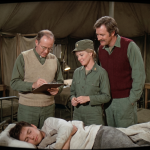
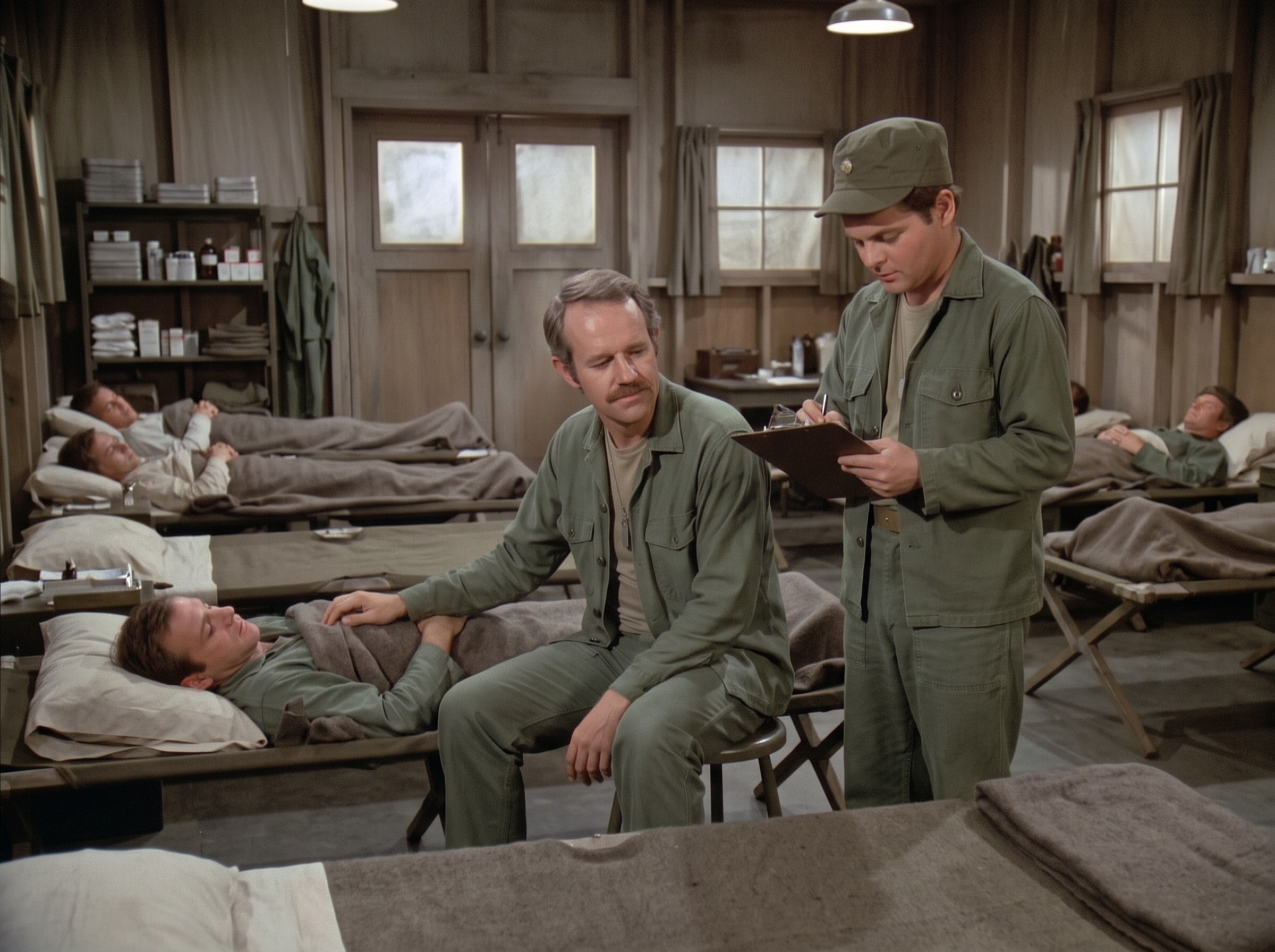
In the Post-Op ward, B.J. had found a moment.
He was sitting by a young soldier’s cot, his hand resting on the boy’s chest.
The soldier was asleep, finally comfortable.
B.J.’s own eyes looked heavy, but they held that soft, steady gaze only a tired father and surgeon can wear.
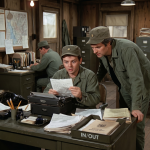
Radar was standing right beside him, that familiar clipboard in hand.
It was always there, Radar’s clipboard, as essential as his ears.
He was scribbling something furiously, the tip of his pencil working over the chart.
Radar was always scribbling, always keeping the chaos from consuming us, one requisition form at a time.
Hawkeye was asleep somewhere, probably drooling on a pillow, but in this quiet ward, B.J. and Radar held the line.
“Just making sure all the Vitals are logged,” Radar whispered.
B.J. nodded, his hand remaining still, offering a gentle, anchor-like presence on the young soldier’s chest.
“He’s stable?” B.J. asked softly.
Radar paused his pencil, checking a reading.
“Pulse is steady, Captain. Breathing has evened out.”
B.J. squeezed the soldier’s arm, a simple, non-verbal affirmation of care.
“Good,” he said, and the relief was clear in his voice.
“He’ll be okay.”
In that moment, looking at them—the exhausted doctor providing silent solace, the earnest clerk meticulously charting hope—the whole madness of the war seemed to recede.
For just that instant, they weren’t in a war zone; they were just two compassionate people trying to help another human being recover.
Suddenly, a cough from across the room broke the quiet.
It wasn’t a bad cough, but in that silent ward, it felt like a crack in a perfect, fragile glass sculpture.
We all froze. B.J.’s hand tightened. Radar’s pencil hovered over the clipboard.
The simple stillness was fractured.
The weight of the situation—the uncertainty, the fragility of the peace—all came rushing back.
It was a small sound, but it felt colossal.
The gentle rest they were protecting was suddenly under threat.
The whole room seemed to hold its breath with them.
B.J. slowly stood up, releasing his hand from the young soldier’s chest.
He turned towards the source of the cough.
Across the ward, another patient, an older soldier with a bandaged leg, had shifted.
He opened his eyes, squinting against the soft, warm light of the ward’s lamps.
For a moment, he just looked confused.
Radar took a cautious step, his face etched with worry, clipboard still clutched tight.
“You alright, soldier?”
The older soldier looked up at B.J., who was now standing, eyes full of weary kindness.
“I just… I dreamed I was home,” the soldier rasped.
“A cookout… I think I could smell the steak.”
A small, quiet smile spread across B.J.’s face.
The dry humor that kept us all sane surfaced.
“Well,” he said, “If you can smell steak, you’re either dreaming, or Klinger just successfully requisitioned a whole steer.”
“And knowing Klinger,” Radar added, a genuine chuckle breaking through his nervousness, “It’s probably the steer. He was talking about trying to ride it first.”
The soldier managed a tired laugh, which triggered another gentle cough.
“Keep dreaming, soldier,” B.J. said, walking over to check the older man’s chart.
“It’s good for the soul. Radar here might even requisition some extra steak dreams for you if you ask nicely.”
Radar flushed. “Well, I can’t promise steak, Captain, but… maybe I could see if we have any more of that pineapple juice.”
The ward felt different then.
The brittle tension had broken, replaced by something warmer.
B.J.’s hand, which had been offering silent reassurance, had moved to checking vitals, but the same care was in the gesture.
And Radar, still diligently holding that clipboard, was now offering a small act of kindness beyond the bureaucracy.
They were a found family, doing what they could in a place where doing anything felt like defiance.
They couldn’t stop the war, they couldn’t even guarantee everyone would make it home.
But they could offer comfort. They could offer a kind word.
And in that quiet post-op ward, with the gentle light and the warm, tired smiles, they were offering everything that mattered.
Looking at them, and at the soldiers resting safely, you couldn’t help but feel a bittersweet glimmer of hope.
It was a reminder that even in the midst of madness, simple humanity and friendship could find a place to bloom.
It’s not the steak, or even the medicine, but the quiet moments of caring that make this crazy place feel like home.