The Last Can of Sardoa
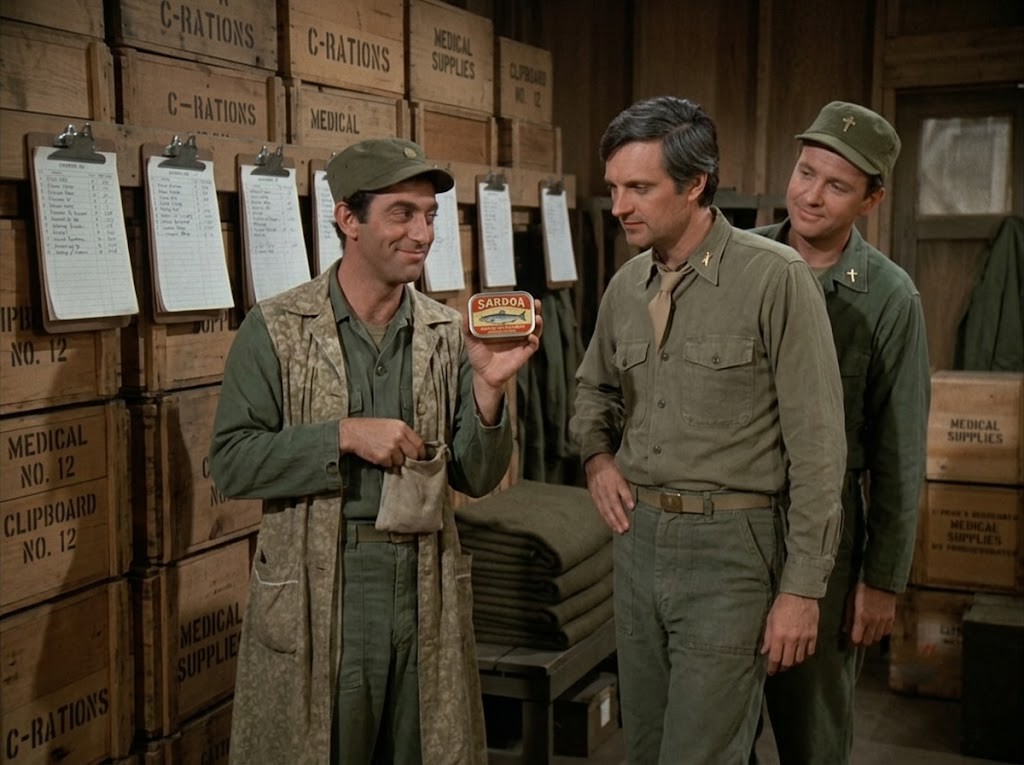
Some days in the Korean mud don’t just wear down your boots; they wear down your soul. After thirty-six straight hours in the operating room, the smell of antiseptic and old blood clings to your skin like a second uniform, and the silence of the swamp is almost too loud to bear.
Hawkeye Pierce stood in the middle of the supply shack, his shoulders slouched under the weight of a fatigue that sleep couldn’t fix. His eyes were heavy, his throat dry, and his mind was still drifting through the endless stitches and clamp lines of the meat market they called surgery.
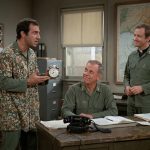
Beside him, Corporal Klinger was holding something in his hand with the reverence usually reserved for the Holy Grail.
It was a single, slightly dented tin of Sardoa sardines.
To anyone outside the 4077th, it was just a cheap piece of canned fish sitting among crates of stale C-rations and sterile gauze. But to the tired souls trapped in the compound, that little tin was a tiny rectangle of pure, unadulterated civilization.
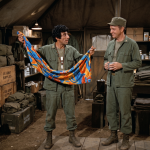
Klinger held it up to the dim light of the warehouse, his face lit with the pride of a man who had just traded a useless clipboard for a piece of heaven. He wore his patterned camo vest over his standard green fatigues, his thumb gently smoothing over the colorful label.
“Look at it, Captain,” Klinger whispered, his voice thick with Toledo theatricality. “Pure oil. Smoked to perfection. I had to promise three favors, two clean sheets, and a pair of fuzzy slippers to a supply sergeant from the Eighth Army just to get him to open the back of his truck.”
Hawkeye stared at the tin, his head tilted, his thumb hooked into his belt. A dry, cynical smile tugged at the corner of his mouth, but underneath the wit, his eyes were hollow.
“Sardines, Klinger?” Hawkeye asked, his voice a raspy drawl. “You risked a court-martial and traded the camp’s actual linen for a handful of oily bait? I’m disappointed. I thought at least it would be a jar of real olives or a clean pair of socks.”
“Bait? This isn’t bait, Doc, this is poetry in a tin!” Klinger countered, pulling a small cloth sack closer to his side as if protecting a treasure. “This is a midnight snack on a terrace overlooking a river that doesn’t have artillery fire echoing off the hills. It’s a taste of a world where people don’t bleed for a living.”
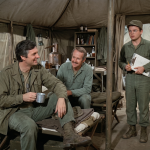
Behind them, Father Mulcahy stood quietly, his hands folded, a gentle, knowing smile resting on his face. The small silver cross on his cap caught the dull light of the shack. He had spent the last two days comforting the wounded and holding the hands of boys who wouldn’t see their mothers again, yet here he was, finding a moment of quiet peace in Klinger’s absurd prize.
“It does represent rather an extraordinary feat of logistics, Pierce,” Mulcahy said softly, his voice providing its usual steady comfort. “And given the current state of the mess hall’s meatloaf, I believe even the saints would overlook a minor infraction of the supply codes for a taste of something genuine.”
Hawkeye looked from the priest back to the tin of fish, and then at Klinger’s hopeful, tired face. The humor in the room suddenly felt incredibly fragile, like a thin sheet of ice over a deep, dark well of exhaustion.
The silence stretched between the three men, heavy with everything they weren’t saying. They were all thinking about the chopper blades that would eventually scream back to life, the young boys on the bus, and the endless miles of frozen dirt separating them from home.
Hawkeye reached out, his fingers hovering just an inch away from the smooth metal of the tin, his face suddenly stripping away all the jokes and the sarcasm.
“Klinger,” Hawkeye said, his voice dropping to a quiet, vulnerable whisper that shook just a little. “If you open that right now… I think I might actually cry.”
Klinger froze, his theatrical smile faltering as he looked into Hawkeye’s eyes. He saw the deep, dark circles under the captain’s lids, the slight tremor in his hand, and the raw, unshielded humanity that Hawkeye usually hid behind a wall of rapid-fire jokes and martinis.
Father Mulcahy stepped a fraction closer, his eyes filled with a deep, fatherly compassion. He knew that look; it was the moment a man’s spirit threatened to snap from the sheer gravity of their environment.
For a long moment, nobody spoke. The ambient sounds of the camp—the distant generator hum, the murmur of voices from the tents, the rustle of the wind through the canvas—seemed to fade away.
Klinger slowly lowered the tin, holding it carefully between both hands. The bravado vanished from his face, replaced by the genuine kindness of the kid from Ohio who looked out for his friends.
“Hey,” Klinger said softly, his voice dropping its sharp edge. “We don’t have to open it right now, Doc. It keeps. That’s the beauty of it. It can wait for a special occasion.”
Hawkeye let out a long, ragged breath, pulling his hand back and rubbing his face. He let his fingers drag down his cheeks, trying to wipe away the phantom image of the operating room.
“A special occasion,” Hawkeye muttered, a faint, genuine smile returning to his face. “What constitutes a special occasion around here? A day without incoming wounded? A Tuesday where the water in the shower is actually lukewarm?”
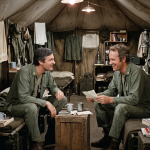
“How about right now?” Mulcahy suggested, his voice warm and steady as an anchor. “A moment of friendship among three tired men in a dusty room. I believe that is a rather profound occasion, all things considered.”
Hawkeye looked at the priest, then at Klinger, feeling the tight knot of tension in his chest begin to loosen. “You’re a wise man, Padre. Too good for this outfit, but we’ll keep you around anyway.”
Klinger cracked a small, crooked smile, his eyes shining. “Tell you what, Captain. I’ll split it three ways. But we need crackers. Real crackers, not the ones that taste like powdered cardboard from the C-ration boxes.”
“I might be able to assist with that,” Mulcahy said, an innocent sparkle in his eyes. “A grateful patient from the logistics sector left a small packet of soda crackers in the chapel tent. I believe they are still crisp.”
“Father, you are a criminal and a scholar,” Hawkeye laughed, the dry, familiar warmth returning to his tone. “See? This is how it starts. A tin of sardines, a packet of church crackers, and before you know it, we’re running a five-star restaurant in the middle of a war zone.”
Klinger carefully tucked the tin back into his pocket, patting it securely. “Only the best for the 4077th, Doc. We gotta keep up appearances. If we lose our taste for the finer things, the mud wins.”
Hawkeye clapped Klinger on the shoulder, his grip lingering for a second longer than usual—a silent thank you for the distraction, for the warmth, for simply being there.
They walked out of the supply shack together, stepping back into the grey, damp afternoon of the compound. The air was cold, and the clouds hung low over the sharp peaks of the mountains, but the heavy weight that had pulled Hawkeye’s shoulders down seemed just a little bit lighter.
They didn’t have much in the swamp—just drafty tents, bad food, and an endless supply of laundry. But as they walked toward the swamp, sharing a quiet, tired laugh, Hawkeye knew they had the one thing that the war couldn’t touch.
They had each other, and as long as Klinger could find a tin of sardines, they still had a piece of home.
Behind the jokes and the stolen moments, it was the small kindnesses that kept the lanterns burning in the darkest corners of the 4077th.