The Colors We Carry
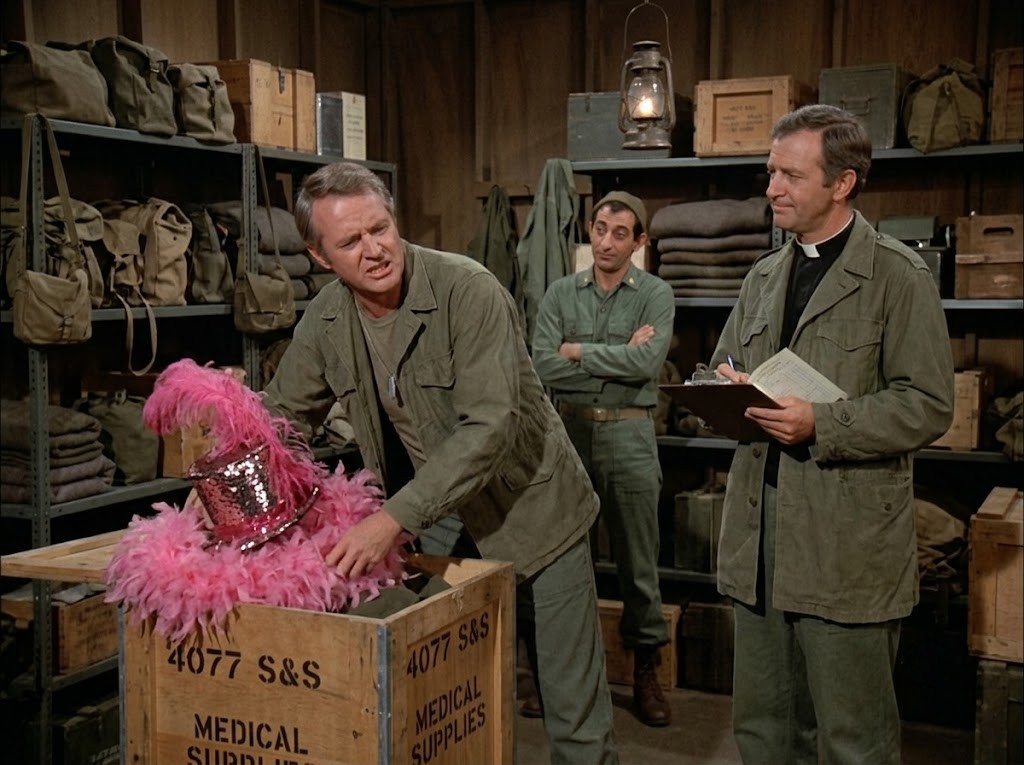
The dust in the supply shack always smelled of old canvas, damp cardboard, and the faint, antiseptic sting of rubbing alcohol. It was a smell every man in the 4077th knew by heart—the scent of a temporary home that had gone on far too long.
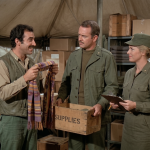
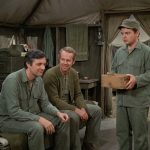
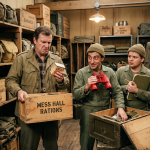
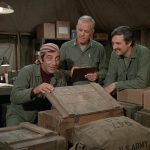
Outside, the Korean sun was baking the tents into olive-drab ovens, and the heavy silence of a lull between casualties hung thick in the air. Inside the supply shack, three men stood gathered around a freshly pried-open wooden crate, staring down as if they had just uncovered a chest of pirate gold.
Only it wasn’t gold. It was something far rarer in a war zone.
Trapper John McIntyre leaned over the crate, his fingers frozen just an inch above the contents, his face twisted into a look of absolute, bewildered disbelief. His brow was furrowed, his mouth slightly open, caught somewhere between a sarcastic quip and a genuine laugh.
“Father,” Trapper said, his voice dropping to a theatrical whisper that echoed off the rough wooden shelves, “tell me the heat is finally getting to me. Tell me I’m looking at a mirage.”
Father Mulcahy adjusted his grip on his clipboard, his kind eyes blinking behind his spectacles as he peered into the depths of the wooden box. A soft, bemused smile tugged at the corner of the priest’s mouth, contrasting gently with the stark military stencil on the side of the crate that read: *4077 S&S MEDICAL SUPPLIES*.
Resting prominently inside, nestled right where a fresh shipment of sterile gauze and arterial clamps should have been, was a cascading explosion of hot pink. A thick, extraordinarily fluffy feather boa overflowed the edges, crowned by a brilliant, shimmering top hat covered entirely in pink sequins.
A few feet back, standing with his arms crossed and an expression of pure, unadulterated innocence, was Corporal Max Klinger. He wasn’t wearing one of his signature chiffon gowns today; he was in his standard-issue olive drabs, looking every bit the dutiful soldier, save for the proud, unmistakable glint in his eyes.
“I assure you, Captain,” Klinger said defensively, shifting his weight from one boot to the other, “it’s no mirage. It’s a miracle of modern logistics.”
“A miracle?” Trapper scoffed, finally reaching down to touch the feathers with two fingers, as if checking to see if it would bite. “Klinger, we’re short on blood plasma, we’re out of penicillin, and our surgical gloves are patched so many times they look like inner tubes. I asked for a crate of critical medical supplies, and you give me a Shirley Temple starter kit!”
“It’s an honest mistake, sir!” Klinger countered, though he didn’t look entirely remorseful. “The supply depot in Seoul is a madhouse. Labels get switched. A box meant for a USO troupe in Pusan gets routed to a mobile army surgical hospital in the middle of nowhere. It happens!”
Father Mulcahy cleared his throat softly, tapping his pencil against the clipboard as he looked down at the bright pink anomaly. “Well, it certainly is… vibrant, Corporal. Though I must admit, I’m having a difficult time finding the corresponding item code in the manual for ‘feathers, flamboyant, one each.'”
“Don’t laugh, Father,” Trapper grumbled, his voice rising just a bit as the frustration of a long, sleepless week began to leak through his usual easygoing facade. “We have twenty-four beds filled in post-op, and three of those kids are running fevers we can’t break because our ice machine is dead. I don’t need sequins. I need things that keep people alive.”
He gripped the edge of the crate, his knuckles whitening slightly against the rough wood, the weight of the camp’s reality suddenly crashing through the comedy of the moment. The silence that followed was heavy, the kind of silence that only happens when men who spend twenty hours a day fighting death are reminded of how little they have to fight it with.
Trapper looked from the pink boa up to Father Mulcahy, his eyes carrying a deep, unspoken exhaustion that no amount of wisecracks could fully hide. “What are we supposed to do with this, Father? Wrap a wound in feathers? Pray the fever away with a dance routine?”
—
Father Mulcahy didn’t answer right away. He looked at Trapper, seeing past the irritation and straight into the profound fatigue that lined the surgeon’s eyes. He knew that look; he saw it in the mirror every morning, and he saw it on every face in the operating room when the generator sputtered and the lights flickered during a difficult closure.
The priest stepped closer, placing a gentle hand on the corner of the crate, right next to Trapper’s clenched fist.
“We do what we always do, John,” Mulcahy said, his voice a steady, calming anchor in the small room. “We make do with what we have. And sometimes, what we have isn’t exactly what we thought we needed.”
Klinger’s defensive posture melted away, replaced by the genuine, warm-hearted kid from Toledo who cared deeply for every person in the camp. He took a step forward, his voice losing its theatrical bravado.
“I didn’t do it on purpose, Captain,” Klinger said quietly, looking down at his boots. “But when I saw it sitting in the back of the truck, after a five-hour drive through dust and potholes… I don’t know. It just made me smile. It was the first thing I’d seen in six months that wasn’t grey or green.”
Trapper looked at Klinger, then down at the box again. The sharp edge of his anger began to soften, dissolving into the familiar, dry irony that kept them all sane. He reached into the crate and carefully lifted the pink sequined top hat, turning it over in his hands. The sunlight from the open door caught the sequins, scattering little dots of bright, rosy light across the dark, drab walls of the supply shack.
“It really is something, isn’t it?” Trapper murmured, a faint, tired smile finally breaking through his stubble. “If Frank Burns saw this, he’d have the military police out here investigating us for a breach of uniform regulations.”
“Oh, Major Burns already saw the manifest, sir,” Klinger chimed in, a mischievous grin returning to his face. “He told me if I didn’t return it to the depot immediately, he’d have me court-martialed for possession of unauthorized civilian plumage.”
“Which is exactly why we’re keeping it,” Trapper said firmly, his eyes lighting up with that familiar, rebellious spark.
Father Mulcahy chuckled, making a small notation on his clipboard with an unmistakable air of satisfaction. “I believe I can classify this under ‘Morale and Welfare Supplies.’ An essential delivery for the psychological well-being of the unit.”
“Spoken like a true theologian, Father,” Trapper laughed. He lifted the feather boa out of the crate, a cloud of pink fluff drifting through the air, looking utterly ridiculous against his stained green utility shirt.
For a few minutes, the war outside the wooden walls didn’t exist. There were no incoming choppers, no distant artillery rumbles, no endless lines of stretchers. There were just three men in a dusty shack, sharing a quiet, absurd moment of pure human connection, brought together by a misplaced box of theatrical supplies.
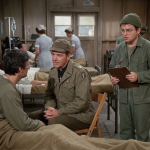
Later that evening, after the temperature finally dropped and the camp settled into its uneasy nighttime routine, Trapper walked through the post-op tent. He wasn’t carrying medicine, because they didn’t have any left to give.
Instead, he walked up to the bed of a nineteen-year-old kid from Iowa who had been crying for his mother an hour before. Without saying a word, Trapper gently placed the bright pink sequined top hat on the boy’s bedside table, right next to his water cup.
The kid looked at the hat, blinked in confusion, and then let out a shaky, genuine laugh—the first sound he’d made all day that wasn’t a groan of pain.
Trapper patted the boy’s shoulder, his heart aching with a mixture of sorrow and profound pride for the makeshift family they had built in this forgotten corner of the world. They didn’t always have the tools to heal every wound, but as long as they had each other, and a little bit of unexpected color, they would find a way to make it through the night.
In a world painted entirely in olive drab, sometimes it was the most ridiculous things that reminded us we were still human.