The Case of the Missing Comfort
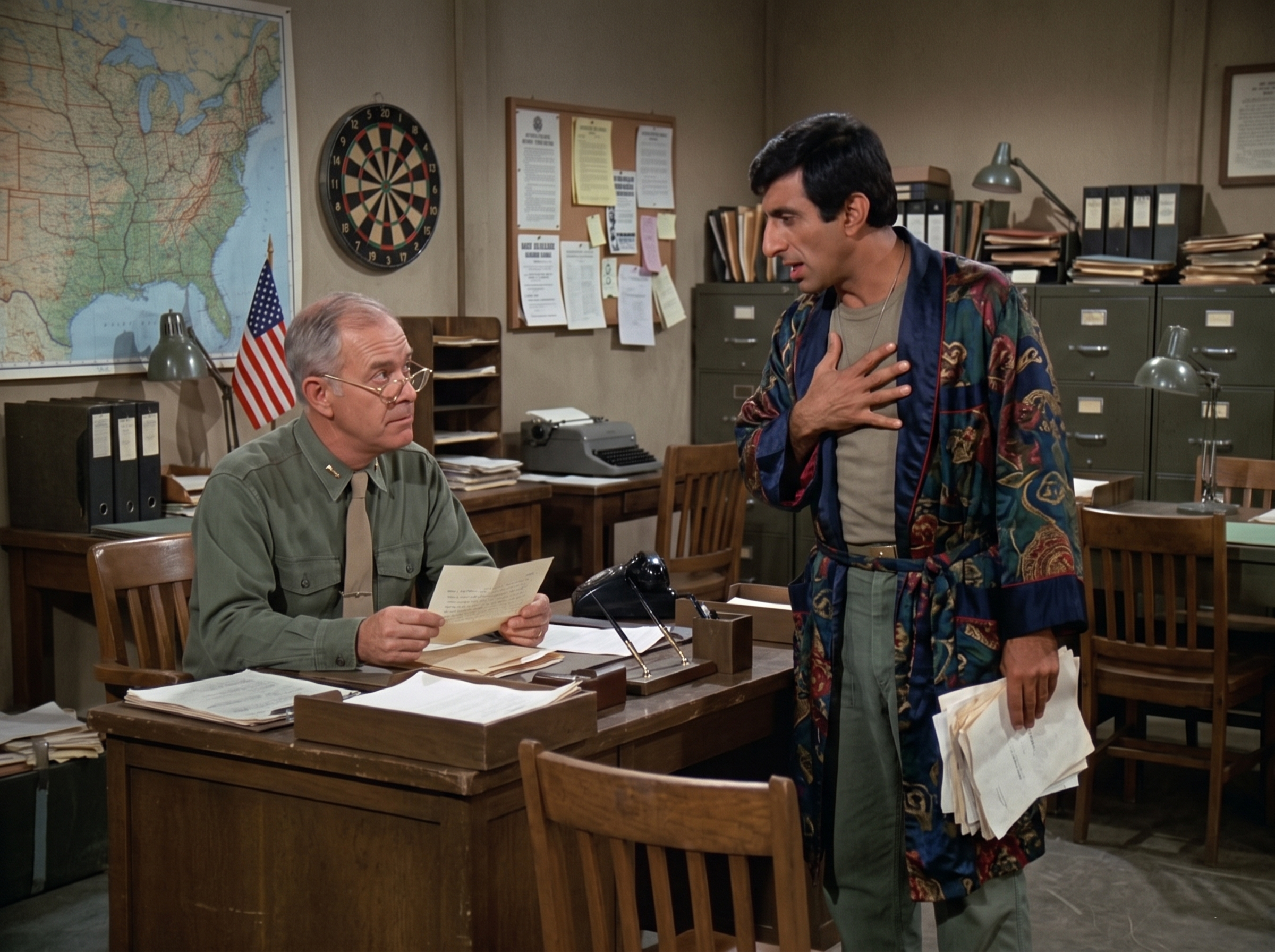
The swamp was finally quiet, or as quiet as a tent filled with restless ghosts and half-empty bottles of gin could ever be. But for Klinger, the quiet didn’t last long; duty, in its most bureaucratic and baffling form, had summoned him to Colonel Potter’s office before he’d even managed to finish his first cup of lukewarm coffee.
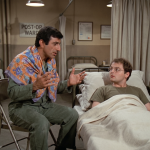
He stood now in the familiar, cramped confines of the command tent. He was wearing his favorite silk paisley robe—the one with the deep blues and burning reds—draped over his standard-issue undershirt and olive-drab trousers. It was a sartorial compromise, a middle ground between civilian longing and military necessity.
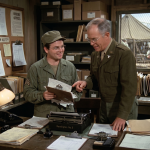
Colonel Potter sat behind his desk, the weight of the war etched into the weary lines around his eyes. In his hands, he held a single, crisp sheet of paper. His spectacles were perched precariously on the bridge of his nose, and he was frowning at the text with the same intensity he usually reserved for a particularly stubborn medical report.
Klinger gestured with his free hand, clutching a stack of requisition forms to his chest like a shield. He felt the familiar, frantic flutter of his own heart, the perennial fear that today was the day they’d finally decided his fashion choices were a court-martial offense.
“I’m telling you, Colonel,” Klinger started, his voice pitching up just enough to betray his nerves. “If this is about the dress in the supply tent, it wasn’t me. I’ve never even seen that shade of mauve. It’s unflattering, and frankly, it offends my sensibilities.”
Potter didn’t look up. He just let out a long, slow sigh that sounded like air escaping a punctured tire. He tapped the paper against his palm. The room felt suddenly very small, the dartboard on the wall seeming to loom over them both, a silent witness to another day of surreal, military absurdity.
“Klinger, shut your trap for one minute,” Potter muttered, though there wasn’t any real heat in it. He finally looked up, peering over his glasses. “I’m not looking for a fashion critique. I’m looking for an explanation for this. Someone has requisitioned twelve crates of heavy-duty knitting needles and four hundred pounds of premium merino wool to be air-dropped to the 4077th. Directly to the mess tent.”
Klinger’s mouth hung open. The absurdity of the request—the sheer, nonsensical scale of it—stunned him into uncharacteristic silence. He looked at the paper, then back at the Colonel, his eyes wide.
“Twelve crates?” Klinger whispered, his voice cracking.
Potter leaned forward, his face hardening into a grim, unreadable mask. “And the signature at the bottom, Klinger… it’s yours.”
The silence that followed was heavy, broken only by the distant, rhythmic hum of a generator outside. Klinger felt the blood drain from his face. He hadn’t signed that. He hadn’t even thought of that. But as he looked at the Colonel’s stern, tired face, he realized that the joke—the elaborate, ridiculous, impossible joke—was closing in on him.
“Colonel, sir,” Klinger began, his hand instinctively going to his chest, clutching the robes, “if I were going to waste a requisition order, I’d at least order something useful, like a shipment of real silk stockings or a crate of actual, drinkable bourbon. Knitting needles? I don’t even know how to purl!”
Potter stared at him for a long, agonizing moment. Then, slowly, the corners of his mouth began to twitch. He dropped the paper onto the desk and leaned back, exhaling a puff of air that might have been a laugh if he’d had the energy for it.
“I know, Corporal,” Potter said softly, his voice losing its sharp edge. “I know it wasn’t you. I’ve been looking at the handwriting. It’s too neat. It’s almost… surgical.”
Klinger blinked. “Surgical?”
“Winchester,” Potter sighed, rubbing his temples. “He’s trying to keep the nurses distracted. He thinks if he can get them knitting sweaters for the locals, they’ll stop complaining about the lack of decent laundry service. He figured if he used your name, the supply sergeant would process it without asking questions, assuming you were up to another one of your schemes.”
Klinger felt his shoulders drop, the tension evaporating as quickly as it had arrived. The absurdity of it—the image of Charles Emerson Winchester III, with his aristocratic posture and haughty sneer, secretly plotting a knitting revolution—suddenly seemed perfectly, beautifully fitting for the 4077th.
He let out a short, sharp laugh, the sound echoing off the tent walls. “He’s trying to knit his way out of the Korean War, Colonel. I think I’ve been out-crazyed.”
Potter smiled then, a genuine, crinkled-eye smile that made the whole office feel a little warmer, a little less like a command center in a war zone. He stood up, stretching his back with a groan. “Well, he’s got the whole surgical team buying in. Mulcahy is already looking for patterns for children’s scarves. I suppose I can’t exactly court-martial the man for trying to keep morale up, even if he did steal your identity to do it.”
Klinger looked down at his colorful robe, then back at the desk. He felt a sudden, profound sense of belonging. They were all just people, really—people trying to find a way to stay sane in a world that had lost its mind. Whether it was by wearing a paisley robe or knitting a sweater for a stranger in a mountain village, they were all just reaching out for something soft in a hard, cold place.
“You want me to cancel it, sir?” Klinger asked, though he knew the answer.
Potter shook his head, walking over to the small window and looking out toward the compound. “No, Klinger. Let it come. God knows we could use a few more sweaters around here when the winter winds hit. But you tell Winchester that next time he needs a signature, he can use his own. I’m tired of having my blood pressure spiked by his eccentricities before noon.”
Klinger nodded, a small, knowing smirk playing on his lips. He gathered his own forms, the ones that actually needed to be processed, and turned to leave. He paused at the door, catching the Colonel’s eye one last time. It was a look shared between two men who had seen too much, understood too much, and somehow, miraculously, still found a reason to keep going.
“I’ll tell him, Colonel,” Klinger said. “Though I have a feeling he’s already moved on to trying to figure out how to import fresh lobster.”
Potter chuckled, a low, rumbling sound that filled the tent. “God help us all.”
Klinger walked out into the dusty heat of the compound, the weight of the day suddenly feeling much lighter than it had minutes before. The war was still there, the distant thunder of artillery still rumbled on the horizon, but for a moment, in a quiet office with a man he respected and a ridiculous story he’d keep for years, the world felt like it might just be okay.
In the end, it was never really about the war; it was about the people who made you laugh while you were waiting for the world to get back to normal.